

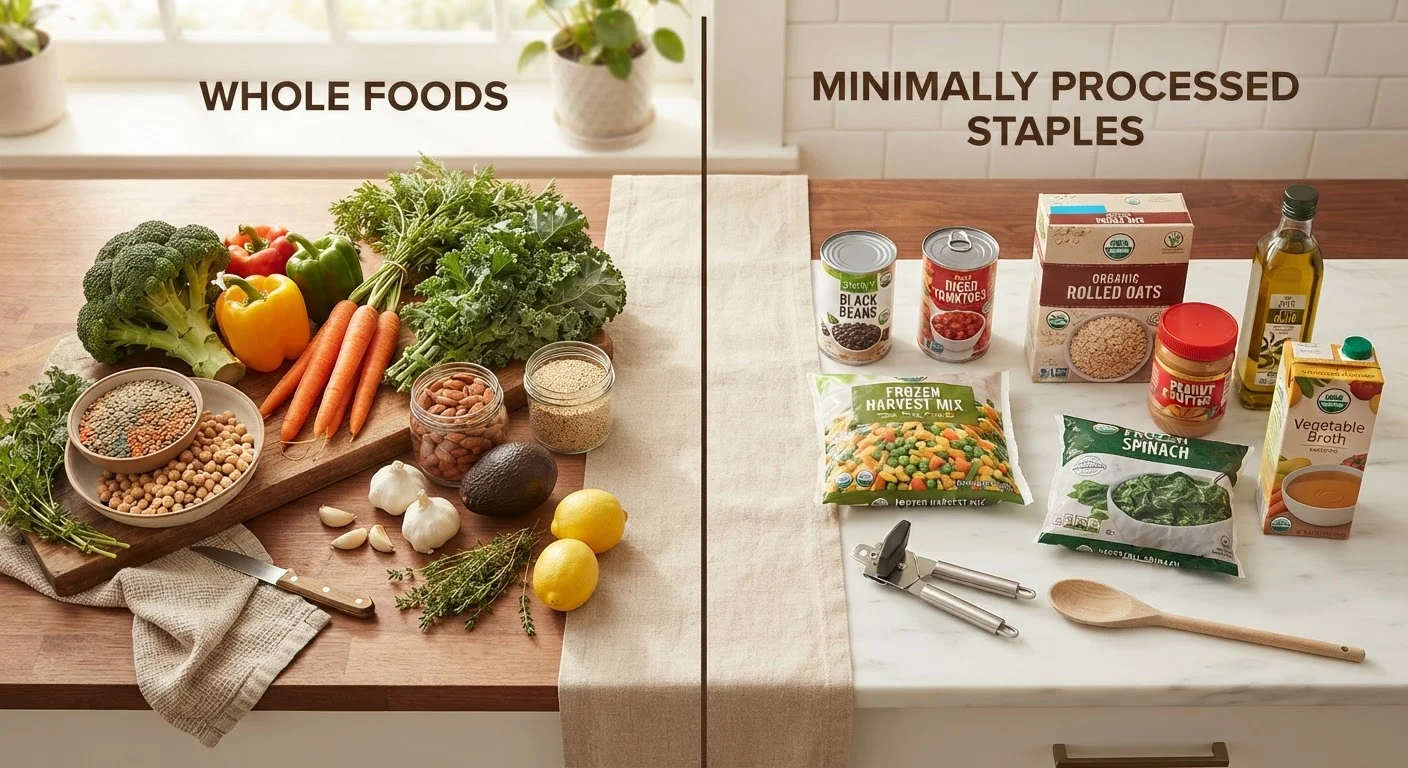
Option A
Whole Foods
Minimally altered, nutrient-dense foods closest to their natural state.
Best for: People who have reliable access to fresh produce, time to cook, and a budget that allows for seasonal ingredients.
Option B
Processed Foods
A broad spectrum from lightly modified staples to heavily engineered products.
Best for: Anyone navigating time constraints, limited budgets, or food access barriers — depending heavily on the degree of processing.
What We Actually Mean by 'Processed'
The word "processed" gets used as a catch-all insult in nutrition conversations, but it covers an enormous range. The NOVA classification system, developed by researchers at the University of São Paulo, groups foods into four categories based on the extent and purpose of processing — from unprocessed or minimally processed foods (fresh vegetables, plain meat) to ultra-processed products (packaged snacks, flavored drinks, instant noodles).
Under this framework, a bag of frozen peas and a fluorescent-colored snack cake are both technically "processed" — but they are nutritionally worlds apart. The more useful distinction is between minimally processed foods, where processing preserves or makes food safer, and ultra-processed foods, which are industrially formulated with additives, flavoring agents, and ingredients rarely found in a home kitchen.
When public health researchers refer to processed food being linked to health concerns, they are almost always talking about the ultra-processed end of the spectrum. Learning to draw that line is genuinely useful. See our guide to reading nutrition labels for practical tools to apply at the grocery store.
| Criterion | Whole Foods | Processed Foods |
|---|---|---|
| Definition | Unaltered or minimally altered from natural state | Modified from original form; ranges from minimal to extensive |
| Fiber content | Generally high, especially in plants | Often low; ultra-processed foods typically strip fiber out |
| Added sugars & sodium | Naturally low or absent | Highly variable; ultra-processed products often high |
| Shelf life | Short to moderate; fresh items spoil quickly | Longer; shelf-stable canned and packaged items reduce waste |
| Cost & accessibility | Variable; fresh items can be costly or unavailable | Often more affordable and widely available |
| Preparation time | Can be significant, especially whole grains and legumes | Generally faster; many items are ready to eat or quick to prepare |
| Research-linked outcomes | Associated with positive health markers in population studies | Ultra-processed specifically linked to poorer outcomes; minimally processed largely neutral |
What Whole Foods Actually Offer — And Where the Limits Are
Whole foods — think fruits, vegetables, legumes, whole grains, nuts, seeds, eggs, and plain meats — tend to deliver nutrients in their most intact form. Fiber is perhaps the most important consideration: it feeds beneficial gut bacteria, supports blood sugar regulation, and is almost entirely absent from ultra-processed diets. Phytonutrients, which are naturally occurring plant compounds associated with reduced inflammation in research, are similarly concentrated in whole foods and diminished or absent in heavily processed alternatives.
That said, "whole food" is not a synonym for "affordable" or "accessible." Fresh produce spoils quickly, bulk whole grains require preparation time, and food deserts — areas with limited access to grocery stores — are a real structural barrier for many Americans. Dismissing processed foods entirely can reflect a significant privilege in access and income.
The good news: frozen and canned vegetables are largely comparable to fresh in terms of key nutrients, and sometimes superior, particularly for produce that travels long distances before reaching stores. The science on frozen versus fresh produce is worth understanding before assuming fresh is always the better choice.
57%
Share of U.S. calorie intake from ultra-processed foods
A study published in BMJ Open estimated that ultra-processed foods account for more than half of daily caloric intake in the average American diet.
4x
Fiber gap between whole and ultra-processed diets
Research suggests Americans consuming predominantly ultra-processed diets average far below the recommended daily fiber intake compared to those eating more whole foods.
~10%
Potential diet cost difference with whole-food swaps
Some nutrition economists estimate that strategic whole-food substitutions — like dried beans for packaged meat alternatives — can modestly reduce weekly food costs.
Building a Practical Approach Without the All-or-Nothing Thinking
Most people are not choosing between a perfectly whole-food diet and an entirely ultra-processed one — they're somewhere in the middle, making dozens of small decisions each week. The most evidence-supported approach isn't elimination; it's substitution. Replacing a few high-frequency ultra-processed items with minimally processed or whole-food alternatives tends to shift nutritional profiles meaningfully over time without requiring a full dietary overhaul.
A few practical anchors: prioritize whole or minimally processed foods for the items you eat most often (breakfast, your main protein source, snacks). Allow more flexibility for occasional foods where convenience or enjoyment takes priority. When buying packaged items, a shorter ingredient list — with recognizable, pronounceable items — is a reasonable rule of thumb.
For readers working with limited grocery budgets, plant-based eating on a budget explores how legumes, grains, and frozen vegetables can anchor a nutrient-dense diet without high costs. And for putting this into weekly practice, our nutrition-focused grocery planning checklist can help you build a cart that balances both categories deliberately.
The NOVA System Isn't Perfect
While the NOVA classification is widely cited in nutrition research, it has critics who argue it oversimplifies food quality by focusing on processing method rather than nutrient content. A plain yogurt with added vitamin D is classified as "processed," while an unfortified food with little nutritional value may be labeled "whole." Use NOVA as a starting framework, not a rigid rulebook. Dietary guidelines from organizations like the USDA take a broader nutrient-based approach — see our look at what dietary guidelines mean and what they don't for more context.
This article is for general informational purposes only and does not constitute medical or dietary advice. For personalized guidance on your nutritional needs, consult a registered dietitian or qualified healthcare provider.
The content provided on our blog site traverses numerous categories, offering readers valuable and practical information. Readers can use the editorial team’s research and data to gain more insights into their topics of interest. However, they are requested not to treat the articles as conclusive. The website team cannot be held responsible for differences in data or inaccuracies found across other platforms. Please also note that the site might also miss out on various schemes and offers available that the readers may find more beneficial than the ones we cover.