

Our Verdict
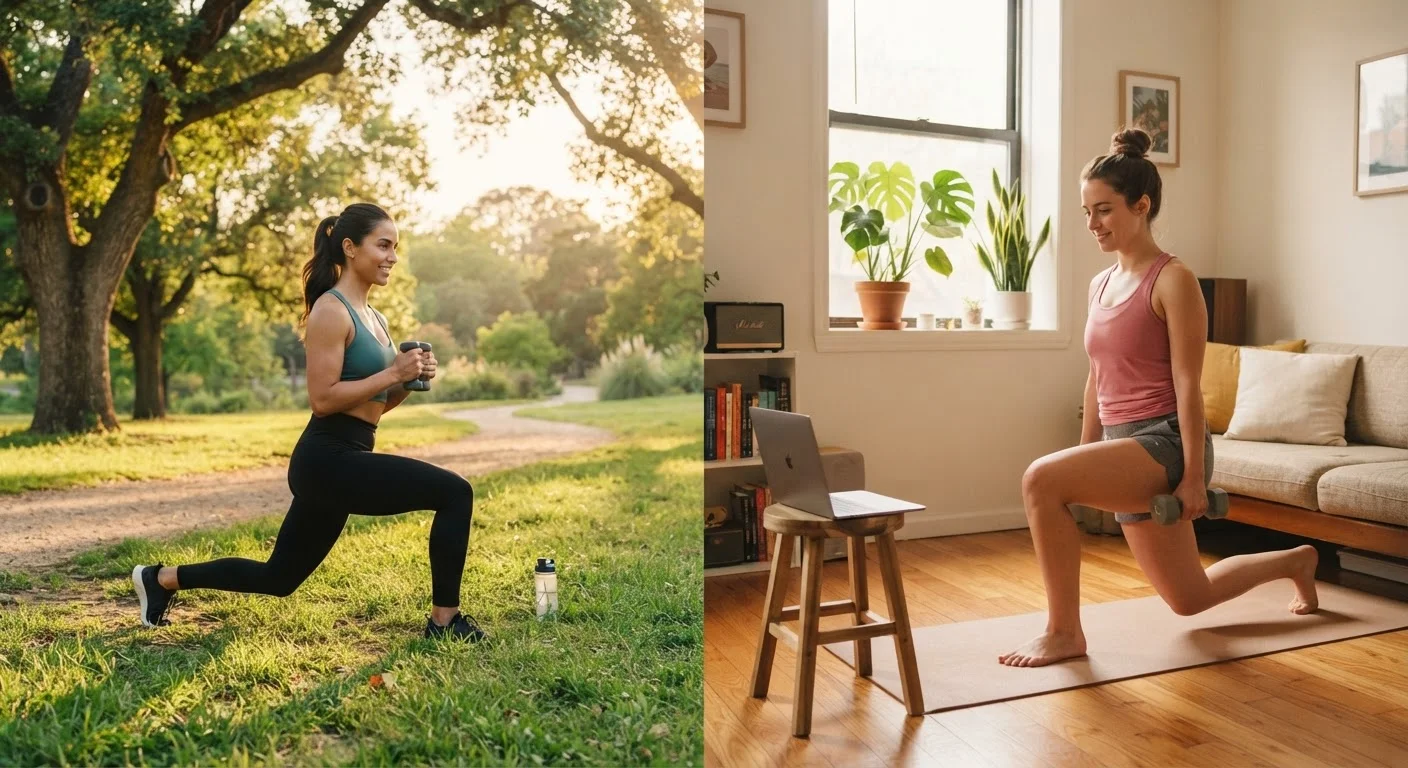
Outdoor workouts and indoor home routines each have genuine, research-supported advantages. Outdoor exercise tends to boost mood and mental well-being, while home workouts remove friction and suit tighter schedules or budgets. Neither is universally superior — the most effective routine is the one that fits your real life consistently.
| Best for | Recommended |
|---|---|
| Those who struggle with motivation or low mood | Outdoor Workouts |
| Those with unpredictable schedules or limited time | Indoor Home Routines |
| Those in apartments or small spaces wanting variety | A mix of both |
| Those on a tight budget with no equipment | Indoor Home Routines |
The Real Question Isn't Where — It's Whether You'll Show Up
When it comes to building a fitness habit without a gym membership, most people get stuck comparing environments rather than asking the more practical question: which setting makes it easier to exercise consistently? Research consistently shows that adherence — simply showing up over time — matters more than workout intensity or location. You can read more about this in our article on why consistency beats intensity in long-term fitness.
Both outdoor workouts and indoor home routines are genuinely effective. The trade-offs are real, though, and understanding them helps you design a routine that doesn't collapse the first time it rains or your motivation dips.
| Outdoor Workouts | Indoor Home Routines | |
|---|---|---|
| Cost | Free (public spaces) | Free to low-cost |
| Weather dependency | High — rain, heat, cold disrupt plans | None — fully weather-proof |
| Mood & mental health boost | Strong — nature and sunlight help | Moderate — depends on setup |
| Convenience | Requires travel or nearby space | Immediate — no commute |
| Equipment needed | None for most activities | None for bodyweight workouts |
| Distraction risk | Low — fewer household interruptions | Higher — home environment varies |
| Exercise variety | High — terrain, routes, activities | Moderate — limited by space |
What Outdoor Workouts Do Well
Exercising outside carries benefits that go beyond physical fitness. Studies have linked outdoor exercise to reduced cortisol levels, improved mood, and lower rates of anxiety and depression compared with the same activity performed indoors. Sunlight exposure supports vitamin D production, and varied terrain — hills, paths, uneven ground — naturally challenges your body in ways a flat living room floor doesn't.
Outdoor workouts are also inherently flexible in terms of space. Running, cycling, bodyweight circuits in a park, or even brisk walking are all zero-cost options. That said, they come with real drawbacks: weather disrupts plans, safety can be a concern depending on your neighborhood, and the time needed to travel to a suitable location adds friction. If you find solo exercise demotivating, pairing outdoor workouts with a friend or group may help — something we explore in the trade-offs of working out alone vs. with others.
Start With What Feels Easier, Not Better
If you're building a new habit, the environment that feels least intimidating is usually the right starting point. A short outdoor walk you actually take is more valuable than an ambitious home workout you keep postponing. Once movement becomes a regular part of your week, you can layer in variety. Motivation fluctuates — learn more about what to do when your workout motivation disappears.
What Indoor Home Routines Do Well
The biggest advantage of working out at home is removing barriers. There's no commute, no weather dependency, and no judgment from strangers. For people with young children, unpredictable work schedules, or social anxiety, home workouts can mean the difference between exercising and not exercising at all.
Effective home workouts don't require a dedicated room or expensive gear. Bodyweight movements — squats, push-ups, lunges, planks — can be done in a small apartment. Our guide on making any room your training area breaks down how to work with tight spaces practically. The limitation is that home environments can also hold distractions: a pile of laundry, a screen, a family member. Without deliberate structure, home routines are easy to postpone indefinitely.
~28%
Adults who meet aerobic activity guidelines
According to CDC physical activity data, roughly 28% of U.S. adults meet both aerobic and muscle-strengthening guidelines — suggesting most people have room to build any consistent routine.
50%
Reduction in dropout with low-barrier exercise
Research published in health behavior journals indicates that reducing exercise barriers — such as commute time — can roughly halve early dropout rates in new exercisers.
How to Decide — and How to Stop Second-Guessing
Rather than committing to one environment permanently, consider treating this as an experiment. Try a two-week outdoor-only period, then two weeks at home, and notice which one you actually completed more workouts during. Track it simply — a notebook or free app works fine. You can find low-cost methods in our piece on free and low-cost ways to track your fitness progress.
Many people find a hybrid approach most sustainable: outdoor walks or runs on good-weather days, home bodyweight circuits when weather or schedule doesn't cooperate. This avoids the all-or-nothing trap that derails so many fitness attempts. For a broader framework on building a routine that bends without breaking, see our guide on building a fitness routine around your real life.
This article is for general informational and educational purposes only and is not a substitute for professional medical or fitness advice. Consult a qualified healthcare provider before starting a new exercise program, especially if you have an existing health condition.
The content provided on our blog site traverses numerous categories, offering readers valuable and practical information. Readers can use the editorial team’s research and data to gain more insights into their topics of interest. However, they are requested not to treat the articles as conclusive. The website team cannot be held responsible for differences in data or inaccuracies found across other platforms. Please also note that the site might also miss out on various schemes and offers available that the readers may find more beneficial than the ones we cover.