

Why Small Spaces Are Not the Barrier You Think
It's easy to look at a cramped studio apartment or a shared bedroom and conclude that working out at home just isn't realistic. But the truth is, most effective bodyweight movements — push-ups, squats, lunges, planks, mountain climbers — fit comfortably within the footprint of a yoga mat. You don't need a dedicated gym room, mirrored walls, or rubber flooring. You need a plan and a clearing.
If you've been waiting until you have more space, a bigger apartment, or extra money to spend, know that those conditions rarely arrive on their own. The good news is that a small home workout habit built now will travel with you no matter where you live next. For a broader look at how to build that habit from the ground up, see our guide to building a fitness routine around your real life.
What you will need
How to Set Up Any Room for a Workout
The steps below walk you through turning any room — a living room, bedroom, or even a wide hallway — into a functional training area in minutes. You don't need to permanently rearrange your furniture; this is about creating a temporary, repeatable setup you can take down just as fast.
Identify your training footprint
Walk your room and find the largest unobstructed floor area — often in front of a sofa, beside a bed, or in the center of a living space. You're looking for a rectangle roughly 6 feet long and 4–6 feet wide. If furniture is in the way, slide one piece back temporarily. You don't need to make this permanent.
Clear and clean the floor surface
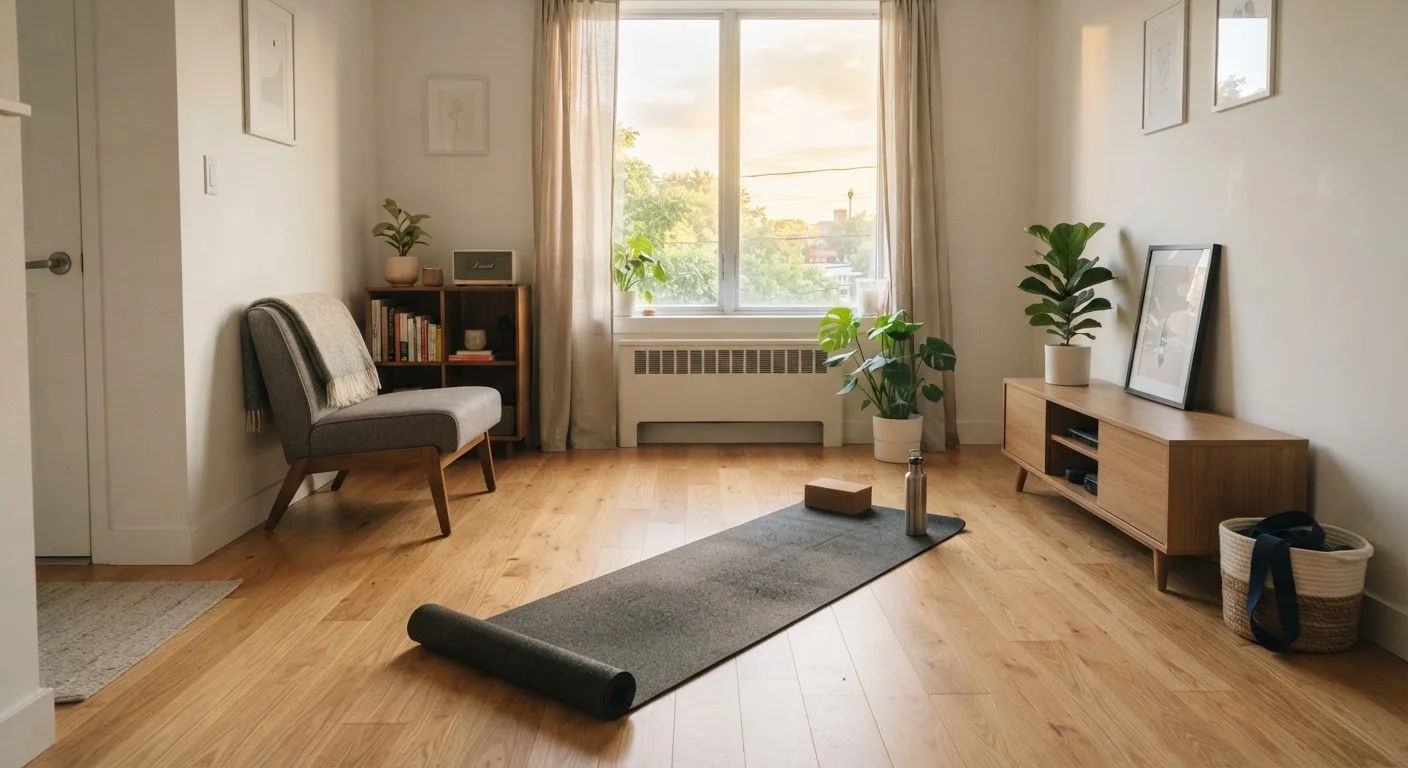
Remove loose items — shoes, bags, cords — that could cause you to trip or restrict movement. If your floor is hard (tile, hardwood, laminate), lay down a yoga mat, a folded towel, or a non-slip rug for cushioning during floor exercises. This also gives you a defined workout zone, which helps mentally separate training from the rest of the room.
Check your overhead clearance
Stand in your training zone and reach both arms straight above your head. If your hands clear the ceiling comfortably, you're good for most movements. Low ceilings rule out jumping exercises — which is actually fine, since low-impact alternatives are easier on joints and more neighbor-friendly. Note any ceiling fans and give them a wide berth.
Set up your minimal equipment
You don't need to buy anything to start. If you already own resistance bands, a single light dumbbell, or a sturdy chair, position them within arm's reach. A chair doubles as a surface for tricep dips and an incline for modified push-ups. Everything else — your bodyweight, the floor, and a wall — is already there.
Plan a warm-up suited to the space
Begin every session with 3–5 minutes of low-intensity movement to raise your heart rate and loosen your joints. In a small space, this might be marching in place, shoulder rolls, arm circles, hip circles, and slow bodyweight squats. Skip the treadmill-style warm-up jog — controlled, deliberate movements work just as well and keep noise to a minimum.
Structure your session and reset afterward
A simple structure — warm-up, 20–30 minutes of main work, cool-down — is all you need. After your session, return furniture to its original position, roll up your mat, and put it somewhere visible. Keeping the mat in plain sight (rather than packed away in a closet) serves as a daily visual reminder and makes your next session quicker to start.
Use a Timer, Not a Rep Count
In tight spaces without a mirror, it's easy to lose track of reps and form at the same time. Try timing your sets instead — 30 seconds of work, 15 seconds of rest. This keeps the session moving, removes the need to count, and scales naturally to your current fitness level.
Choosing Movements That Work in Tight Quarters
Not every exercise suits a small indoor space. High-impact moves like jumping jacks or box jumps can disturb downstairs neighbors and strain joints on hard floors. Fortunately, you can hit every major movement pattern — push, pull, hinge, squat, carry, and rotate — without leaving your mat. Our article on cardio, strength, flexibility, and balance breaks down exactly what each type of movement trains and why variety matters.
- Strength: Push-ups, squats, glute bridges, tricep dips off a chair, wall sits
- Cardio (low-impact): Marching in place, step-touches, slow mountain climbers, standing bicycle crunches
- Flexibility & mobility: Hip flexor stretches, seated forward folds, thoracic rotations
- Balance: Single-leg stands, slow reverse lunges, heel-to-toe walks along a wall
If you want to understand how bodyweight training compares to equipment-based work, bodyweight versus free weights is worth reading before you invest in anything.
Hard Floors and Joint Impact
Repeated high-impact moves — jumping, burpees with a jump — on hard floors without adequate cushioning can stress knees, ankles, and hips over time. If your flooring is unforgiving, choose low-impact variations or use a folded mat. If you experience joint pain during or after exercise, stop and consult a healthcare professional before continuing.
Staying Consistent When Your Space Does Double Duty
The hardest part of training at home isn't the exercise — it's the mental separation between your workout zone and the rest of your life. When your bedroom is also your office and your living room is also your gym, the boundary blurs quickly.
A few strategies help. First, use a visual cue: unrolling a mat or placing a water bottle in your training spot signals your brain that it's movement time. Second, anchor your workout to an existing habit — right after your morning coffee, before you switch on your laptop, or immediately after dinner. This approach, sometimes called habit stacking, is explored further in our article on fitting movement into a packed schedule.
Finally, track what you do — even a simple tally in a notebook builds a visible record of effort. Low-cost methods for doing this are covered in our piece on free and low-cost ways to track fitness progress. And when your body needs a break, remember that rest is part of the process — not a sign that you've fallen off track. Our article on rest days as training days explains why recovery matters as much as the work itself.
This article is for general informational and educational purposes only and is not a substitute for professional medical or fitness advice. Consult a qualified healthcare provider before starting any new exercise program, particularly if you have an existing health condition or injury.
The content provided on our blog site traverses numerous categories, offering readers valuable and practical information. Readers can use the editorial team’s research and data to gain more insights into their topics of interest. However, they are requested not to treat the articles as conclusive. The website team cannot be held responsible for differences in data or inaccuracies found across other platforms. Please also note that the site might also miss out on various schemes and offers available that the readers may find more beneficial than the ones we cover.