

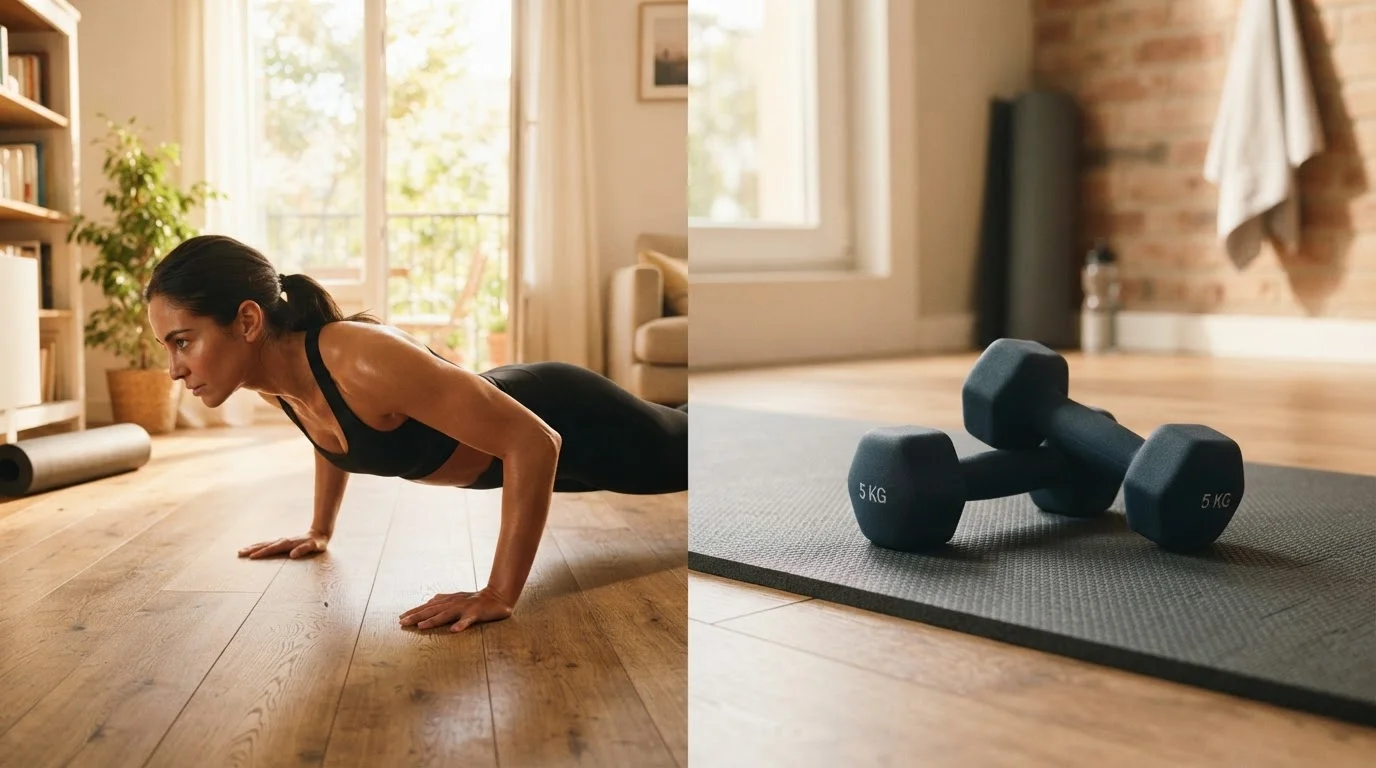
Option A
Bodyweight Training
The always-available, zero-cost movement practice.
Best for: Anyone who wants a consistent, flexible routine without equipment, gym access, or extra spending.
Option B
Free Weights
The scalable tool for measurable strength progression.
Best for: People who want to systematically increase load, build muscle mass, and track progress with precision.
What You're Actually Training Differently
Strip away the marketing language around both approaches and the core difference is simple: bodyweight training uses your own mass as resistance, while free weights let you add external load. That one variable changes quite a bit about how each method works in practice.
With bodyweight training, your body moves through space — think pull-ups, push-ups, or pistol squats. This demands coordination, balance, and joint stability alongside raw strength. You're rarely isolating a single muscle; you're training movement patterns. That has real functional value, and it's one reason many physical therapists and coaches use bodyweight work in rehabilitation and athletic development alike.
Free weights — dumbbells, barbells, kettlebells — allow you to load those same movement patterns externally. A goblet squat and a bodyweight squat use identical mechanics, but the added weight changes the stimulus meaningfully. Because you can increase the load in small increments over weeks and months, progressive overload (gradually increasing the training demand placed on your muscles) becomes much easier to apply and track.
See common fitness myths that hold people back for more on how training assumptions can steer beginners in the wrong direction.
| Criterion | Bodyweight Training | Free Weights |
|---|---|---|
| Equipment cost | None required | Moderate to high upfront cost |
| Location flexibility | Anywhere, anytime | Gym or home setup required |
| Progressive overload | Possible but requires creativity | Straightforward, easily tracked |
| Muscle isolation | Limited; mostly compound movement | Easier to isolate specific muscles |
| Balance and coordination demand | High — trains stability naturally | Lower, depending on exercise |
| Beginner-friendliness | Very accessible | Requires technique learning |
| Injury risk (if form breaks down) | Generally lower | Higher under heavier loads |
The Access and Cost Reality
For many young adults, the real deciding factor isn't training philosophy — it's access. A gym membership, depending on location and tier, can run anywhere from modest to genuinely burdensome on a tight monthly budget. Add commute time, crowded equipment, and the psychological friction of showing up somewhere unfamiliar, and the gym becomes a barrier as much as a resource.
Bodyweight training removes nearly all of those barriers. Your living room, a local park, or even a hotel room works. If you're building a routine around real-life constraints rather than ideal conditions, this matters enormously. Building a fitness routine around your real life covers exactly how to structure that kind of approach.
Free weights require either a gym or an upfront investment in equipment. A basic set of adjustable dumbbells represents a meaningful one-time cost. For some people, that's a worthwhile investment that pays off over years. For others — especially those in smaller living spaces or with tight budgets — it simply isn't realistic right now.
~$50/month
Average U.S. gym membership cost
According to fitness industry surveys, the average American gym membership runs between $40 and $70 per month, representing a real annual expense for budget-conscious adults.
8 weeks
Time to see strength gains from bodyweight training
Research consistently shows that beginners following a structured bodyweight program can observe measurable strength and endurance improvements within 6 to 8 weeks of consistent practice.
If space is a concern, making any room your training area offers practical strategies for working with what you have.
Progression: Where Each Method Shines and Struggles
One of the most honest conversations in fitness is about what happens when a training method stops challenging you. Both approaches have answers — but they're not equally convenient.
With free weights, progression is built in. Add five pounds. Do one more rep. Increase the set count. These are quantifiable, repeatable steps that make it easy to confirm you're actually getting stronger over time.
Bodyweight progression is more creative but equally valid. You move from a standard push-up to an archer push-up to a one-arm push-up. You increase leverage, reduce stability, or slow the tempo. The ceiling is high — gymnasts and calisthenics athletes demonstrate extraordinary strength built entirely through bodyweight methods — but finding and programming those progressions takes more knowledge and patience.
For beginners, this distinction matters less. Most people starting out have so much room for initial adaptation that either method will produce noticeable improvements in strength and fitness within weeks. The progression challenge typically becomes relevant after several months of consistent training.
Neither Method Requires a Perfect Setup
A common misconception is that free weights only work in a fully equipped gym, or that bodyweight training is only for beginners. Neither is true. Many experienced athletes use bodyweight movements as primary training tools, and a single pair of dumbbells at home can support years of progressive strength work. The best method is the one you'll actually do consistently. As always, if you have an existing injury or health condition, consult a qualified healthcare professional before starting or changing a training program.
Whichever approach you choose, the social dimension of training is worth considering. Working out alone versus with others explores how accountability and community affect long-term consistency.
The content provided on our blog site traverses numerous categories, offering readers valuable and practical information. Readers can use the editorial team’s research and data to gain more insights into their topics of interest. However, they are requested not to treat the articles as conclusive. The website team cannot be held responsible for differences in data or inaccuracies found across other platforms. Please also note that the site might also miss out on various schemes and offers available that the readers may find more beneficial than the ones we cover.