

Our Verdict
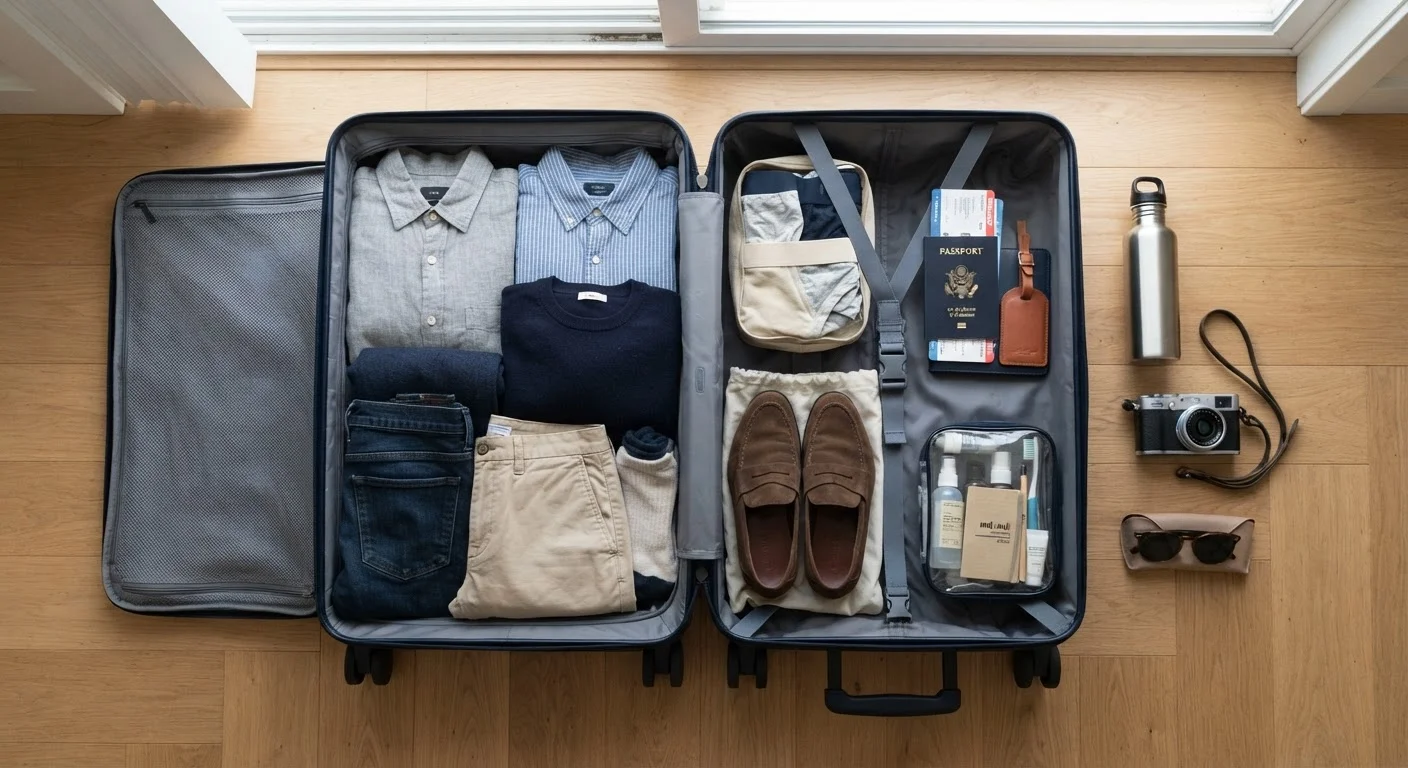
Carry-on only travel is a genuinely powerful money-saving strategy for the right trip and the right traveler. It eliminates baggage fees, speeds up airport time, and forces a focused approach to packing that many travelers end up appreciating. That said, it demands flexibility, planning, and honest self-assessment about your actual needs on the road.
Best for solo travelers, couples, or digital nomads taking trips of one to two weeks in consistent climates who are willing to pack intentionally and do laundry on the road.
What Carry-On Only Travel Actually Means
Carry-on only travel means flying with just one personal item or one carry-on bag — nothing that goes in the cargo hold. You're limited by airline size and weight restrictions, which vary by carrier but generally allow bags around 22 x 14 x 9 inches for overhead bins.
This approach has exploded in popularity among budget travelers, partly because checked bag fees have risen sharply across domestic and international carriers. What feels like a small fee per leg adds up fast across a multi-stop itinerary. As hidden travel costs go, baggage fees are one of the most predictable — and avoidable — drains on a tight trip budget.
The strategy isn't just about saving money, though. It also changes how you move through airports, how quickly you can change plans, and how much mental energy you spend managing your stuff.
The Real Advantages of Going Bag-Free at the Gate
Eliminates checked bag fees on every flight
Domestic airlines typically charge $35–$40 per checked bag each way; on a round trip with a connection, fees can exceed $150 before you've left the airport. Carry-on only removes this cost entirely on most carriers.
Faster airport experience from check-in to exit
Skipping checked luggage means bypassing the check-in desk entirely on many airlines and walking straight off the plane at your destination — no baggage claim wait required.
Zero risk of lost or delayed luggage
Airlines occasionally misroute checked bags, leaving travelers without clothes or gear for days. Keeping everything in the cabin eliminates this disruption completely.
Greater flexibility for last-minute flight changes
Rebooking onto a different flight is far simpler without checked bags, which is especially useful when delays or cancellations force quick decisions at the airport.
Encourages intentional, lighter packing habits
The constraint of a single bag forces travelers to evaluate what they actually use versus what they haul out of habit, often resulting in trips that feel less burdened overall.
Beyond fee savings, carry-on travel reduces a specific kind of travel stress that's easy to underestimate: the wait. Checking a bag means arriving earlier, queuing at check-in, and standing at baggage claim after landing — sometimes 30 to 60 minutes of additional airport time per leg. On a trip with multiple flights, that time compounds quickly.
There's also the lost luggage question. Airlines do misroute checked bags, and while it's relatively rare, it's genuinely disruptive. Traveling carry-on only eliminates that variable entirely.
For budget travelers using flexible timing and destinations to find lower fares, carry-on only also unlocks some ultra-low-cost carriers that charge for any checked luggage at all — making the strategy directly tied to accessing cheaper fares.
The Honest Drawbacks You Should Know Before Committing
Strict size and weight limits restrict what you bring
Airlines enforce carry-on dimensions and, on some carriers, weight limits. Overpacked bags may be gate-checked or require you to pay a fee anyway, negating the savings.
TSA liquid rules limit toiletries and liquids
The 3-1-1 rule (containers of 3.4 oz or less in a single quart-size bag) means full-size shampoos, sunscreens, and medications in liquid form must stay home or be purchased at the destination.
Challenging for trips longer than two weeks
Extended travel requires either significant laundry planning or accepting outfit repetition, which suits some travelers but is genuinely stressful for others.
Difficult in cold, multi-climate, or activity-heavy trips
Bulky winter layers, hiking boots, formal wear, or sports gear quickly max out a carry-on, making this strategy impractical for trips that span wildly different conditions.
Bin space is not always guaranteed
On full flights, overhead bins fill up fast. Gate agents may check your carry-on involuntarily, and securing early boarding to avoid this often costs extra.
TSA Liquid Rules Apply Regardless of Bag Size
Even in a carry-on, all liquids must comply with the TSA 3-1-1 rule: containers of 3.4 ounces (100ml) or less, packed in a single clear quart-size bag. Medications and certain medical liquids may be exempt but should be declared at screening. Always verify current rules directly with the TSA before your trip, as guidelines can change.
Overhead bin space is also not guaranteed. On full flights, gate agents may check carry-ons at no cost — but that defeats the purpose if you're carrying liquids, electronics, or fragile items you planned to keep with you. Boarding early (often by paying for priority) is sometimes necessary to secure bin space, which adds a cost back into the equation.
Who Actually Thrives With a Single Bag
Solo travelers and couples traveling to warm or consistent-weather destinations for one to two weeks are the clearest candidates. A week in a beach city or a Europe trip in summer is very manageable in a 40-liter bag, especially if you're willing to do a load of laundry midway through.
Digital nomads and remote workers who move frequently have perhaps the strongest case for carry-on only living — their entire life fits in one bag by design. Solo travel planning in general pairs naturally with light packing, since every decision is yours alone.
$35–$40
Typical domestic checked bag fee, each way
Most major U.S. airlines charge per checked bag per direction; fees can add up significantly across a multi-leg itinerary.
30–60 min
Estimated time saved skipping baggage claim
Travelers who bypass checked luggage often save meaningful time at both departure and arrival airports, particularly on busy travel days.
If you're unsure what to leave behind, packing light without sacrificing essentials is a skill that can be learned — and most travelers who try carry-on only for the first time are surprised by how little they actually needed.
When Carry-On Only Doesn't Make Sense
Families traveling with young children face real constraints: car seats, strollers, formula, medications, and entertainment gear don't compress into a carry-on. The strategy that works brilliantly for one adult can become genuinely impractical when multiplied across a family of four.
Cold-weather or multi-climate trips present another challenge. A single carry-on bag filled with winter layers, boots, and rain gear leaves almost no room for anything else. If your itinerary spans ski slopes and beach days in the same trip, a checked bag may simply be the practical choice.
Athletes, musicians, photographers, and others who travel with specialized gear face hard limits that no amount of packing skill can overcome. And if you're comparing travel modes entirely, road trips versus flying changes the baggage equation completely — your car's trunk doesn't charge per bag.
The honest answer is that carry-on only isn't a universal hack. It's a deliberate trade-off, and knowing when it works — and when it doesn't — is what separates a smooth trip from a frustrating one.
The content provided on our blog site traverses numerous categories, offering readers valuable and practical information. Readers can use the editorial team’s research and data to gain more insights into their topics of interest. However, they are requested not to treat the articles as conclusive. The website team cannot be held responsible for differences in data or inaccuracies found across other platforms. Please also note that the site might also miss out on various schemes and offers available that the readers may find more beneficial than the ones we cover.