

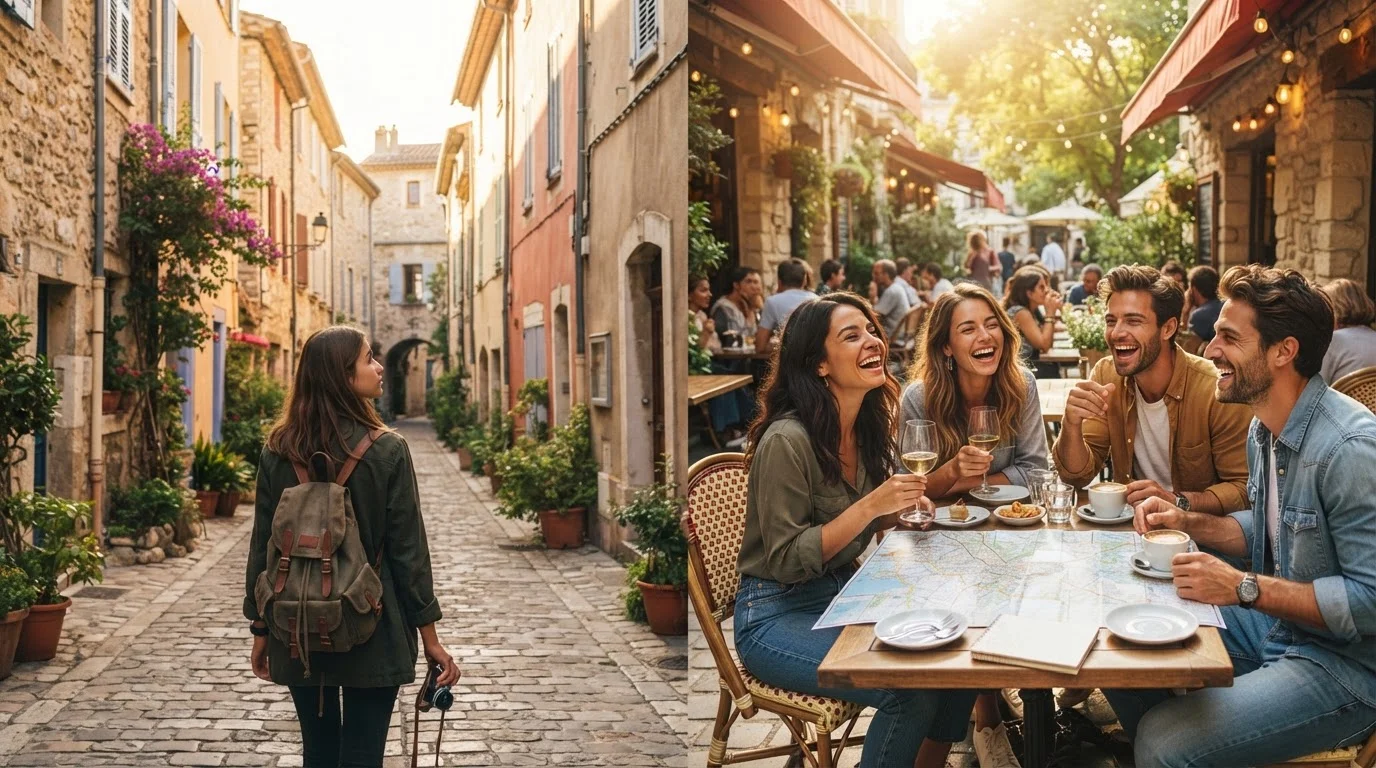
Our Verdict
Solo travel rewards independence and self-discovery at a real financial and logistical premium. Group travel stretches budgets and builds shared memories, but demands compromise and coordination. Neither approach is inherently superior — the best fit is the one that matches how you actually want to spend your time and energy on the road.
Solo travel suits independent planners comfortable navigating uncertainty alone; group travel works best for social travelers who prioritize shared experiences and want to offset costs.
How Your Travel Style Changes Everything Downstream
Whether you book alone or with others doesn't just affect who you sit next to on the plane — it ripples through nearly every planning decision: accommodation type, daily budget, itinerary flexibility, and even how much stress you carry before departure. Understanding that dynamic up front makes the whole planning process cleaner.
For a deeper look at how destination choice and timing interact with budget realities, see planning around a budget. And if you're newer to trip planning, it's also worth clearing out the common misconceptions covered in travel planning myths that lead new travelers astray before committing to either style.
Total flexibility over schedule and itinerary
Solo travelers can change plans on a whim — extending a stay, skipping an attraction, or leaving early — without negotiating with anyone. This makes spontaneous decisions genuinely easy.
Faster, deeper connections with locals and other travelers
Traveling alone signals openness. Locals and fellow travelers are more likely to strike up conversation with a solo person than approach a group, leading to encounters that often become trip highlights.
Group cost-splitting significantly reduces per-person expenses
Shared accommodations, rental cars, and multi-course meals divided among four people can cut individual costs by 30–50% compared to solo equivalents.
Built-in companionship reduces decision fatigue
Having travel companions means someone else can handle restaurant research one night, navigation the next. The mental load of constant solo decision-making is real and cumulative.
Shared memories and experiences create lasting bonds
Group travel produces the kinds of shared stories and inside jokes that reinforce friendships long after the trip ends — a social benefit that solo travel simply can't replicate.
Complete personal control over the travel budget
Solo travelers spend exactly as much — or as little — as they choose with no social pressure to upgrade, eat out more, or add activities. Budget discipline is far easier to maintain.
The Real Costs: Solo vs. Group Budgets
Solo travelers pay a single-occupancy premium on most hotel rooms and private accommodations — sometimes 30–50% more per night than the per-person rate in a double or shared room. Group travelers can split Airbnb rentals, hire shared transport, and split restaurant bottles of wine. Those savings compound quickly over a ten-day trip.
On the flip side, group trips often include social spending pressure — an extra dinner out, an activity nobody wants to skip, or upgrading a room to fit everyone. Solo travelers spend exactly what they choose to spend, nothing more. For practical strategies on keeping either style affordable, the Budget Travel Tips hub is a strong starting point.
~72%
Solo travelers who are women
Solo travel has grown substantially, with multiple surveys indicating women now make up a large majority of solo travelers globally, reflecting a broad shift in who travels independently.
30–50%
Potential savings from shared accommodation
Splitting the cost of a vacation rental or double hotel room among two or more travelers typically reduces the per-person nightly rate by this range compared to single-occupancy pricing.
Flexibility, Pace, and the Compromise Factor
This is where solo travel genuinely shines. You wake up, check the weather, and decide to spend the entire morning at one museum instead of rushing to hit four highlights. Nobody is waiting. Nobody has a flight preference. That kind of unscripted movement is difficult — sometimes impossible — to replicate in a group.
Groups, though, create their own energy. Decisions get made faster when someone steps up as the organizer, and having a partner or crew at each destination adds a layer of real-time safety and spontaneity. Many travelers find that shared moments — getting hilariously lost together, discovering a hidden restaurant — become the stories they actually tell afterward.
Solo travel is more expensive per person
Single-occupancy hotel rates and non-shareable transport costs mean solo travelers routinely pay more for equivalent experiences. This can add hundreds of dollars to a week-long trip.
Group travel requires constant compromise
Aligning preferences on accommodation, pace, activities, and dining across multiple people is genuinely challenging. Even close friends often have incompatible travel styles that only emerge on the road.
Solo travelers carry the entire logistics burden alone
Every missed connection, booking error, or sudden change is the solo traveler's problem to solve without backup. This demands stronger preparation and higher stress tolerance.
Group trips can generate interpersonal tension
Disagreements over money, pace, or decision-making in unfamiliar environments can strain even strong friendships. Financial disputes — who owes what — are among the most common group travel friction points.
Solo travel can be isolating on longer trips
Extended solo travel, particularly in non-English-speaking destinations, can become genuinely lonely. Without proactive social effort, days can pass without meaningful human interaction.
Staying organized regardless of your travel style matters. Travel apps, spreadsheets, and paper planning tools each have a role depending on your group size and complexity.
Safety, Logistics, and the Planning Workload
Solo travelers carry the entire logistical load themselves — every booking confirmation, every backup plan, every missed connection is theirs to solve. That's empowering for some and genuinely exhausting for others. Group trips distribute that burden, though they also multiply communication overhead: syncing six schedules across three time zones is its own kind of project management.
From a safety standpoint, traveling with others provides an immediate support system in unfamiliar environments. Solo travelers compensate with extra preparation: sharing itineraries with someone at home, staying in well-reviewed, centrally located accommodation, and building in buffer time. Neither approach is inherently unsafe — both benefit from the habits outlined in habits of organized travelers.
Hybrid Travel: A Third Option Worth Considering
Many experienced travelers don't choose one style exclusively. A common approach is to book solo flights and accommodation for flexibility, then join locally organized day tours or short group excursions for activities that are more fun — or safer — with others. This hybrid model captures some of the freedom of solo travel while softening the loneliness and cost disadvantages. It's worth building this option into your planning conversations rather than treating solo and group as binary choices.
Packing strategy also shifts with group size. Solo travelers often commit to carry-on-only setups to stay nimble. Groups have more flexibility — and more chaos. See the carry-on only travel pros and cons breakdown to decide what fits your style.
The content provided on our blog site traverses numerous categories, offering readers valuable and practical information. Readers can use the editorial team’s research and data to gain more insights into their topics of interest. However, they are requested not to treat the articles as conclusive. The website team cannot be held responsible for differences in data or inaccuracies found across other platforms. Please also note that the site might also miss out on various schemes and offers available that the readers may find more beneficial than the ones we cover.