

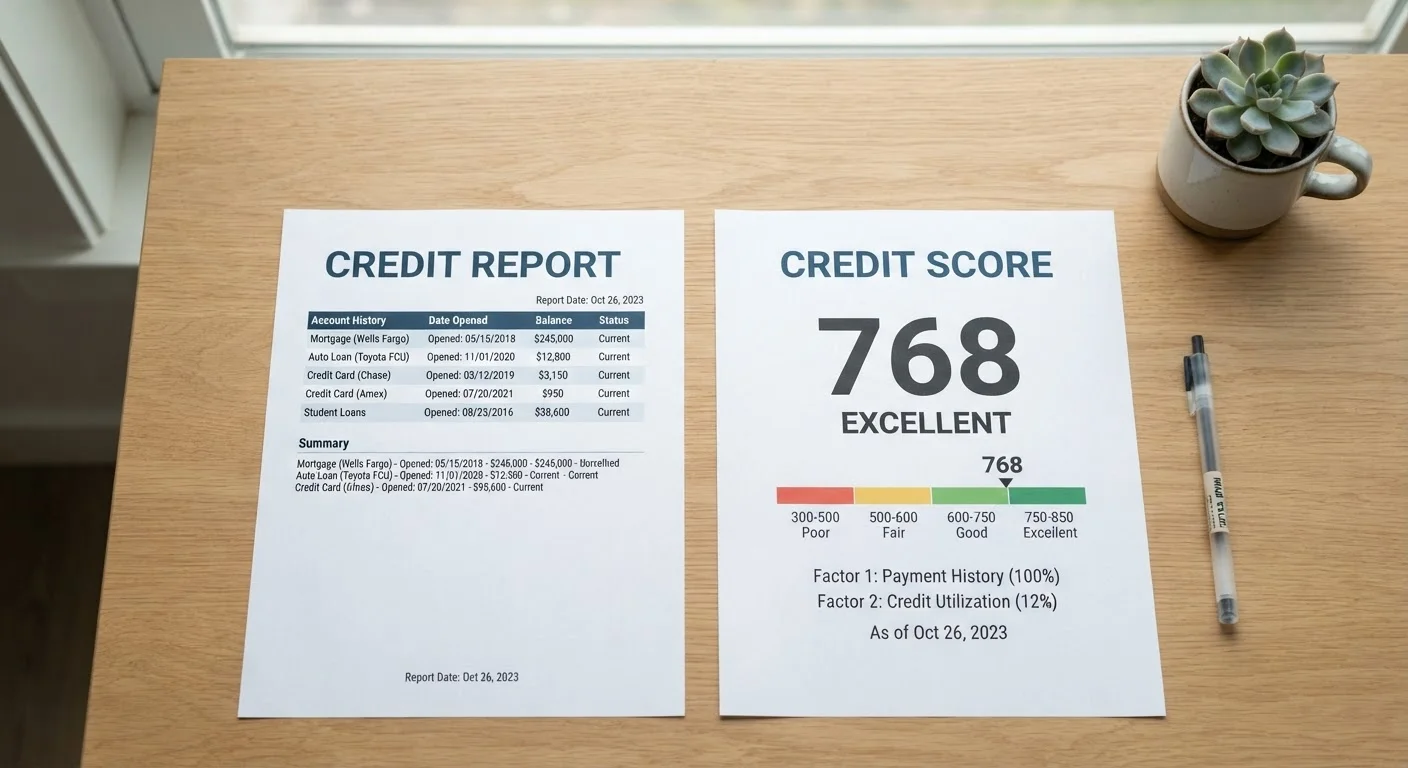
Two Different Documents, One Connected System
Many people use the terms interchangeably, but your credit report and your credit score are not the same thing. Understanding the distinction helps you take targeted action — because fixing a score problem and fixing a report problem often require different steps.
Your credit report is essentially a financial biography. It lists every credit account you've opened, your payment history on each account, your current balances, how long each account has been open, and any negative events like late payments, collections, or bankruptcies. This document is produced by the three major consumer reporting bureaus: Equifax, Experian, and TransUnion.
Your credit score, by contrast, is a number — typically ranging from 300 to 850 under the most widely used models — that condenses your report's data into a single measure of credit risk. Scoring companies like FICO and VantageScore apply mathematical formulas to your report's contents to generate that number. The score itself is not stored in your report; it is calculated fresh each time a lender requests it.
You Have Multiple Credit Scores
There is no single universal credit score. FICO alone has dozens of scoring model versions, and VantageScore is a separate model entirely. Lenders choose which model to use, so the score you see on a free monitoring app may differ from the one a lender pulls. What matters most is understanding the range your score falls in and the report data driving it.
What Your Credit Report Actually Contains
A credit report is broken into several distinct sections. Knowing what each one includes helps you spot problems and understand what lenders are actually seeing.
- Personal information: Your name, current and past addresses, date of birth, and Social Security number (partially masked). This section does not affect your score.
- Account history: Also called tradelines, this section lists each credit account — credit cards, auto loans, student loans, mortgages — along with the account status, credit limit or loan amount, current balance, and payment history.
- Inquiries: Hard inquiries from lenders who pulled your report during a credit application, and soft inquiries such as your own checks or pre-approval screenings.
- Public records and collections: Bankruptcies and accounts sent to collections appear here and are among the most damaging items a report can contain.
Because each bureau collects data independently, your three reports may not be identical. A creditor might report to only two bureaus, or a payment might be recorded at slightly different times. That's why reviewing all three — available free at AnnualCreditReport.com — is worthwhile. For a deeper walkthrough of each section, see our guide to reading your credit report.
How Your Score Is Calculated From That Report
A credit score doesn't appear in your report — it's derived from it. Scoring models analyze your report's data and assign weight to different factors. Under the widely referenced FICO scoring framework, five categories generally matter most:
- Payment history — whether you pay on time
- Amounts owed — how much of your available credit you're using (your utilization rate)
- Length of credit history — how long your accounts have been open
- Credit mix — the variety of account types you carry
- New credit — recent applications and new accounts
Because your score is recalculated from live report data, it can change month to month as your balances, payment status, or account ages shift. One of the fastest-moving factors is credit utilization, which responds quickly when balances rise or fall. For a full breakdown of how each factor is weighted, our guide to credit score factors explains the details.
Review All Three Reports, Not Just One
Since each bureau operates independently, the same account error might appear on one report but not the others. Checking all three gives you the full picture and ensures you catch anything that could unfairly drag down your score. You can access all three for free at AnnualCreditReport.com.
Why Both Matter — and When Each One Is Used
Lenders, landlords, and even some employers may check one or both, depending on what decision they're making.
When you apply for a credit card or personal loan, lenders typically pull your score first for a quick eligibility check. If they proceed, they may also review your full report to assess specific risk factors — like a history of missed payments or high balances on multiple accounts. For major decisions like a mortgage, lenders often examine both in detail. Our article on credit scores and mortgage applications explains what lenders focus on when the stakes are high.
The practical takeaway: your report is the source of truth. If your score is low, the explanation lives in your report. Common culprits include late payments, high utilization, or an error that shouldn't be there at all. Disputing inaccurate information directly with the bureau — a right protected under the Fair Credit Reporting Act — can correct the record and, in turn, improve the score that's calculated from it.
1 in 5
Americans with errors on their credit report
A study by the Federal Trade Commission found that approximately one in five consumers had an error on at least one of their three credit reports.
3
Separate credit bureaus maintaining your data
Equifax, Experian, and TransUnion each independently collect and maintain credit data, meaning your report can vary across all three.
Staying informed about common credit score myths also helps you avoid missteps, like closing old accounts or avoiding your report out of fear that checking it will cause harm.
This article is for general informational and educational purposes only and does not constitute personalized financial or legal advice. For guidance specific to your situation, consult a qualified financial professional.
Frequently Asked Questions
No. A credit report is a detailed record of your credit history, while a credit score is a three-digit number derived from that data. They are produced by different entities and serve different purposes, though they are closely related.
You can access free reports from all three major bureaus at AnnualCreditReport.com, the federally authorized source. Federal law entitles you to at least one free report from each bureau per year.
Different scoring models (such as FICO and VantageScore) and different versions of those models can produce different numbers. Additionally, each bureau may have slightly different data, leading to score variations.
Yes. If you find inaccurate information, you can file a dispute directly with the bureau that issued the report. The bureau is generally required to investigate within 30 days under the Fair Credit Reporting Act.
No. Reviewing your own credit report is considered a soft inquiry and does not affect your score. Only hard inquiries — initiated by lenders when you apply for credit — can temporarily lower it.
Financial experts generally suggest reviewing all three bureau reports at least once a year to catch errors or signs of fraud. Staggering the requests throughout the year lets you monitor your credit more continuously.
The content provided on our blog site traverses numerous categories, offering readers valuable and practical information. Readers can use the editorial team’s research and data to gain more insights into their topics of interest. However, they are requested not to treat the articles as conclusive. The website team cannot be held responsible for differences in data or inaccuracies found across other platforms. Please also note that the site might also miss out on various schemes and offers available that the readers may find more beneficial than the ones we cover.