

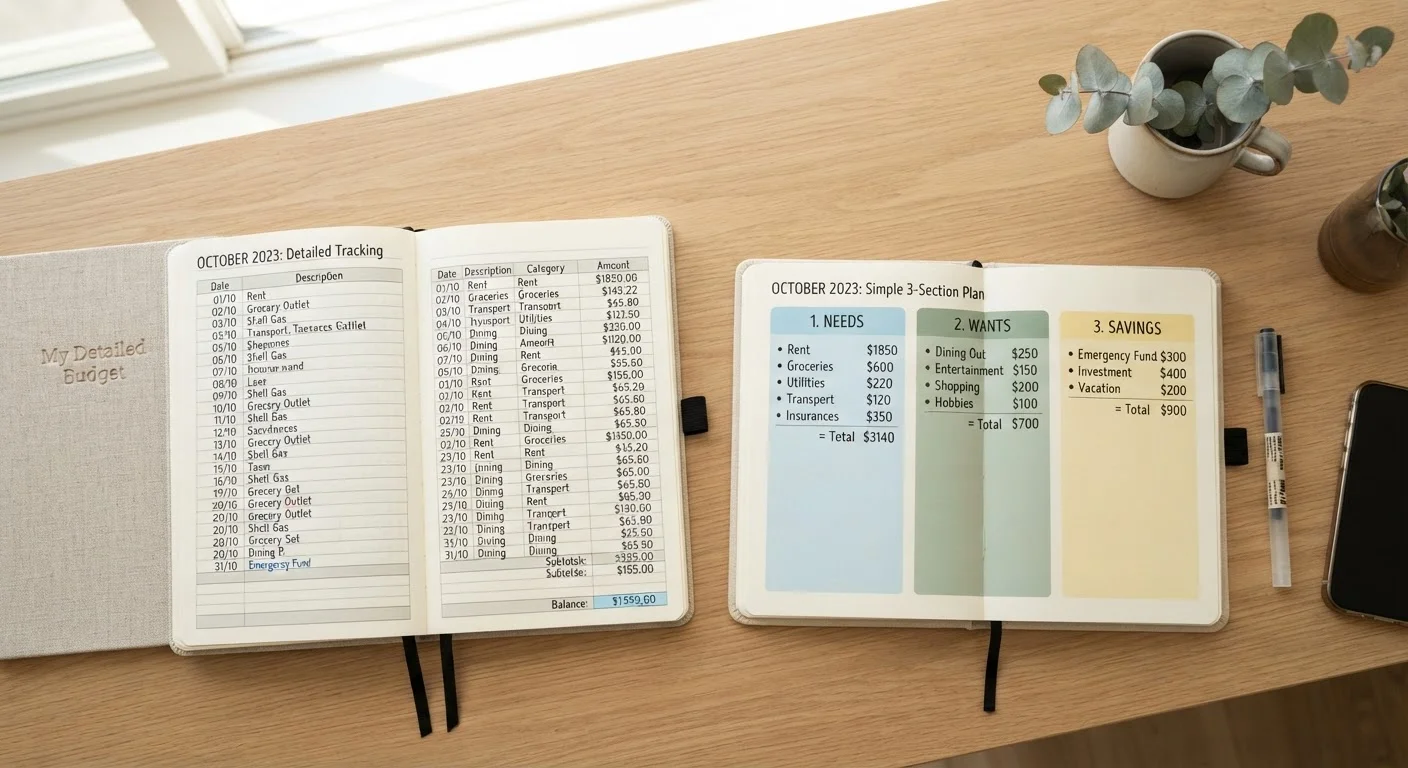
Option A
Zero-Based Budgeting
The meticulous, every-dollar-has-a-job approach.
Best for: People who want full control over every spending category and are willing to budget actively each month.
Option B
The 50/30/20 Rule
The simple, percentage-driven framework for beginners.
Best for: People who want a low-maintenance structure that separates needs, wants, and savings without detailed tracking.
How Each Method Works
Understanding the mechanics of each approach helps you see why they suit different people — and different financial moments.
Zero-Based Budgeting
With zero-based budgeting (ZBB), you start with your total monthly income and assign every dollar to a category — rent, groceries, transportation, savings, debt payments, and so on — until you reach zero. That doesn't mean you spend everything; it means every dollar has a named job, including money earmarked for savings or an emergency fund. You rebuild this plan from scratch each month, which means it automatically adjusts when your income or expenses shift. If you're new to the terminology, our budgeting glossary defines terms like discretionary spending and net income plainly.
The 50/30/20 Rule
The 50/30/20 rule divides your after-tax income into three buckets: 50% toward needs (rent, utilities, groceries, minimum debt payments), 30% toward wants (dining out, subscriptions, entertainment), and 20% toward savings and extra debt repayment. The appeal is simplicity — you don't track individual line items, just whether each expense fits into its bucket. For a deeper look at how this framework holds up on a limited income, see our detailed breakdown.
| Criterion | Zero-Based Budgeting | 50/30/20 Rule |
|---|---|---|
| Setup complexity | High — every dollar categorised | Low — three broad buckets |
| Monthly time commitment | 30–60 minutes to rebuild | Minutes once established |
| Best income type | Variable or irregular income | Stable, predictable income |
| Spending visibility | Very high — line-item detail | Moderate — category-level only |
| Flexibility for tight budgets | High — no fixed percentages | Lower — percentages may not fit |
| Ideal for beginners | Less so — steeper learning curve | Yes — simple to learn quickly |
| Debt paydown focus | Strong — allocate every spare dollar | Moderate — fits within 20% bucket |
Key Differences That Affect Your Choice
Both methods share the same goal — making your spending intentional — but they diverge significantly in effort, flexibility, and fit.
~78%
Americans living paycheck to paycheck
Various workforce surveys consistently show a large share of US workers have little financial buffer, underscoring why a workable budget structure matters.
30%+
Income spent on housing alone by many renters
The US Department of Housing and Urban Development considers households spending over 30% of income on housing to be cost-burdened, which can strain the 50/30/20 framework.
1 in 3
Adults with no written budget
According to general financial literacy research, a significant portion of adults manage spending without any formal budget structure.
Time and Effort
Zero-based budgeting demands a monthly session, typically 30–60 minutes, to allocate every dollar. The 50/30/20 rule, once set up, may only need a quick monthly check-in. If you're building your first budget, starting with the simpler method and graduating to ZBB later is a reasonable path. Our monthly budget setup checklist walks through the steps regardless of which method you use.
Handling Fixed vs. Variable Expenses
Zero-based budgeting makes the distinction between fixed and variable costs explicit — you list them separately and allocate accordingly. The 50/30/20 rule blends both types into broad categories, which can obscure whether you're overspending in a specific area. Understanding this distinction matters; see our guide on fixed vs. variable expenses for the full picture.
Low-Income and Tight-Budget Contexts
When income is very tight, the 50/30/20 split can be difficult to maintain — housing alone may consume well over 50% of take-home pay in many US cities. Zero-based budgeting is more adaptable here because it doesn't require fixed percentages; you allocate based on what you actually have. Another method worth considering is envelope budgeting — see envelope budgeting in a cashless world for a comparable discipline-focused approach.
You Can Combine Elements of Both
Some people use the 50/30/20 rule as a high-level guide and apply zero-based thinking within each category — for example, itemising exactly how the 30% 'wants' bucket is spent. This hybrid approach suits people who want structure without full line-item granularity. There's no rule requiring you to pick exactly one method and apply it rigidly.
This article is for general informational purposes only and does not constitute personalised financial advice. Consider consulting a qualified financial professional for guidance specific to your situation.
The content provided on our blog site traverses numerous categories, offering readers valuable and practical information. Readers can use the editorial team’s research and data to gain more insights into their topics of interest. However, they are requested not to treat the articles as conclusive. The website team cannot be held responsible for differences in data or inaccuracies found across other platforms. Please also note that the site might also miss out on various schemes and offers available that the readers may find more beneficial than the ones we cover.