

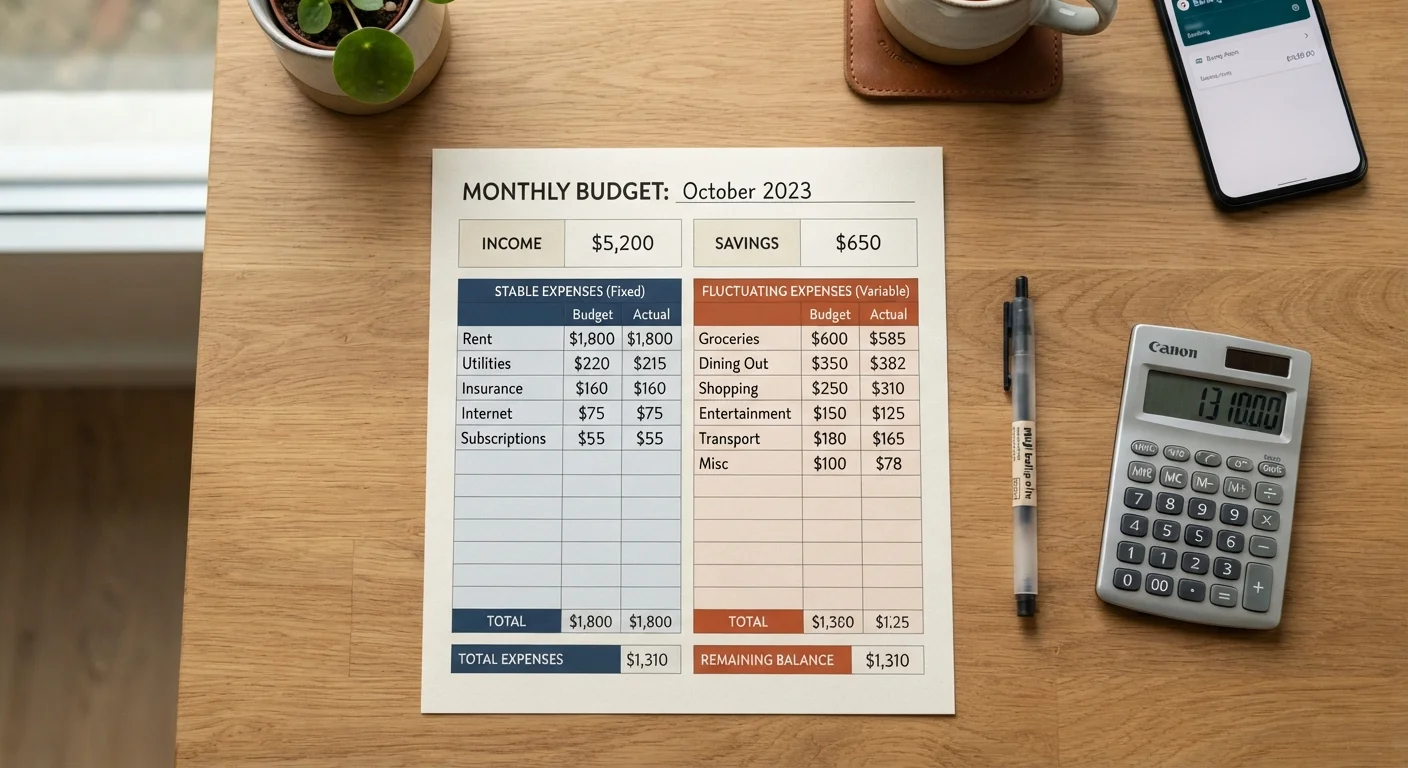
Option A
Fixed Expenses
The predictable, non-negotiable costs you plan around.
Best for: Building the stable foundation of any budget — expenses you know are coming every month.
Option B
Variable Expenses
The flexible, fluctuating costs you actively manage.
Best for: Identifying where spending adjustments are most realistic and impactful month to month.
What Fixed Expenses Actually Are
A fixed expense is any cost that stays the same from month to month, regardless of how you spend your time or make daily choices. Rent or mortgage payments are the most common example: you owe the same amount on the first of every month whether you stayed home all month or traveled every weekend.
Other typical fixed expenses include:
- Car loan or lease payments
- Student loan minimum payments
- Health, renters', or auto insurance premiums
- Phone plan monthly fees
- Subscription services at flat monthly rates
Fixed expenses are the backbone of any budget because they define the floor — the minimum amount of money you must bring in each month just to stay current on obligations. If your fixed expenses total $1,800 a month, no budget strategy changes that figure in the short term. Understanding this helps you avoid overcommitting income before accounting for everything else.
For a broader introduction to personal finance vocabulary, see our budgeting glossary for definitions of terms like net income, discretionary spending, and more.
| Criterion | Fixed Expenses | Variable Expenses |
|---|---|---|
| Amount each month | Stays the same | Changes based on behavior |
| Examples | Rent, loan payments, insurance | Groceries, gas, dining out |
| Predictability | High — easy to plan for | Low to moderate — requires tracking |
| Short-term flexibility | Little to none | Significant — can be adjusted |
| Budget role | Sets your spending floor | Defines your discretionary range |
| Primary savings lever | Renegotiate or refinance over time | Reduce or cut immediately if needed |
What Variable Expenses Are — and Why They Matter More for Budgeting
A variable expense is any cost that changes in amount from month to month, usually based on your habits, needs, or circumstances. Groceries are the classic example: your total shifts depending on what you cook, how many people you're feeding, and whether you meal-plan or shop impulsively.
Common variable expenses include:
- Groceries and household supplies
- Gasoline or transportation costs
- Dining out and entertainment
- Clothing and personal care
- Medical copays and prescriptions
- Gifts and seasonal spending
Variable expenses are where most of your day-to-day financial decisions live — and where most opportunities to adjust spending actually exist. When cash is tight, you generally cannot reduce your rent payment mid-lease, but you can scale back how often you eat out or delay a non-urgent purchase.
~33%
Average share of income spent on housing
The U.S. Bureau of Labor Statistics Consumer Expenditure Survey consistently shows housing as the largest single fixed expense category for American households.
~13%
Average share of income spent on food
Food — split between at-home and away-from-home spending — is one of the largest variable expense categories, according to BLS Consumer Expenditure data.
A practical approach is to look at three months of bank statements and average out each variable category. That average becomes your monthly target — not a cap, but a benchmark that tells you whether a given month is running high or low. If you're planning for shared finances, budgeting as a couple introduces how variable spending dynamics shift when two people are involved.
The Semi-Variable Middle Ground
Not every expense fits neatly into one box. Semi-variable expenses — sometimes called mixed expenses — have a fixed base component and a variable layer on top. Utilities are the most common example: your electricity bill carries a fixed service charge each month, but the total fluctuates depending on how much power you actually use.
Why Semi-Variable Expenses Trip Up Budgets
Many people underestimate semi-variable costs because they focus only on the fixed base amount. A particularly hot summer or a month of heavy streaming can push a bill significantly higher than expected. Building a small buffer — even $15–$30 per category — into your monthly plan for these expenses reduces the likelihood of a budget shortfall. Think of it as padding for predictable unpredictability.
Other semi-variable examples include:
- Internet plans with data overage charges
- Cell plans with per-minute or per-GB overages
- Gym memberships with optional add-on classes
For budgeting purposes, it helps to treat the predictable base as a fixed expense and budget a small buffer on top for the variable portion. This prevents an unexpectedly high utility bill from throwing off your entire monthly plan.
How to Use This Distinction to Build a Realistic Budget
Understanding the difference between fixed and variable expenses is not just an academic exercise — it directly shapes how you construct a workable spending plan. Here's a straightforward approach:
- List all fixed expenses first. Add them up. This is your non-negotiable monthly baseline.
- Subtract that total from your monthly take-home income. The remainder is what's available for variable expenses, savings, and debt repayment.
- Categorize your variable expenses using recent bank or credit card statements. Group them into broad buckets: food, transport, personal, entertainment.
- Set monthly targets for each variable category based on your averages — and identify one or two categories where you could realistically reduce spending.
- Revisit monthly. Fixed expenses occasionally change (a lease renewal, a new insurance rate). Treat each change as a trigger to rebalance the rest of your budget.
This structure gives you control without requiring perfection. Even modest reductions in variable spending can free up cash to direct toward an emergency fund — something covered in depth in our saving and emergency funds guide. And if you travel on a tight budget, the same variable-spending discipline applies: see budget travel tips for strategies that translate the same mindset to travel spending.
This article is for general informational and educational purposes only. It does not constitute personalized financial advice. For guidance specific to your situation, consider consulting a licensed financial professional.
The content provided on our blog site traverses numerous categories, offering readers valuable and practical information. Readers can use the editorial team’s research and data to gain more insights into their topics of interest. However, they are requested not to treat the articles as conclusive. The website team cannot be held responsible for differences in data or inaccuracies found across other platforms. Please also note that the site might also miss out on various schemes and offers available that the readers may find more beneficial than the ones we cover.