

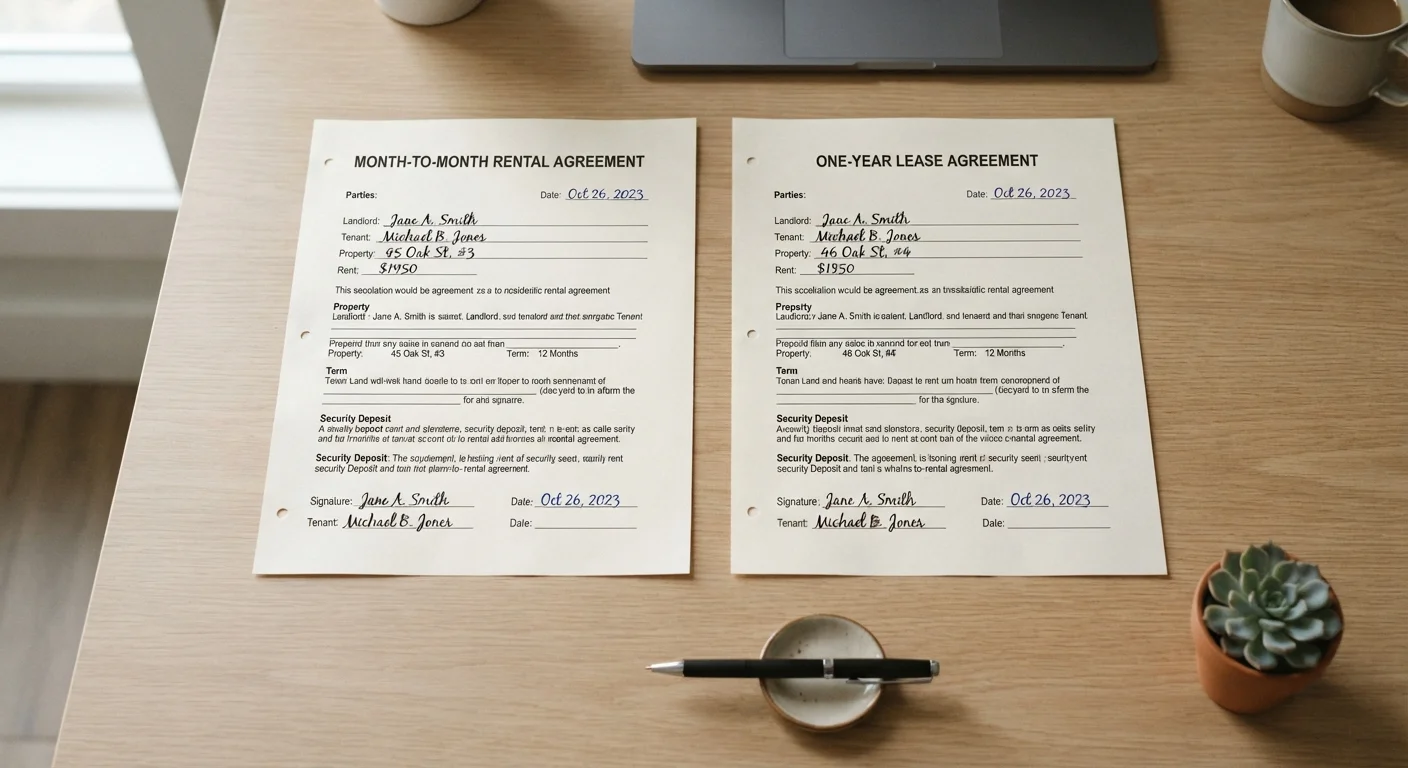
Option A
Month-to-Month Lease
The flexible, rolling rental agreement.
Best for: Renters who need short-term housing or expect their living situation to change soon.
Option B
Fixed-Term Lease
The stable, locked-in commitment.
Best for: Renters who want predictable costs and long-term housing security in one place.
What Each Lease Type Actually Means
A lease agreement is a legally binding contract between a renter and a landlord. The key difference between its two main forms comes down to how long you commit — and what happens when circumstances change.
A month-to-month lease (also called a periodic tenancy) renews automatically every 30 days. Neither party locks into a long obligation; either the landlord or the tenant can typically end the arrangement with proper written notice — usually 30 days, though this varies by state.
A fixed-term lease runs for a set period, most commonly 12 months, though 6-month and 18-month terms also exist. Both parties agree to the terms — including rent amount — for that entire duration. The landlord generally cannot raise your rent or ask you to leave mid-lease without legal cause, and you can't vacate without potentially facing an early-termination clause.
Understanding these structures also connects to how you think about your overall budget. For a deeper look at predictable versus variable costs in your finances, see how fixed and variable expenses shape your budget.
| Criterion | Month-to-Month Lease | Fixed-Term Lease |
|---|---|---|
| Commitment length | Renews monthly, no set end date | Set term, typically 6–18 months |
| Monthly rent cost | Often 10–25% higher than market | Locked in at signing rate |
| Rent increase risk | Can increase with notice any month | Protected for full lease term |
| Tenant exit flexibility | Leave with ~30 days' notice | Early exit may trigger penalties |
| Landlord termination risk | Landlord can end with short notice | Cannot end without legal cause |
| Best for budget planning | Less predictable month to month | Highly predictable costs |
Cost, Stability, and the Trade-Offs You're Making
The financial gap between these two lease types is real and worth calculating before you sign anything.
Month-to-month leases command a premium. Landlords charge more — sometimes 10–25% above the standard monthly rate — to compensate for the uncertainty of not knowing when you'll leave. That same flexibility also means your landlord can adjust rent upward more frequently, as long as they provide the legally required notice period for your state.
Fixed-term leases offer rent stability. Your rate is locked for the entire term, shielding you from mid-year market increases. In high-demand rental markets, this can amount to meaningful savings if rents rise in your area during your lease period.
10–25%
Month-to-month rent premium over fixed-term
Landlords commonly charge a premium for rolling leases to offset the uncertainty of an unpredictable tenancy end date.
30 days
Typical minimum notice to vacate or terminate
Most U.S. states require at least 30 days' written notice to end a month-to-month tenancy, though some require 60 days.
The trade-off with a fixed-term lease is exit cost. If your life changes — a new job in another city, a relationship shift, or a financial hardship — leaving before the term ends may mean paying one to two months' rent as a termination fee, or continuing to pay rent until a replacement tenant is found. Some leases are stricter than others, so reading the early-termination clause carefully is essential before signing.
If you're sharing your rental with roommates, the lease type also affects shared liability. Renting with roommates involves joint legal responsibility regardless of which lease structure you use — something to understand before anyone co-signs.
Flexibility, Protections, and When Each Makes Sense
Month-to-month leases feel liberating, but the flexibility runs both ways. While you can leave with short notice, your landlord can also end the tenancy — or substantially raise your rent — on the same short timeline. In competitive rental markets, this can leave you scrambling for a new place under time pressure.
Fixed-term leases give you stronger tenant protections during the lease period. Barring lease violations, a landlord cannot legally end your tenancy before the term expires. This matters if you're in a rapidly gentrifying area where landlords may want to replace tenants or redevelop a property.
If you ever need to leave a fixed-term lease early, two options often come into play: subletting and lease transfers. These are meaningfully different approaches — subletting vs. a lease transfer each carry distinct responsibilities and your lease agreement may restrict one or both.
Notice Requirements Vary by State
The required notice period to end a month-to-month lease is set by state law, not the landlord. Most states require 30 days, but several — including California and Oregon — require 60 days for longer-term tenants. Always check the tenant rights rules in your specific state before assuming 30 days is sufficient. Your local housing authority or a tenant advocacy organization can provide authoritative guidance.
For renters weighing whether leasing even makes long-term financial sense compared to ownership, it helps to look at the broader picture — owning vs. renting involves more than just comparing monthly payments.
This article is for general informational purposes only and does not constitute legal or financial advice. Lease terms, tenant protections, and notice requirements vary by state and locality. Always review your full lease agreement and consult a qualified professional or tenant advocacy resource for guidance specific to your situation.
The content provided on our blog site traverses numerous categories, offering readers valuable and practical information. Readers can use the editorial team’s research and data to gain more insights into their topics of interest. However, they are requested not to treat the articles as conclusive. The website team cannot be held responsible for differences in data or inaccuracies found across other platforms. Please also note that the site might also miss out on various schemes and offers available that the readers may find more beneficial than the ones we cover.