

Our Verdict
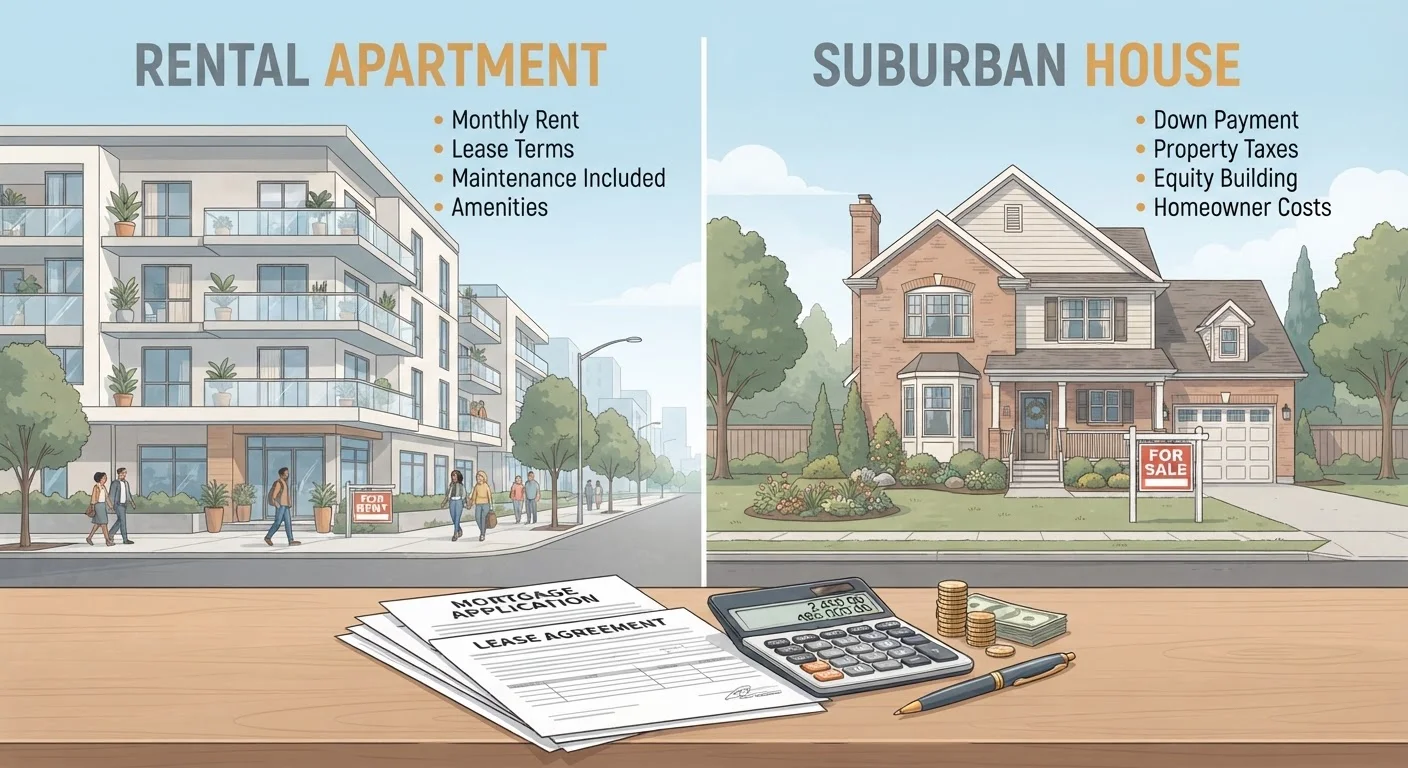
Owning a home offers equity growth and stability but carries significant ongoing costs that renters never face directly. Renting preserves flexibility and predictability but limits wealth-building potential over time. The financial gap between the two paths is rarely as simple as comparing monthly payments.
Homeownership tends to make the most financial sense for people who plan to stay in one place for at least five to seven years, have stable income, and have fully accounted for costs beyond the mortgage.
Why the Monthly Payment Is Only Half the Story
When people compare renting to buying, the conversation often starts and ends with one number: the monthly payment. But focusing solely on mortgage versus rent leaves out a wide range of costs that quietly shape the true financial picture of each path.
For renters, the real cost picture is more layered than a single rent figure suggests — our guide to what renting actually costs breaks that down in detail. On the ownership side, the same logic applies, only the additional costs are larger and less predictable.
Understanding both sides completely — not just the headline numbers — is the foundation of a sound housing decision.
This Is General Information, Not Financial Advice
Housing decisions are highly personal and depend on local market conditions, income, credit, family situation, and long-term goals. The figures cited here are illustrative ranges drawn from commonly referenced industry guidance. Always consult a licensed financial adviser, real estate professional, or HUD-approved housing counselor before making a major housing decision.
The Full Cost Stack of Homeownership
A mortgage payment typically bundles principal and interest, but the expenses of owning a home extend well beyond that.
1%–2%
Annual home maintenance budget rule of thumb
Financial planners commonly recommend setting aside 1%–2% of a home's value each year to cover routine upkeep and unexpected repairs.
2%–5%
Typical buyer closing costs as share of purchase price
The Consumer Financial Protection Bureau notes that closing costs generally range from 2% to 5% of the loan amount, depending on location and loan type.
5–7 years
Minimum horizon often cited to justify buying
Housing economists generally suggest homeownership becomes financially advantageous over renting only after five to seven years, once transaction costs are absorbed.
- Property taxes: These vary significantly by location but commonly run between 0.5% and 2.5% of the home's assessed value annually. A $350,000 home could mean $1,750–$8,750 per year.
- Homeowners insurance: Lenders require it, and it typically costs $1,000–$2,500 per year depending on location, coverage, and home value.
- Maintenance and repairs: A commonly cited rule of thumb is to budget 1%–2% of the home's value annually for upkeep — that's $3,500–$7,000 per year on a $350,000 home. Unexpected repairs (roof, HVAC, plumbing) can push costs far higher in any given year.
- HOA fees: If the property is in a managed community, monthly HOA fees ranging from $100 to over $500 are common.
- Closing costs and transaction costs: Buying and eventually selling each carry costs — typically 2%–5% of the purchase price at closing, and 5%–6% in real estate agent commissions on the sale side.
For a deeper look at how maintenance responsibility is divided — and what that means financially — see our breakdown of who is responsible for what repairs.
Builds equity and long-term wealth
Each mortgage payment reduces the loan balance, and property appreciation can significantly increase net worth over a decade or more.
Fixed-rate mortgage offers payment predictability
Unlike rent, a fixed-rate mortgage payment stays constant for the loan term — providing a hedge against housing inflation over time.
Freedom to modify and personalize the property
Owners can renovate, repaint, landscape, and redesign without landlord approval, allowing the home to be adapted to changing needs.
Potential tax advantages
Mortgage interest and property taxes may be deductible for some homeowners who itemize — though tax rules change and individual benefit varies. Consult a tax professional.
Stability for long-term planning
Owners cannot be asked to vacate at a landlord's discretion, providing stability that is especially valuable for families with school-age children.
What Renting Actually Costs — and What It Doesn't
Renters trade the equity upside of ownership for a more contained and predictable cost structure — most of the time.
- Rent itself: Fixed for the lease term, but subject to increases at renewal. In competitive rental markets, annual increases of 5%–10% are not uncommon.
- Renters insurance: Far cheaper than homeowners insurance — typically $15–$30 per month — and covers personal property and liability.
- Utilities and fees: Depending on the lease, renters may pay some or all utilities, parking, pet fees, or storage costs.
- Security deposits: Usually one to two months' rent upfront, which is not a recurring cost but is a meaningful out-of-pocket expense at move-in.
Critically, renters are not responsible for structural repairs, roof replacement, appliance failures (in most leases), or property taxes. That insulation from large unexpected costs is a genuine financial benefit.
Maintenance costs fall entirely on the owner
Roof leaks, plumbing failures, and HVAC replacements are the homeowner's financial responsibility — costs that can reach thousands of dollars with little warning.
Significant upfront and transaction costs
Down payments, closing costs, inspection fees, and moving expenses can total tens of thousands of dollars before moving in — and selling carries its own substantial costs.
Equity is illiquid and not guaranteed
Home values can fall, and even stable equity cannot be accessed quickly without selling or borrowing against the property, which introduces additional risk.
Reduced financial flexibility
A mortgage is a long-term legal obligation. Relocating for work, downsizing, or responding to income changes is more complex and costly than ending a lease.
Property taxes and insurance add ongoing cost
These expenses increase the true monthly cost of ownership well above the mortgage payment and can rise independently of the mortgage itself.
The Equity Argument — and Its Limits
The strongest financial case for homeownership is equity: over time, mortgage payments reduce the loan balance and — if home values rise — the gap between what you owe and what the home is worth grows. That accumulated value can be a significant source of long-term wealth.
However, equity is not guaranteed and is not liquid. Home values can stagnate or decline, as many homeowners experienced during the 2008 housing crisis and in localized market corrections since. Accessing equity typically requires selling the home, taking out a home equity loan, or a cash-out refinance — all of which carry costs or risks of their own.
The equity advantage also takes years to materialize. In the early years of a mortgage, most of each payment goes toward interest rather than principal, so equity accumulates slowly at first. If someone buys and sells within three to four years, transaction costs can eliminate any equity gains entirely.
For a broader side-by-side comparison of these financial dynamics, renting vs. buying trade-offs covers both financial and lifestyle dimensions in depth.
Making the Comparison Work for Your Situation
No spreadsheet can capture every variable, but a few questions can help frame the decision more honestly:
- How long do you plan to stay? The longer the horizon, the more homeownership's fixed-rate stability and equity potential work in your favor.
- Do you have reserves for repairs? Owning without an emergency fund is financially risky. Lenders approve mortgages based on income and debt ratios — not on whether you can handle a $6,000 HVAC replacement.
- What is your local rent-to-price ratio? In some markets, renting is significantly cheaper on a monthly basis than buying a comparable home; in others, mortgage payments are close to or below rents. This ratio matters enormously.
- Is your income and job situation stable? Homeownership is harder to exit quickly than a lease. Flexibility has real value if your career or personal situation is likely to shift.
Your credit profile and existing debt load also directly affect mortgage terms and the true cost of borrowing, so understanding that picture before applying is essential.
This article is for general informational purposes only and does not constitute financial or legal advice. Consult a qualified financial professional before making housing or investment decisions.
The content provided on our blog site traverses numerous categories, offering readers valuable and practical information. Readers can use the editorial team’s research and data to gain more insights into their topics of interest. However, they are requested not to treat the articles as conclusive. The website team cannot be held responsible for differences in data or inaccuracies found across other platforms. Please also note that the site might also miss out on various schemes and offers available that the readers may find more beneficial than the ones we cover.