

Why These Three Components Matter Most
Most homeowners know their HVAC system heats and cools the home, but far fewer understand the specific parts doing the work. Filters, coils, and vents are the trio most directly affected by everyday use — and the trio most likely to cause system failures when neglected. Knowing what each one does gives you a clear framework for routine upkeep and helps you recognize when something is wrong before it becomes expensive.
This isn't about becoming your own technician. It's about understanding your system well enough to maintain what you can, catch warning signs early, and have informed conversations with a licensed HVAC professional when needed. For a broader look at how these tasks fit into a year-round schedule, see the quarterly home maintenance checklist.
| Standard Filter Replacement Interval | Every 30–90 days (1-inch filters) (General manufacturer guidance; varies by household conditions) |
| Thick Filter Lifespan | 6–12 months (4–5 inch media filters) (General manufacturer guidance) |
| Recommended Clearance Around Outdoor Unit | At least 2 feet on all sides (Standard HVAC industry recommendation) |
| Coil Cleaning Frequency | Annually (condenser); as needed (evaporator) (U.S. Department of Energy maintenance guidelines) |
| Who Handles Refrigerant | Licensed HVAC technician only (Required under U.S. EPA Section 608 regulations) |
Air Filters: Your System's First Line of Defense
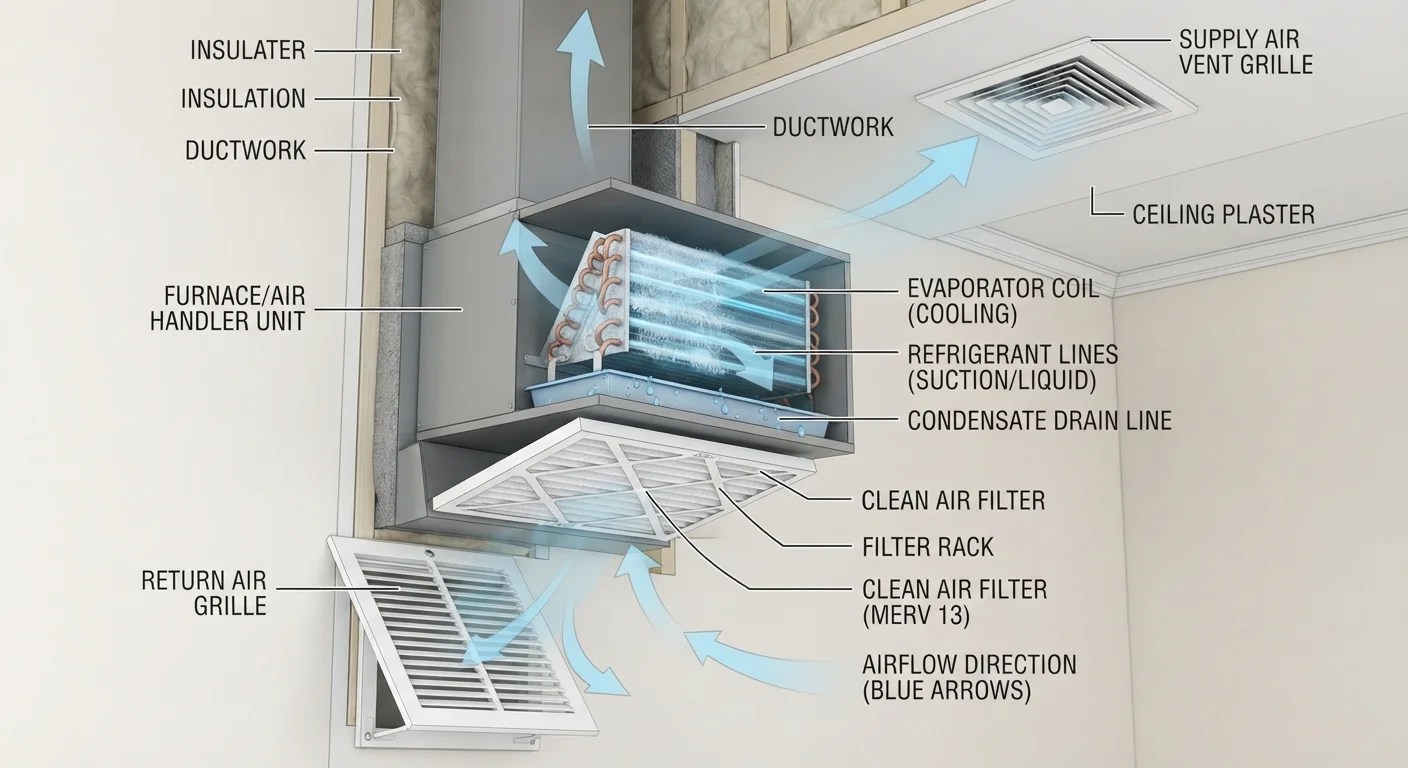
The air filter sits in the return air duct or at the air handler and captures airborne particles — dust, pollen, pet dander, mold spores — before they enter the system. This protects both the mechanical components and, to a degree, the air quality inside your home.
Filters are rated using a MERV scale. A MERV 1–4 filter catches large particles but lets finer ones through; MERV 8–12 captures much smaller debris and is appropriate for most residential systems; MERV 13 and above is used in medical or high-allergy environments and can restrict airflow if your system isn't designed for it. Using a filter with a rating that's too high for your equipment can strain the blower and reduce efficiency.
Most manufacturers recommend replacing standard 1-inch filters every 30–90 days depending on household conditions — more frequently with pets or allergy sufferers, less often in a one-person home with no pets. Thicker 4–5 inch filters typically last 6–12 months. A clogged filter is one of the most common causes of reduced airflow, frozen evaporator coils, and premature system wear. Check your filter monthly and replace it before it looks visibly gray and matted.
MERV Rating
Minimum Efficiency Reporting Value — a standardized scale from 1 to 16 that measures how effectively an air filter captures particles of varying sizes. Higher numbers indicate finer filtration, but not every system can handle high-MERV filters without airflow restrictions.
Evaporator Coil
The indoor coil located in the air handler that absorbs heat from indoor air during the cooling process. Refrigerant flows through it and evaporates, pulling heat out of the air before it's recirculated.
Condenser Coil
The outdoor coil that releases the heat extracted from your home's air into the outside air. It works in conjunction with the compressor in the outdoor unit.
Static Pressure
The resistance to airflow within a duct system. When vents are closed or ducts are obstructed, static pressure rises, forcing the blower to work harder and potentially causing premature wear or duct leakage.
Return Vent
A vent that draws room air back into the HVAC system to be filtered, conditioned, and recirculated. Return vents must remain unblocked to maintain proper airflow balance.
Refrigerant
A chemical compound that cycles through the HVAC system's coils, changing between liquid and gas states to absorb and release heat. Refrigerant levels and handling must be managed by a licensed technician.
Coils: Where Temperature Change Actually Happens
Your HVAC system has two coils: the evaporator coil (inside, in the air handler) and the condenser coil (outside, in the compressor unit). Together, they transfer heat using refrigerant — absorbing heat from indoor air in cooling mode and releasing it outdoors.
The evaporator coil sits directly downstream from the air filter. When the filter is clean, the coil stays cleaner longer. When it's dirty, debris coats the coil's fins, insulating them and reducing heat transfer. In humid conditions, a dirty evaporator coil can also freeze over, blocking airflow entirely. Signs of a frozen coil include warm air blowing from vents, ice visible on the refrigerant line, or water pooling around the air handler.
The condenser coil is exposed to outdoor elements — leaves, grass clippings, cottonwood seeds, and general grime accumulate on its fins over time. Keeping the area around the outdoor unit clear (at least two feet of clearance) and rinsing the fins gently with a garden hose annually helps maintain efficiency. However, internal coil cleaning, refrigerant work, and anything requiring access to sealed components must be done by a licensed HVAC technician. Do not attempt to clean evaporator coils with household sprays unless using a product specifically rated for that purpose, and follow manufacturer instructions carefully.
Neglecting coil maintenance is one of the deferrals that most consistently leads to major repair bills — a pattern covered in more depth in our article on maintenance tasks new homeowners put off.
Up to 15%
Energy lost to dirty or clogged HVAC coils
According to the U.S. Department of Energy, fouled coils can reduce system efficiency by as much as 15%, increasing operating costs.
~$300–$600
Typical evaporator coil cleaning service cost
Industry estimates for professional coil cleaning vary by region and system type; costs rise significantly if refrigerant is also needed.
Vents and Registers: Moving Air Where It Needs to Go
Vents (also called registers or grilles) are the visible covers on walls, floors, and ceilings that supply conditioned air to each room or return it to the air handler. Supply vents blow air in; return vents pull air back through the system.
A common misconception is that closing supply vents in unused rooms saves energy. In reality, most central HVAC systems are designed to move a specific volume of air. Closing vents increases static pressure in the ductwork, which can strain the blower motor and cause ducts to leak at seams over time. Keep supply vents open and unobstructed by furniture, rugs, or curtains.
What you should do regularly: vacuum vent covers to remove dust buildup, make sure return vents are completely unobstructed (never block a return vent with furniture), and listen for unusual noises — rattling or whistling can indicate a loose grille, debris in the duct, or pressure imbalances. If certain rooms are consistently too hot or too cold despite a functioning system, that's often a duct or balancing issue best assessed by a technician.
For homeowners thinking about how attic-level factors interact with HVAC performance, the article on attic insulation and ventilation explains how those systems connect to overall energy efficiency.
When to Call a Licensed Technician
Homeowners can safely replace filters, clear debris around the outdoor unit, and vacuum vent covers. Any work involving refrigerant, internal coil access, electrical components, or ductwork modifications must be performed by a licensed HVAC professional. If your system is blowing warm air, freezing up, making unusual sounds, or cycling on and off rapidly, schedule a service call rather than attempting a diagnosis on your own.
The content provided on our blog site traverses numerous categories, offering readers valuable and practical information. Readers can use the editorial team’s research and data to gain more insights into their topics of interest. However, they are requested not to treat the articles as conclusive. The website team cannot be held responsible for differences in data or inaccuracies found across other platforms. Please also note that the site might also miss out on various schemes and offers available that the readers may find more beneficial than the ones we cover.