

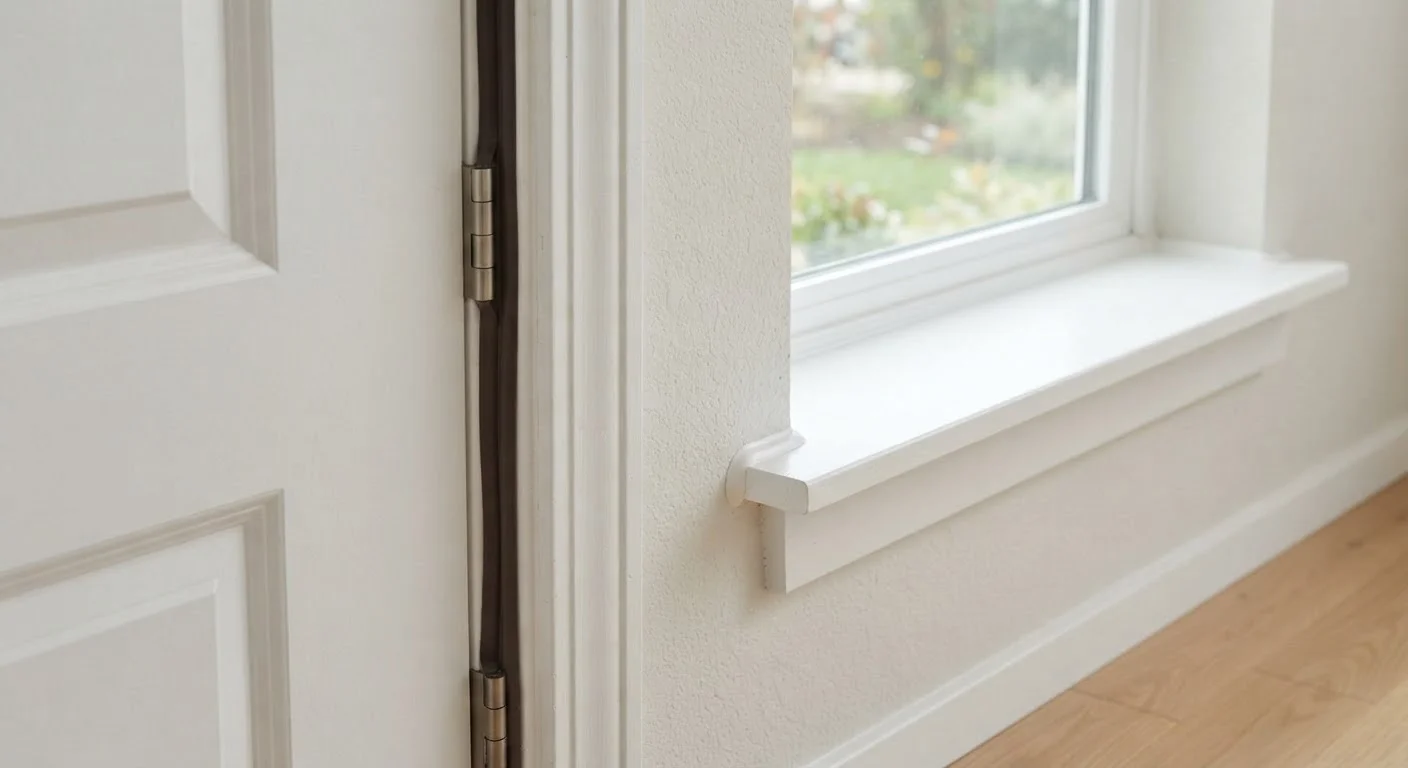
Option A
Caulk
The permanent, rigid seal for stationary gaps.
Best for: Sealing fixed, non-moving gaps around window frames, door casings, baseboards, and exterior penetrations.
Option B
Weatherstripping
The flexible, compressible seal for moving parts.
Best for: Sealing the edges of operable doors and windows that open, close, and flex with use.
Why Getting This Wrong Costs You Money
A small draft might feel like a minor annoyance, but air leakage around doors and windows is one of the leading causes of wasted energy in American homes. According to the U.S. Department of Energy, drafts and gaps can account for 25–30% of heating and cooling energy loss in a typical home. The fix is usually cheap — but only when you reach for the right material.
Caulk and weatherstripping are often sold side by side and both promise to stop drafts, which leads many new homeowners and renters to treat them as interchangeable. They aren't. Using caulk where weatherstripping belongs — or vice versa — means the seal will fail quickly, sometimes within weeks. Understanding the core difference is the first skill in a broader seasonal maintenance routine that protects your home year-round.
25–30%
Home energy lost to air leaks
The U.S. Department of Energy estimates that drafts and unsealed gaps account for roughly a quarter to a third of a home's heating and cooling energy loss.
$5–$20
Typical cost of a door weatherstrip kit
Basic weatherstripping materials for a standard exterior door are widely available at hardware stores, making this one of the most cost-effective home improvements by energy savings per dollar spent.
The Core Rule: Moving vs. Stationary
Every draft-sealing decision starts with one question: Does this surface move?
- If the surface is stationary — a window frame, door casing, the joint where trim meets wall, or an exterior gap around a pipe — use caulk. Caulk bonds to both sides of a fixed gap and cures into a durable, airtight seal. It cannot flex repeatedly without cracking.
- If the surface moves — the edges of a door or operable window that open and close daily — use weatherstripping. Weatherstripping is compressible; it forms a seal when compressed by a closing door or sash and releases cleanly when the door opens again.
A common mistake: applying caulk along the side jamb of a door to stop a draft. The door's repeated movement will break that bond within days. The right call is foam, felt, or vinyl weatherstripping installed in the jamb's door stop.
| Criterion | Caulk | Weatherstripping |
|---|---|---|
| Best application | Fixed, stationary gaps and joints | Moving edges of doors and windows |
| Typical locations | Window frames, door casings, exterior penetrations | Door jambs, door bottoms, operable window channels |
| Flexibility | Cures rigid; cracks if flexed repeatedly | Compresses and recovers with each use |
| Common materials | Acrylic latex, silicone | Foam tape, V-strip, door sweep |
| Typical lifespan | 5–10+ years when correctly applied | 1–5 years depending on type and use |
| DIY difficulty | Low — gun and steady hand needed | Low — scissors, adhesive, or screws |
| Paintable | Yes (acrylic latex); no (silicone) | Generally no |
Choosing the Right Type Within Each Category
Caulk options: Acrylic latex caulk is easy to apply, paintable, and cleans up with water — ideal for interior trim and window frames. Silicone caulk is more flexible and water-resistant, making it the better choice for exterior applications or areas near moisture. For bathroom or kitchen joints, look for formulas labeled mildew-resistant. (For a deeper dive on bathroom-specific choices, see when to use grout, caulk, or sealant.)
Weatherstripping options: Foam tape is the easiest to install and works for light-use windows and secondary doors. V-strip (tension seal) installs inside the door channel and holds up better to heavy daily use. Door sweeps attach to the bottom of a door and seal the gap at the threshold — one of the highest-impact, lowest-cost upgrades on an exterior door.
Durability varies significantly. Foam tape may need replacement annually in high-use doors, while metal or reinforced vinyl weatherstripping can last several years. Factor in how often the door or window is used when choosing your material.
How to Find the Gaps Worth Sealing
Before buying anything, take stock of where air is actually escaping. On a cold or windy day, run your hand slowly along the perimeter of exterior doors and windows. You can also hold a lit incense stick near suspected gaps — moving smoke reveals air movement more clearly than touch alone.
Key spots to check:
- Door jambs and door stops — feel for cold air with the door closed; this calls for weatherstripping.
- Window frame-to-wall joints — visible cracks or gaps in caulk; re-caulk these when the old bead is cracked or has pulled away.
- Exterior penetrations — where pipes, wires, or vents enter the house; these almost always need caulk.
- The door bottom — visible light under a closed door means you need a door sweep or threshold seal.
Untreated gaps don't only waste energy — they invite moisture. If you're unsure how water intrusion can escalate, small water leaks can become serious structural problems faster than most homeowners expect.
Renters: Check Before You Caulk
Most weatherstripping and caulk applications are considered minor maintenance and are generally renter-safe, but policies vary by landlord and lease. Some leases require written permission for any modifications, even small ones. Before starting, notify your landlord or property manager — especially for exterior-facing work. If sealing drafts is urgent and your landlord is unresponsive, document the issue in writing. See our guide on when to DIY vs. call a professional for guidance on where renter repairs typically end.
The content provided on our blog site traverses numerous categories, offering readers valuable and practical information. Readers can use the editorial team’s research and data to gain more insights into their topics of interest. However, they are requested not to treat the articles as conclusive. The website team cannot be held responsible for differences in data or inaccuracies found across other platforms. Please also note that the site might also miss out on various schemes and offers available that the readers may find more beneficial than the ones we cover.