

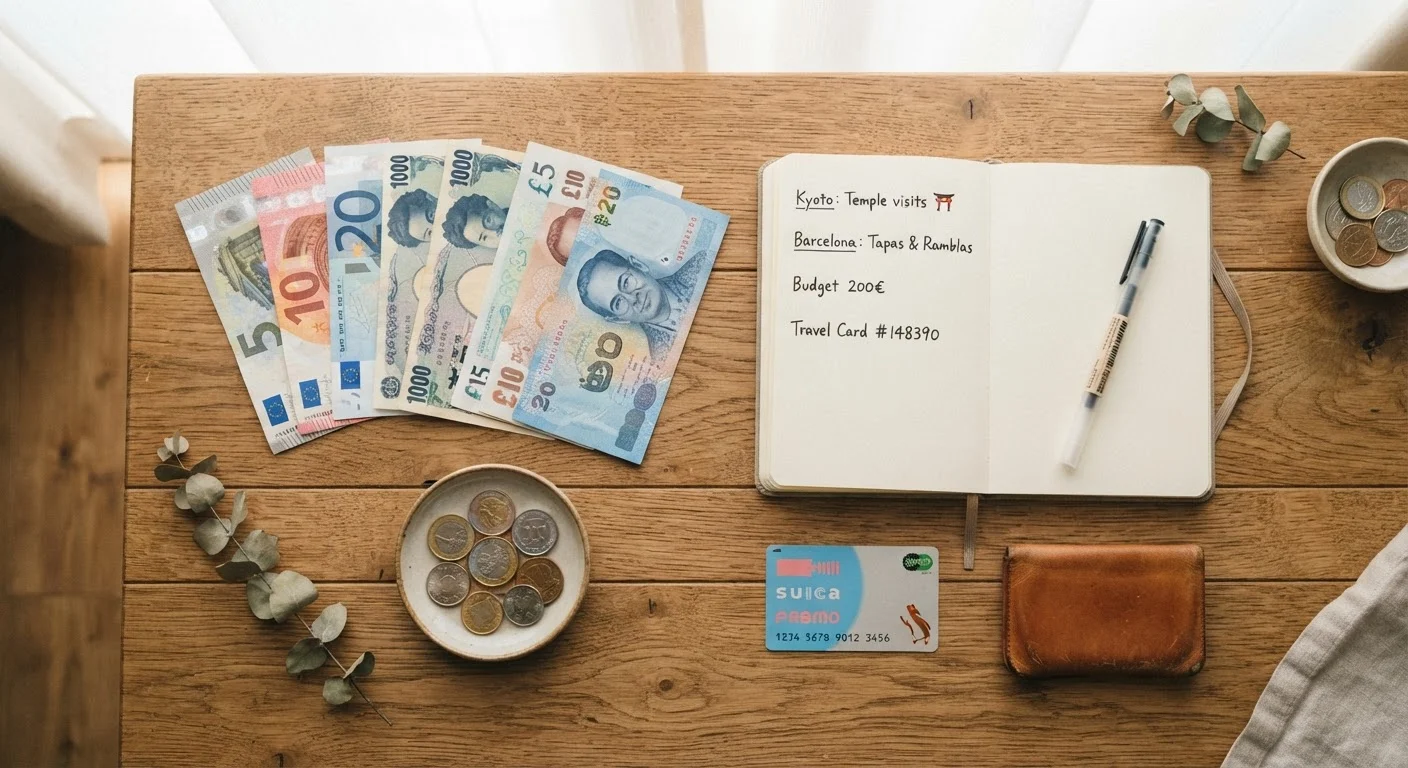
Why Currency Basics Matter Before You Land
Most travel budget leaks aren't from splurging on restaurants or souvenirs — they come from quietly losing money at every currency touchpoint: the airport kiosk, the hotel front desk, the ATM that charges double. Once you understand the mechanics, you can sidestep most of those losses without changing your itinerary at all.
Before your next departure, check our first-timer planning checklist — currency exchange sits near the top of overlooked details. This reference guide picks up from there and goes deeper into how payments actually work abroad.
| Typical foreign transaction fee | 1%–3% per transaction (Varies by card issuer; many travel cards charge 0%) |
| Common ATM operator surcharge abroad | $2–$5 per withdrawal (Varies widely by country and ATM network) |
| DCC markup over interbank rate | 3%–10% typical (Range cited by consumer finance researchers; varies by operator) |
| Countries still heavily cash-dependent | Many in Southeast Asia, parts of Africa & Latin America (General regional pattern; verify for specific destinations) |
| Recommended backup card storage | Separate from primary wallet (Standard travel security guidance) |
The Core Terms You Need to Know
A lot of confusion at the exchange counter comes down to vocabulary. Knowing the difference between the interbank rate and a retail rate, or understanding what dynamic currency conversion actually does to your bill, puts you in a much stronger position. Use this glossary as a quick lookup before or during your trip.
Interbank Rate
The exchange rate that banks use when trading currency with each other — essentially the wholesale price of a currency. Consumers rarely receive this exact rate, but it's the benchmark to compare against any rate you're offered.
Foreign Transaction Fee
A surcharge — typically 1–3% of the transaction amount — added by your card issuer when you make a purchase in a foreign currency or with a foreign bank. Many travel-oriented cards waive this fee entirely.
Dynamic Currency Conversion (DCC)
A service offered at ATMs and point-of-sale terminals that lets you pay in your home currency instead of the local one. It sounds convenient, but the exchange rate used is typically set by the merchant or ATM operator and is nearly always worse than your card's rate.
Spread
The difference between the rate at which a currency exchanger buys and sells a currency. A wide spread means the exchanger is taking a larger cut — common at airport kiosks and tourist-area exchange counters.
ATM Surcharge
A fee charged by the ATM operator (not your own bank) for using their machine. This is separate from any fee your home bank charges, meaning you can face two fees on a single withdrawal.
Currency Peg
When a country fixes its currency's value to another currency (often the U.S. dollar or euro), the exchange rate stays stable rather than fluctuating with market forces. Useful context when budgeting for certain destinations.
These aren't abstract concepts — each one represents a real decision point where money either stays in your pocket or flows out of it. Pair this vocabulary with the hidden cost breakdown for the full picture.
ATMs, Cards, and Cash: What Actually Costs What
There is no single universally cheapest payment method — the right choice depends on the country, the vendor, and your card's fee structure. Here's how the main options compare:
- ATMs abroad: Generally offer rates close to the interbank rate, but fees stack up. Your home bank may charge a flat foreign transaction fee, and the local ATM operator often adds its own surcharge. Always choose to be billed in the local currency, not your home currency, to avoid dynamic currency conversion markups.
- Credit cards: Cards with no foreign transaction fees pass the interbank rate directly to you, making them highly efficient for larger purchases. Always decline the merchant's offer to convert to your home currency at the point of sale.
- Debit cards: Similar to ATM rules — useful for cash withdrawals but watch for per-transaction fees that eat into small withdrawals disproportionately.
- Airport and hotel exchange counters: Convenient but consistently the most expensive option. Reserve these only for emergencies or small amounts you need immediately on arrival.
- Cash: Essential in many regions — rural areas, markets, small restaurants, and countries with limited card infrastructure. Arriving with a modest amount of local currency already in hand reduces pressure to accept bad rates on day one.
3%–10%
Typical DCC markup above interbank rate
Dynamic currency conversion markups vary by operator but consistently exceed standard card conversion rates, according to consumer finance analyses.
2–3×
Fee cost of multiple small ATM withdrawals vs. one larger one
When a bank charges a flat fee per withdrawal, making several small withdrawals multiplies total fees relative to a single equivalent withdrawal.
For a broader look at managing money on extended travel, see our long-term budget travel funding guide.
Smart Habits That Protect Your Travel Budget
The mechanics above translate into a handful of repeatable habits that experienced budget travelers use on every trip:
- Notify your bank before departure. Unexpected foreign charges can trigger fraud blocks that freeze your card at the worst possible moment.
- Withdraw larger amounts less frequently. If your bank charges a flat ATM fee, one bigger withdrawal costs less in total fees than three small ones.
- Always pay in local currency. Whether at an ATM or a card terminal, selecting your home currency activates dynamic currency conversion — almost always at a worse rate.
- Carry a backup card. Keep it separately from your primary wallet. Card skimming and theft happen; having a second option can rescue an entire trip.
- Track exchange rates before you go. Knowing the rough interbank rate for your destination helps you quickly spot whether a quoted rate is reasonable or exploitative.
These habits work alongside smart spending in other categories — like food. Eating at local markets rather than tourist restaurants pairs naturally with paying cash in local currency. Our guide on eating well abroad without overspending covers exactly how to do that.
Prepaid Travel Cards: Worth It?
Prepaid travel cards let you load foreign currency before departure, locking in a rate and giving you a dedicated travel wallet. They can reduce impulse overspending and protect your main bank account from skimming. However, fees for loading, reloading, and inactivity vary considerably by product — read the full fee schedule before committing. They're one tool among several, not a guaranteed money-saver.
This article is for general informational purposes only and does not constitute financial or legal advice. Fees, rates, and card policies vary by institution and destination. Always verify terms with your bank and check current travel advisories with official government sources before traveling.
The content provided on our blog site traverses numerous categories, offering readers valuable and practical information. Readers can use the editorial team’s research and data to gain more insights into their topics of interest. However, they are requested not to treat the articles as conclusive. The website team cannot be held responsible for differences in data or inaccuracies found across other platforms. Please also note that the site might also miss out on various schemes and offers available that the readers may find more beneficial than the ones we cover.