

Why Pet Food Labels Are So Confusing
If you've ever turned a bag of dog or cat food over and felt more confused after reading the label than before, you're not alone. Pet food labels are regulated — but the terminology is technical, the marketing language is often vague, and the ingredient list can feel like a foreign language.
The good news: once you understand the basic rules, a label starts to tell a clearer story. This guide breaks down what's required on a label, what common terms actually mean legally, and how to separate useful information from marketing noise. For a useful parallel, see how reading human nutrition labels works — many of the same principles apply.
| Ingredient list order | Listed by pre-cooking weight, heaviest first (AAFCO Model Regulations) |
| "With [ingredient]" minimum | At least 3% of that ingredient required (AAFCO naming rules) |
| "Entrée" or "Formula" minimum | At least 25% of named ingredient required (AAFCO naming rules) |
| Most important label line | Nutritional adequacy statement (AAFCO statement) |
| Regulating bodies | AAFCO model rules + individual state feed control offices |
The Ingredient List: What the Order Tells You
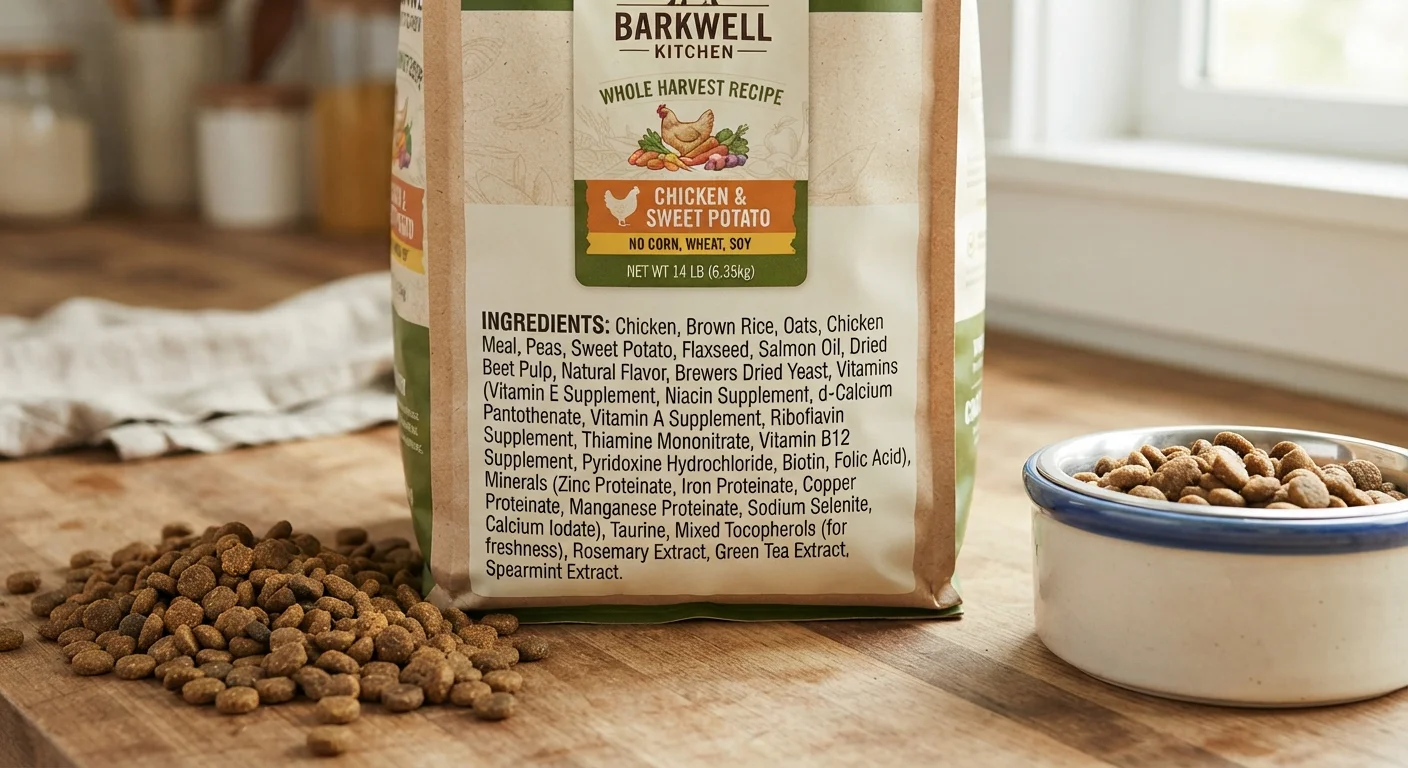
Pet food ingredients are listed by weight before processing — this is called pre-cooking weight. That means a fresh ingredient like chicken, which contains a lot of water, may rank higher on the list than a dry ingredient like pea flour, even if the dry ingredient contributes more protein after cooking.
This isn't a loophole — it's just how all food labels work. The key is to look at the first five to seven ingredients collectively, since they make up the bulk of the food. A named protein source (like "chicken," "salmon," or "beef") appearing first is generally a positive signal.
Watch out for ingredient splitting: a manufacturer might list "ground corn," "corn gluten meal," and "corn bran" separately. Individually, none ranks at the top — but combined, corn could be the primary ingredient. This is a legal practice, not fraud, but it's worth knowing about.
AAFCO
The Association of American Feed Control Officials — a voluntary organization that develops model regulations for pet food labeling and nutrient standards adopted by most U.S. states.
Crude Protein
A measure of total nitrogen in food used to estimate protein content. It includes protein from all sources, both digestible and indigestible.
Dry Matter Basis
A method of comparing nutrients across wet and dry foods by removing moisture from the equation, giving a more apples-to-apples comparison of actual nutrient content.
Ingredient Splitting
The practice of listing multiple forms of the same ingredient separately so that each appears lower on the ingredient list than it would if combined.
Nutritional Adequacy Statement
A required label statement confirming that a food meets AAFCO nutrient profiles for a specific life stage, either through formulation or a feeding trial.
By-Products
Secondary products from animal processing — such as organ meats and bone — that are not muscle meat. Named by-products (e.g., "chicken by-products") are considered more transparent than generic ones.
Decoding Common Label Claims
The AAFCO sets model regulations that most U.S. states adopt for pet food labeling. Several terms on labels have specific legal definitions under these guidelines:
- "Complete and balanced": The food meets AAFCO nutrient profiles for the stated life stage (e.g., adult maintenance, growth). This is one of the most meaningful claims on a label.
- "Chicken formula" or "with chicken": The naming rules matter here. A product called "Chicken Entrée" must be at least 25% chicken by weight. A product labeled "with Chicken" only needs 3% chicken. The difference is significant.
- "Natural": Under AAFCO guidelines, this means no artificial flavors, colors, or preservatives — but it says nothing about quality or nutritional value.
- "Grain-free": Replaces grains with other carbohydrate sources like peas or lentils. This is not inherently healthier; consult your veterinarian, especially for dogs, given ongoing research into potential cardiac links.
Understanding these distinctions helps you spend your money more intentionally. For broader context on how your own food guidelines are developed, this overview of dietary guideline frameworks offers a useful reference point.
A Note on "Grain-Free" and Heart Health
The FDA has been investigating a potential link between grain-free diets high in legumes and a form of heart disease called dilated cardiomyopathy (DCM) in dogs. Research is still ongoing and no definitive cause has been established. If you're considering a grain-free diet for your dog, talk with your veterinarian first rather than making the switch based on marketing language alone.
Guaranteed Analysis and Life Stage Statements
The Guaranteed Analysis panel shows minimum percentages of crude protein and crude fat, and maximum percentages of crude fiber and moisture. These are legal minimums and maximums — not exact values — and they're calculated on an "as-fed" basis, which makes comparing wet and dry foods tricky without doing a little math to convert to a dry-matter basis.
The nutritional adequacy statement (sometimes called the AAFCO statement) is arguably the most important line on the label. It tells you whether the food was formulated to meet a nutrient profile or tested through a feeding trial, and which life stage it's designed for — puppy/kitten, adult, senior, or "all life stages." If a bag doesn't have this statement, that's a meaningful red flag.
Pet food costs can add up quickly. If you're weighing your options, this breakdown of real pet ownership costs puts food expenses in broader financial context.
This article is for general informational purposes only and does not constitute veterinary or nutritional advice. Always consult a licensed veterinarian before making significant changes to your pet's diet.
The content provided on our blog site traverses numerous categories, offering readers valuable and practical information. Readers can use the editorial team’s research and data to gain more insights into their topics of interest. However, they are requested not to treat the articles as conclusive. The website team cannot be held responsible for differences in data or inaccuracies found across other platforms. Please also note that the site might also miss out on various schemes and offers available that the readers may find more beneficial than the ones we cover.