

The Test Every Withdrawal Should Pass
Your emergency fund exists for one purpose: to absorb financial shocks that would otherwise destabilize your life. But that boundary erodes quickly when it's unclear what actually qualifies. Before withdrawing from your emergency fund, an expense should meet all three of the following criteria:
- Unexpected. You could not have reasonably predicted or planned for it.
- Necessary. Delaying or skipping it would cause direct financial, health, or safety harm.
- Urgent. It cannot wait until your next paycheck or until you save separately for it.
If an expense fails even one of these tests, it belongs in your budget — not your emergency fund. Understanding what an emergency fund is designed to do makes drawing this line much easier.
| Three-part emergency test | Unexpected + Necessary + Urgent |
| Primary purpose of an emergency fund | Cover essential costs during sudden financial shocks |
| Common legitimate emergencies | Job loss, urgent medical bills, essential car or home repair |
| Common non-emergencies | Planned travel, sale purchases, predictable annual bills |
| Right tool for predictable future costs | Sinking fund, not an emergency fund |
What Counts as a Real Financial Emergency
The following situations generally meet the three-part test above. They are legitimate reasons to access your emergency savings:
Emergency Fund
A dedicated savings reserve set aside to cover unexpected, necessary, and urgent expenses. It is not meant for planned or discretionary purchases.
Sinking Fund
A separate savings account built up gradually over time to pay for a known future expense, such as a vacation, holiday gifts, or car maintenance.
Discretionary Expense
A spending choice that is optional or can be planned for in advance, as opposed to an unexpected necessity. Examples include upgrades, entertainment, and non-urgent shopping.
Income Disruption
A sudden, unplanned reduction or complete stop in earnings — such as job loss or a medical leave — that prevents covering basic living costs from regular income.
- Job loss or sudden income disruption. If your paycheck stops unexpectedly, your emergency fund is designed to cover essential living costs — rent, utilities, groceries, minimum debt payments — while you stabilize.
- Urgent medical or dental expenses. An unplanned ER visit, urgent procedure, or prescription not covered by insurance qualifies. Routine checkups and elective procedures do not.
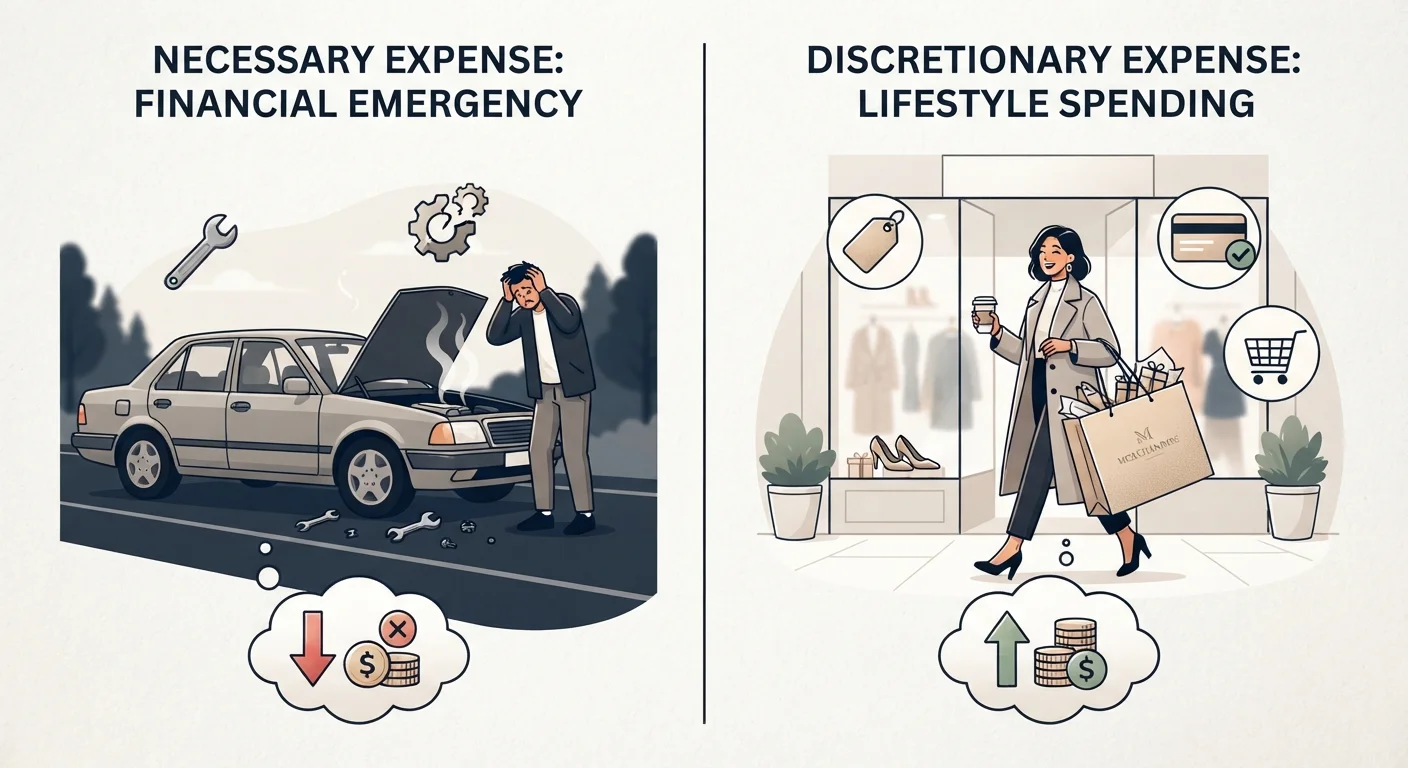
- Essential car repair. If your vehicle is your only way to get to work and the repair cannot wait, that is a legitimate emergency. A preferred upgrade or cosmetic fix is not.
- Critical home repair. A burst pipe, furnace failure in winter, or broken lock directly threatens safety or habitability. A leaky faucet that drips but functions is not urgent.
- Unavoidable family crisis costs. Last-minute travel to care for a critically ill family member, or costs tied to a sudden bereavement, can qualify when they are truly unplanned.
For guidance on sizing your fund to cover these scenarios, see how much should actually be in your emergency fund.
What Doesn't Count — And Where to Plan for It Instead
Many expenses feel urgent in the moment but fail the three-part test on closer inspection. These are not emergencies:
- Predictable annual bills. Car registration, insurance renewals, and subscription renewals come every year. They belong in your monthly budget or a sinking fund.
- Holiday and gift spending. Holidays arrive on the same date every year. A sinking fund — a dedicated savings bucket for a known future expense — is the right tool here.
- Sale or deal pressure. A limited-time offer creates urgency, but it is manufactured urgency, not a genuine emergency.
- Planned travel. Even if the trip is important to you, it is discretionary and predictable. Save for it separately.
- Electronics and appliance upgrades. Replacing a working phone or TV that you simply want to update is not an emergency. A refrigerator that stops working entirely is a different story.
- Credit card debt payments beyond minimums. Accelerated debt payoff is a worthy goal, but using emergency savings to do it leaves you exposed to the next real emergency.
The difference between sinking funds and emergency funds is worth understanding — the right account for a predictable expense is never your emergency fund.
When You're Genuinely Unsure
If an expense feels borderline, ask: "If I didn't have an emergency fund, would I need to take on high-interest debt to cover this today?" If the honest answer is yes and the cost is truly unavoidable, it may qualify. If you could reasonably delay it or save for it over the next few months, it doesn't. Building a sinking fund for recurring irregular expenses is the best long-term fix for the gray areas.
Rebuilding After a Legitimate Withdrawal
Using your emergency fund for the right reason is not a failure — it means the system worked. The next step is replenishment. Treat rebuilding like a bill: set a fixed monthly contribution until the fund is restored. Even small, consistent amounts add up. For a deeper look at where to keep these savings so they stay accessible but separate from your spending, the comparison of high-yield and regular savings accounts is a useful starting point. When you are ready to audit your overall readiness, the emergency fund self-assessment checklist can help you spot gaps and set your next concrete steps.
This article is for general informational and educational purposes only and does not constitute personalized financial advice. Consult a qualified financial professional for guidance specific to your situation.
The content provided on our blog site traverses numerous categories, offering readers valuable and practical information. Readers can use the editorial team’s research and data to gain more insights into their topics of interest. However, they are requested not to treat the articles as conclusive. The website team cannot be held responsible for differences in data or inaccuracies found across other platforms. Please also note that the site might also miss out on various schemes and offers available that the readers may find more beneficial than the ones we cover.