

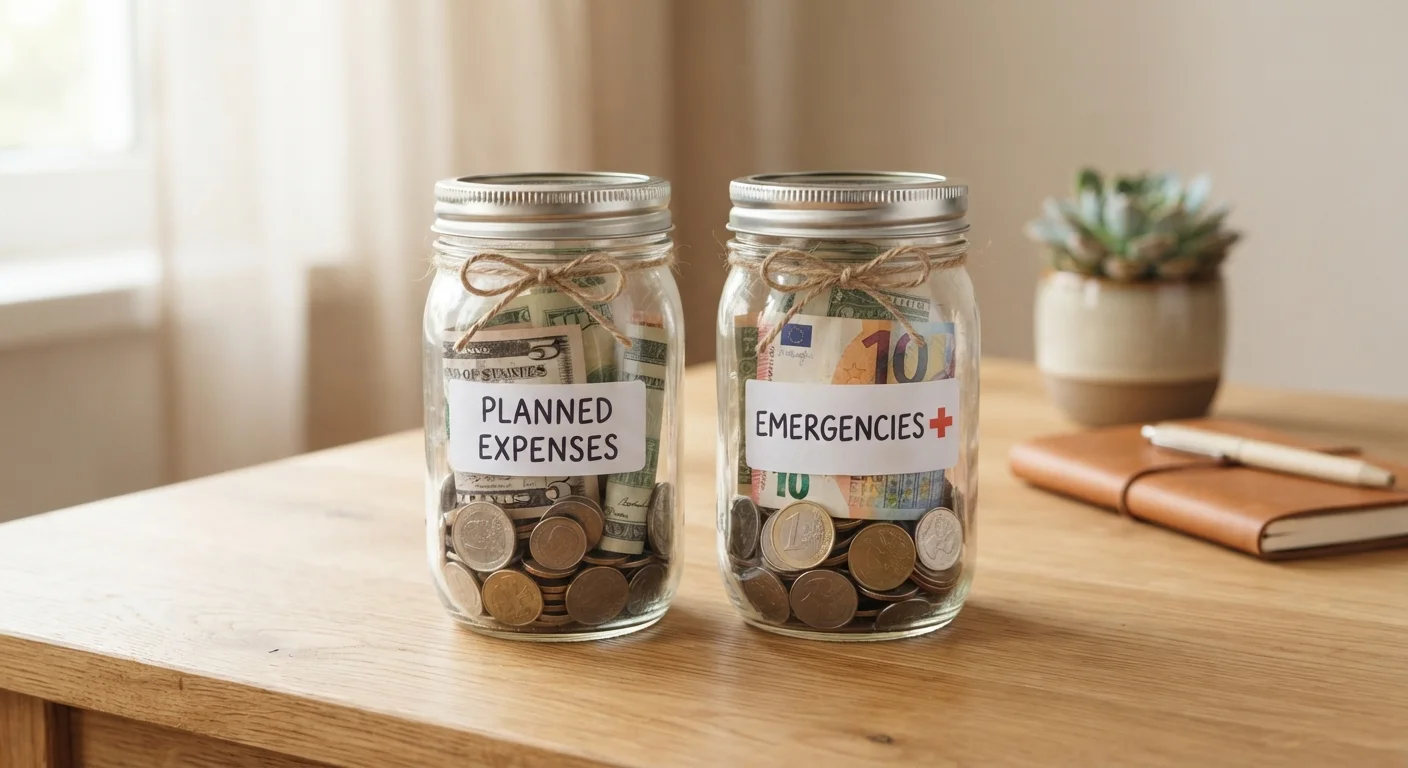
Option A
Sinking Fund
The planned-expense savings tool.
Best for: Anyone saving toward a specific, predictable future cost like a car repair, vacation, or annual insurance premium.
Option B
Emergency Fund
The financial safety net for life's surprises.
Best for: Anyone who needs a dedicated cushion for unexpected, urgent expenses like job loss, medical bills, or urgent home repairs.
The Core Difference: Planned vs. Unplanned
Both sinking funds and emergency funds are savings accounts. Both require consistent contributions. But their jobs are fundamentally different — and mixing them up is one of the most common budgeting mistakes young adults make.
A sinking fund is money you intentionally set aside for a cost you know is coming. The expense isn't a surprise — you just don't have the cash ready yet. Think: holiday gifts, annual car registration, a new laptop, or a security deposit on an apartment. You pick a target amount, divide it by the number of months until you need it, and save that fixed amount each month.
An emergency fund is different in kind, not just degree. It exists for events you cannot predict — sudden job loss, an unexpected medical bill, a car breakdown that strands you. The goal isn't to plan for a specific cost but to maintain a liquid buffer large enough to absorb financial shocks without going into debt. For a deeper look at how emergency funds work as a cornerstone of financial stability, see our emergency fund explainer.
| Criterion | Sinking Fund | Emergency Fund |
|---|---|---|
| Purpose | Save for known future expenses | Cover unexpected financial crises |
| Expense type | Predictable and planned | Unpredictable and urgent |
| Target amount | Specific cost you calculate | 3–6 months of essential expenses |
| Timeline | Has a defined end date | Maintained indefinitely |
| After use | Fund closes or resets | Must be replenished |
| Examples | Vacation, car repair, holiday gifts | Job loss, medical bill, major breakdown |
| Savings account needed | Separate labeled account | Dedicated, accessible account |
How Much to Save in Each
Sizing these two accounts uses completely different logic.
For a sinking fund, the math is straightforward: estimate the cost, set a deadline, and divide. If you need $1,200 for a vacation in 12 months, you save $100 per month. Each sinking fund has a finish line — once you've paid the expense, the fund resets or closes.
For an emergency fund, the standard general guidance is three to six months of essential living expenses — rent, utilities, groceries, minimum debt payments, and transportation. The right amount depends on your income stability, household size, and risk tolerance. A freelancer with variable income may aim for six months; a dual-income household with stable jobs might feel secure with three. There's no single correct answer, but the fund should never have a planned depletion date.
~57%
Americans unable to cover a $1,000 emergency
A Bankrate survey found that a majority of U.S. adults could not pay for a $1,000 unexpected expense from savings alone.
3–6 months
Recommended emergency fund size
Most financial planning guidance suggests covering three to six months of essential living expenses as a general benchmark.
It's also worth noting that an emergency fund is never truly "finished" — it needs to be replenished after each use and periodically reassessed as your expenses grow.
Where to Keep Each Fund
Both funds benefit from being held in separate, dedicated savings accounts — away from your checking account and away from each other. Keeping them separate creates a psychological and practical barrier that makes it harder to dip into funds impulsively.
For your emergency fund, accessibility matters: you want to be able to reach the money within one to three business days in a genuine crisis. A high-yield savings account (HYSA) at an online bank is a common choice, as it tends to earn more interest than a standard savings account while remaining accessible. To understand the trade-offs, our HYSA vs. regular savings account comparison breaks down the differences clearly.
One thing to avoid: storing your emergency fund in your everyday checking account. The funds blend into your spending money and are far more likely to get used for non-emergencies. Our article on keeping emergency funds in a checking account explains why this convenience carries a real cost.
For sinking funds, some people use multiple labeled sub-accounts (many online banks allow this) or a single dedicated savings account with a mental tally. Either approach works — the key is that sinking fund money stays clearly separate from both your emergency fund and your spending money.
Can One Account Do Both Jobs?
Technically, you could keep both funds in the same account — but it's not recommended. Without clear separation, it's easy to lose track of which dollars are reserved for emergencies and which are earmarked for a specific goal. Separate accounts, even if they earn the same interest rate, make your intentions visible and reduce the risk of accidentally spending money you can't afford to lose.
Building Both on a Tight Budget
A common concern: Do I need to fully fund one before starting the other? The practical answer for most people is to prioritize a small emergency fund first — even $500 to $1,000 — before actively building sinking funds. That starter buffer prevents small surprises from becoming debt.
Once you have a basic safety net in place, you can split contributions. If you have $200 a month available for savings, you might put $120 toward your emergency fund and $80 toward one or two sinking funds for near-term expenses. As your emergency fund grows toward your three-to-six-month target, you can gradually shift more toward sinking funds.
If you're also carrying high-interest debt, the allocation becomes more nuanced. Our article on saving vs. paying down debt walks through how to weigh those competing priorities. And for a broader framework on tracking where your money goes each month, the budgeting basics hub offers foundational strategies to get started.
The bottom line: sinking funds and emergency funds are not interchangeable. Using sinking fund money for a true emergency leaves you without a safety net. Treating your emergency fund as a vacation fund drains the buffer you'll desperately need when something goes wrong. Name them clearly, keep them separate, and contribute to both consistently — even in small amounts.
This article is for general informational and educational purposes only and does not constitute personalized financial advice. Consider consulting a qualified financial professional for guidance specific to your situation.
The content provided on our blog site traverses numerous categories, offering readers valuable and practical information. Readers can use the editorial team’s research and data to gain more insights into their topics of interest. However, they are requested not to treat the articles as conclusive. The website team cannot be held responsible for differences in data or inaccuracies found across other platforms. Please also note that the site might also miss out on various schemes and offers available that the readers may find more beneficial than the ones we cover.