

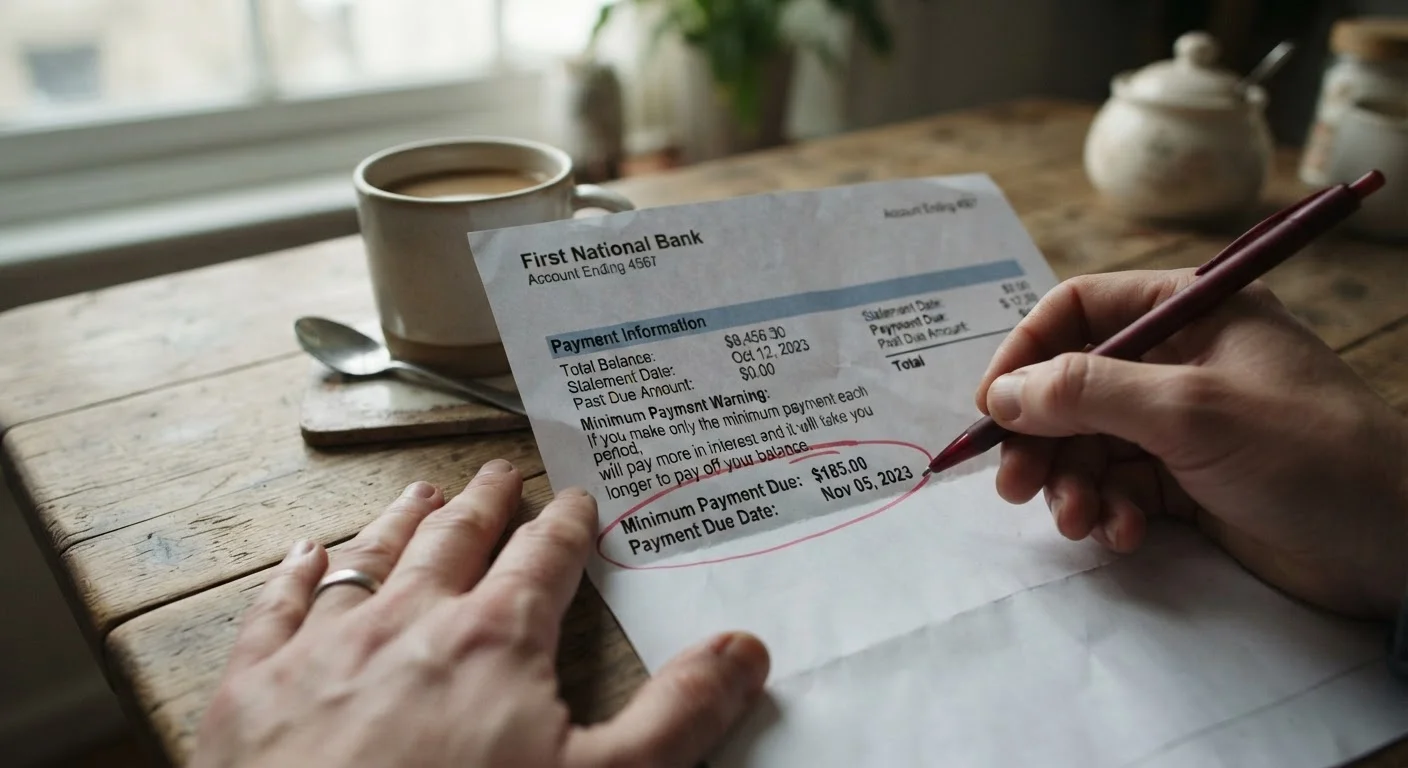
How Minimum Payments Are Calculated — and Why They're So Low
Credit card issuers typically set minimum payments as either a flat dollar amount (often $25–$35) or a small percentage of your outstanding balance — commonly 1–3% — whichever is greater. On a $3,000 balance at 2%, that's just $60 a month.
Those minimums are structured to keep you current on the account, not to get you out of debt quickly. From a lender's perspective, a borrower who carries a balance and pays interest month after month is a profitable customer. That's not a judgment — it's simply how revolving credit is designed to work. Understanding that design is the first step to working around it.
How your balance relates to your credit limit also matters here: carrying a high balance relative to your limit can drag down your credit score even when you're making every minimum payment on time.
Treating the minimum payment as the 'correct' payment amount.
Why it happens: Statements display the minimum prominently, and it's technically enough to keep the account in good standing, so many borrowers treat it as the standard target.
Ignoring the APR when deciding how aggressively to pay down a card.
Why it happens: Borrowers often focus on the monthly payment amount rather than the interest rate, making it easy to underestimate how quickly a high APR inflates the total owed.
Continuing to charge new purchases while trying to pay down a balance.
Why it happens: A card that still has available credit feels like a resource, especially during a tight month. But new charges added to a balance you're trying to reduce can offset months of progress.
Missing a payment entirely because the minimum feels unaffordable.
Why it happens: When money is tight, it can feel like there's no point in paying if you can't pay much. But a missed payment triggers fees and credit score damage that compound the problem.
What Compounding Interest Actually Does to Your Balance
Most credit cards calculate interest daily using your annual percentage rate (APR) divided by 365. That daily rate is applied to your current balance — including any interest that has already accrued. This is compounding, and it works against you when you carry a balance.
22%
Average credit card APR in recent years
Federal Reserve data has tracked average credit card interest rates rising steadily, with rates for accounts assessed interest frequently exceeding 20% APR.
14+ years
Estimated payoff time on minimum payments
On a $3,000 balance at 22% APR, paying only the minimum each month can extend repayment well beyond a decade, based on standard amortization calculations.
Here's a concrete illustration: on a $3,000 balance at 22% APR, paying only the minimum each month could take more than 14 years to pay off and cost over $3,500 in interest alone — more than the original balance. Increasing that payment to $100 per month could cut repayment time to under four years and save thousands in interest. These figures are approximations; your actual results will depend on your card's terms and whether you add new charges.
This dynamic is similar to how unpaid interest grows on student loans. If you're also managing education debt, understanding interest capitalization can sharpen your overall repayment strategy.
Putting It Into Practice: Paying More Without Derailing Your Budget
The good news is that you don't need to pay off your entire balance at once to change your outcome meaningfully. Even an extra $20–$40 per month above your minimum can shorten repayment by months and reduce total interest paid by a noticeable amount.
Every Dollar Above the Minimum Counts
When you pay more than the minimum, the extra amount goes directly toward reducing your principal balance — the actual debt you owe. A smaller principal means less interest is charged the following month, which accelerates your payoff. Even an additional $25 a month makes a measurable difference over the life of the balance.
A useful starting point: identify the card with the highest APR and direct any extra payment dollars there first, while keeping minimums on all other accounts. This approach — sometimes called the avalanche method — minimizes the total interest you pay over time. If you're working with a very tight budget, realistic strategies for staying current without sacrificing essentials can help you find a sustainable path.
One precaution worth noting: if you add new purchases to a card while trying to pay it down, the math resets against you. Where possible, pause new charges on a card you're actively paying off.
This article is for general informational and educational purposes only and does not constitute personalized financial, tax, or legal advice. Consult a qualified financial professional for guidance specific to your situation.
The content provided on our blog site traverses numerous categories, offering readers valuable and practical information. Readers can use the editorial team’s research and data to gain more insights into their topics of interest. However, they are requested not to treat the articles as conclusive. The website team cannot be held responsible for differences in data or inaccuracies found across other platforms. Please also note that the site might also miss out on various schemes and offers available that the readers may find more beneficial than the ones we cover.