

Our Verdict
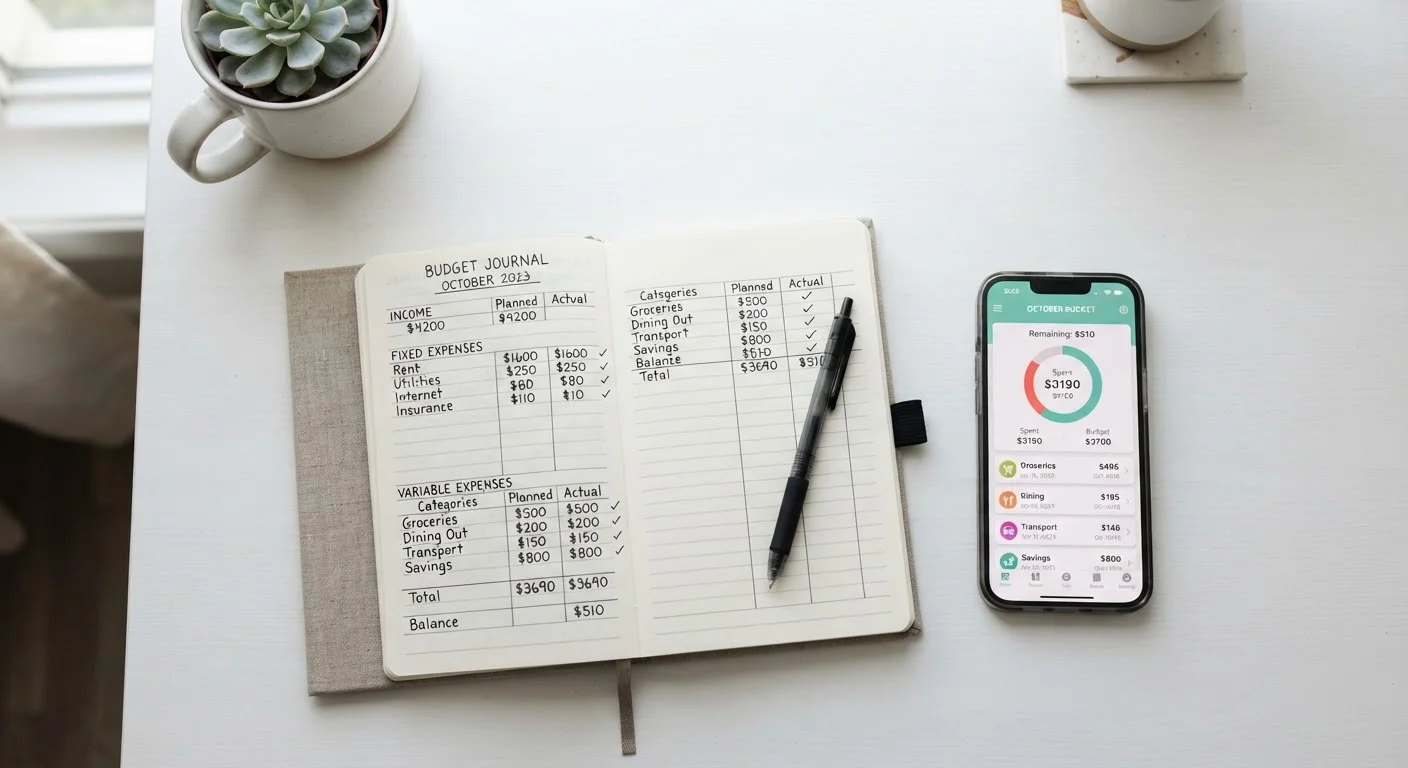
Both methods can work — what separates success from failure is how often you actually engage with your budget. Pen-and-paper tends to suit people who think visually, prefer privacy, or want a tactile habit. Apps suit those who want automation, real-time data, and portability. There is no universally superior option; the right choice is whichever format you will honestly return to each week.
| Best for | Recommended |
|---|---|
| Visual thinkers who want mindful, intentional tracking | Pen-and-paper budgeting |
| People with multiple accounts or irregular income streams | Budgeting apps |
| Anyone who has abandoned both methods before | Hybrid approach (paper planning + app tracking) |
| Those with privacy concerns about linking bank accounts | Pen-and-paper budgeting |
Why the Tool Matters Less Than the Habit
The personal finance world is full of app recommendations, productivity notebooks, and color-coded spreadsheets. But research on behavior change consistently points to one factor that outweighs all of them: whether you actually use the system you chose. A beautifully designed app that sits unopened on your phone accomplishes nothing. Neither does a journal you filled in for three days in January.
Before comparing features, it helps to be honest about your own patterns. Do you enjoy writing things down? Do you forget to check apps unless you get a notification? Are you motivated by seeing numbers change in real time, or does staring at a screen make you tune out? Your answers matter more than any list of pros and cons. If you've never built a budget before, the step-by-step walkthrough for first-time budgeters is a good place to start before deciding on a format.
The Real Case for Pen and Paper
Manual budgeting has one underrated advantage: the act of writing something down forces you to process it. Studies on note-taking suggest that handwriting engages deeper cognitive encoding than typing, which may translate to stronger awareness of where your money is going. When you write "$47 — dinner out" by hand, you feel it differently than when an app auto-categorizes a charge.
Pen-and-paper budgeting also has zero learning curve, no subscription fee, no risk of a data breach, and no temptation to spend money on premium app features. It works on a plane, in a power outage, and when your phone dies.
Try a Two-Week Pilot First
Before committing to any system, run a two-week trial with genuine daily use. Note whether you're actually opening it, whether it's changing any spending decisions, and whether it feels like a chore or a habit. Two weeks is enough time to see whether a format fits your life without a long-term investment.
The main friction points are real, though. You have to do all the math yourself, you can't pull historical reports, and if your income comes from multiple sources or you have many spending categories, it becomes tedious to keep current. It also doesn't send you an alert when you're about to overspend on groceries.
For an analog method that still works in a world where most purchases are digital, see how the envelope budgeting method adapts to cashless spending.
What Budgeting Apps Actually Do Well
The strongest argument for budgeting apps is automation. Once you link your accounts, many apps pull in transactions automatically, categorize them, and show your spending versus your plan in real time. For someone juggling a checking account, a credit card, and a side-hustle income stream, that aggregation alone saves significant time.
| Pen and Paper | Budgeting Apps | |
|---|---|---|
| Setup effort | Low — grab a notebook and start | Medium — account linking, configuration |
| Cost | Minimal (notebook and pen) | Free to $15+/month depending on tier |
| Automation | None — fully manual | High — auto-import and categorization |
| Privacy | Complete — no data shared | Varies — bank credentials often required |
| Real-time visibility | Only when you update it | Near-instant with synced accounts |
| Historical reporting | Manual — requires your own records | Built-in charts and trend data |
| Engagement depth | High — active, intentional process | Lower — easy to skim passively |
| Best for | Visual, tactile, privacy-conscious users | Multi-account, tech-comfortable users |
Apps are also portable. You can check your budget in line at the grocery store before deciding whether to grab an extra item. That real-time access can close the gap between budgeting and actual spending decisions — which is where many budgets fall apart.
The downsides are worth naming honestly. Some apps require linking bank credentials, which raises legitimate privacy concerns. Free tiers often have limited features, and paid tiers add a recurring cost to your budget. Perhaps most importantly, automation can create a passive relationship with your finances — you glance at a dashboard but never deeply engage with the numbers.
Whatever tool you use, a structured monthly setup process helps. The monthly budget setup checklist covers income, fixed costs, variable spending, and irregular expenses in one place.
Choosing the Format That Sticks
Rather than treating this as an either/or decision, consider what has tripped you up before. If you've started apps and stopped checking them, the problem might not be the app — it might be that you haven't built a weekly budget review habit yet. If you've kept a paper budget but found it too time-consuming when life got busy, adding one automated tool for transaction tracking might help without forcing you to abandon what works.
A hybrid approach many people find effective: use paper or a simple notebook for monthly planning (setting category limits, writing out your financial goals) and use an app or a basic spreadsheet to log transactions through the month. This combines the mindful engagement of writing with the convenience of digital records.
~1 in 3
Americans who follow a written budget
Surveys by Gallup and similar organizations consistently find that a minority of US adults maintain a formal budget, regardless of income level.
70%+
Mobile banking users in the US
The Federal Reserve's consumer finance reports show the majority of US adults now use some form of mobile banking, reflecting the infrastructure for app-based budgeting.
Whichever method you choose, the mechanics matter less than the ritual. Setting a specific time each week — even 10 minutes on Sunday evening — to review what you've spent does more for long-term financial health than any app feature. For a broader framework on building a budget that reflects your actual life, see this end-to-end budgeting guide.
This article is for general informational and educational purposes only and does not constitute personalized financial advice. Consider consulting a licensed financial professional for guidance specific to your situation.
The content provided on our blog site traverses numerous categories, offering readers valuable and practical information. Readers can use the editorial team’s research and data to gain more insights into their topics of interest. However, they are requested not to treat the articles as conclusive. The website team cannot be held responsible for differences in data or inaccuracies found across other platforms. Please also note that the site might also miss out on various schemes and offers available that the readers may find more beneficial than the ones we cover.