

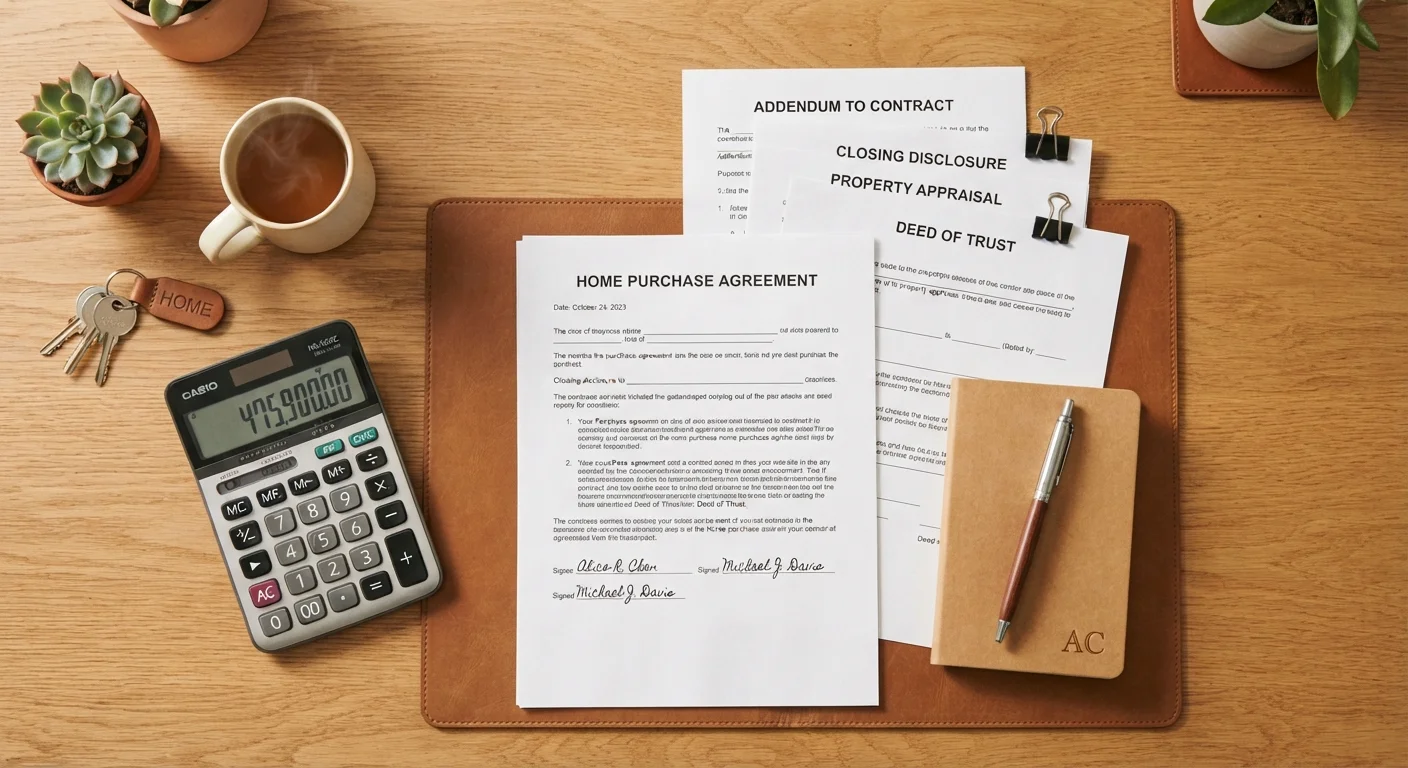
The Hidden Price Tag at the Finish Line
You've saved for a down payment, gotten pre-approved, and found the right home. Then your lender hands you a Loan Estimate and the total due at closing is thousands more than you expected. For many first-time buyers, closing costs are the biggest financial surprise of the entire homebuying process.
Closing costs are the fees and prepaid expenses required to finalize a mortgage and transfer ownership of a property. According to general industry guidance, buyers typically pay between 2% and 5% of the loan amount in closing costs — on a $350,000 home with a small down payment, that could mean $7,000 to $17,500 due at signing, separate from your down payment.
Understanding exactly what each charge is for — and who can be held accountable for it — puts you in a much stronger position. This breakdown covers the most common line items you'll see on your Closing Disclosure.
Loan Origination Fee
This fee is charged by your lender for processing and underwriting your mortgage application. It typically amounts to 0.5% to 1% of the loan amount, though it varies by lender. It may appear as a single line item or broken into sub-charges like an underwriting fee or application fee.
This is one of the few closing costs where negotiation is genuinely possible. When comparing lenders, look at the origination fee alongside the interest rate — a lower rate paired with a high origination fee may not save you money over time.
Loan origination fees are one of the few closing costs where direct negotiation with lenders is genuinely possible.
Discount Points
Discount points are optional prepaid interest you pay upfront to lower your mortgage interest rate. One point equals 1% of the loan amount and typically reduces your rate by a fraction of a percentage point — though the exact reduction varies by lender and market conditions.
Whether buying points makes sense depends on how long you plan to stay in the home and how quickly the monthly savings offset the upfront cost. This requires a break-even calculation specific to your numbers — a lender or financial adviser can help you work through it.
Whether discount points are worth buying depends entirely on your break-even timeline and how long you plan to stay.
Title Search and Title Insurance
A title search is a review of public records to confirm the seller has the legal right to sell the property and that there are no outstanding liens, judgments, or ownership disputes. Title insurance then protects against claims that weren't discovered during the search.
There are two separate policies: one that protects the lender (almost always required) and an optional owner's policy that protects you. In some states, it's customary for the seller to pay for the owner's policy — this is worth clarifying in your purchase agreement. Buyers can often shop for their own title company, which may result in lower fees.
Buyers can often shop for their own title company — this is one of the most overlooked opportunities to reduce closing costs.
Appraisal Fee
Before approving your loan, your lender will order a professional appraisal to confirm that the home's value supports the purchase price. Appraisal fees typically range from $300 to $700 for a standard single-family home, though the cost can be higher for larger properties or complex markets.
The appraisal protects the lender — and indirectly you — from overpaying relative to market value. If the appraisal comes in below the agreed purchase price, you may need to renegotiate with the seller or cover the gap out of pocket. See our piece on why first-time buyers overpay for more on navigating valuation gaps.
If the appraisal comes in below the purchase price, you may need to renegotiate or cover the gap yourself.
Prepaid Interest, Taxes, and Insurance
These aren't fees in the traditional sense — they're upfront prepayments for ongoing expenses. At closing, you'll typically prepay mortgage interest for the remaining days in the month, as well as several months of homeowners insurance premiums and property taxes into an escrow account.
Escrow accounts are managed by your lender or loan servicer and used to pay your property taxes and insurance when they come due. The exact amount depends on your closing date, local tax rates, and your insurance premium. These prepaid items are disclosed on your Loan Estimate and Closing Disclosure.
Prepaid costs at closing are ongoing expenses paid upfront — not extra fees, but real money you'll need to have ready.
Government Recording and Transfer Fees
Local and state governments charge fees to officially record the change in property ownership and the new mortgage lien in public records. Transfer taxes — sometimes called deed taxes or stamp taxes — are calculated as a percentage of the sale price and vary significantly by state and county.
These fees are largely non-negotiable because they're set by government entities. In some markets, it's customary for the seller to pay transfer taxes; in others, the buyer pays. Your real estate agent or attorney can clarify local customs before you finalize your offer.
Government recording and transfer fees are set by local and state law — they're non-negotiable, but knowing who pays is negotiable.
How to Reduce What You Owe at Closing
Not every closing cost is set in stone. Some fees are regulated or government-set and cannot be changed. Others — particularly lender origination fees and title services — can be negotiated or shopped for competing quotes. Under federal rules, lenders must allow you to use your own title company for certain services listed on the Loan Estimate.
Compare Your Loan Estimate to Your Closing Disclosure
Federal law requires lenders to provide a Loan Estimate within three business days of receiving your application, and a Closing Disclosure at least three business days before closing. Lay both documents side by side. Some fees cannot change at all; others can increase by up to 10%. If something looks different, ask your lender to explain it in writing before you sign.
One of the most common strategies is asking the seller to contribute to closing costs as part of your purchase offer. Known as a seller concession, this approach shifts some of the upfront burden without changing your loan amount — though lenders set limits on how much a seller can contribute based on loan type and down payment size.
First-time buyers may also qualify for state or local assistance programs that offset closing costs. Contact your state's housing finance agency to learn what programs are available in your area.
For a fuller picture of what homeownership costs beyond closing day, see our guide on the true financial picture of owning vs. renting. And if you're still mapping out the broader process, our homebuying process walkthrough covers every stage from saving to signing.
This article is for general informational and educational purposes only and does not constitute financial, legal, or real estate advice. Closing costs vary by lender, location, and loan type. Consult a licensed real estate professional, attorney, or financial adviser for guidance specific to your situation.
The content provided on our blog site traverses numerous categories, offering readers valuable and practical information. Readers can use the editorial team’s research and data to gain more insights into their topics of interest. However, they are requested not to treat the articles as conclusive. The website team cannot be held responsible for differences in data or inaccuracies found across other platforms. Please also note that the site might also miss out on various schemes and offers available that the readers may find more beneficial than the ones we cover.