
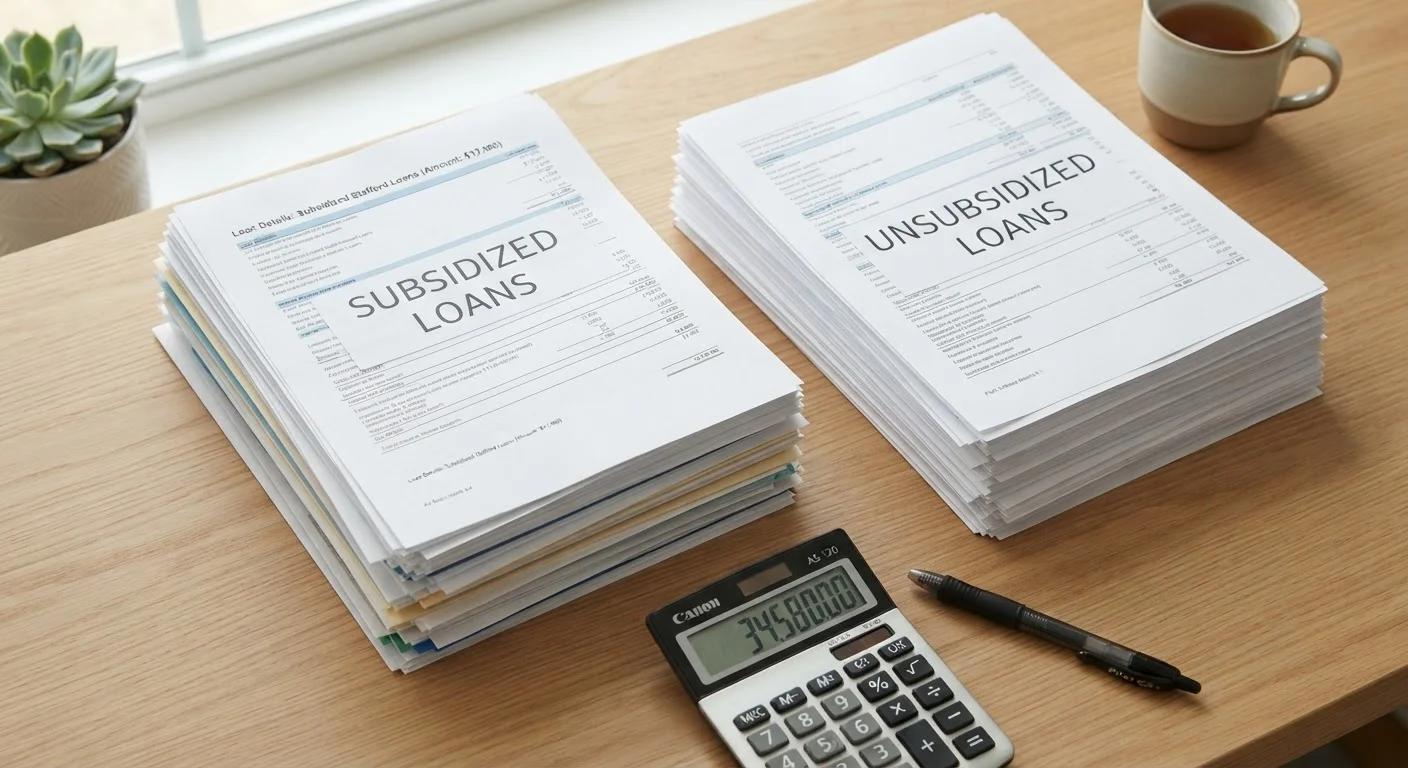
Option A
Subsidized Federal Loans
The need-based option with built-in interest protection.
Best for: Undergraduate students who demonstrate financial need and want to minimize interest accrual while still in school.
Option B
Unsubsidized Federal Loans
The widely available option with fewer restrictions but more interest risk.
Best for: Undergraduate and graduate students at any income level who need additional funding beyond subsidized loan limits.
What Sets These Two Loan Types Apart
Both subsidized and unsubsidized federal student loans come from the U.S. Department of Education under the Direct Loan program. They share the same fixed interest rates for a given academic year, the same six-month grace period after leaving school, and access to the same federal repayment plans. But one critical difference separates them: who pays the interest while you are in school.
With a subsidized loan, the federal government covers interest that accrues during enrollment (at least half-time), during the grace period, and during approved deferment periods. Your balance when you enter repayment is the same amount you originally borrowed — assuming you don't defer after your grace period ends.
With an unsubsidized loan, interest starts accruing from the moment funds are disbursed. If you don't pay that interest while in school, it capitalizes — meaning it gets added to your principal — when repayment begins. On a $10,000 unsubsidized loan at a 6.5% rate over four years, that can add several hundred to over a thousand dollars to what you owe before you make a single payment. For a deeper explanation of how this math plays out, see how interest grows differently between these two loan types.
| Criterion | Subsidized Loans | Unsubsidized Loans |
|---|---|---|
| Financial need required? | Yes | No |
| Available to graduate students? | No | Yes |
| Interest during enrollment | Government pays it | Borrower accrues it |
| Interest during grace period | Government pays it | Borrower accrues it |
| Interest capitalization risk | None during school | Yes, at repayment start |
| Federal repayment plans | All plans available | All plans available |
| Interest rate (same year) | Same as unsubsidized | Same as subsidized |
| Grace period length | 6 months | 6 months |
Eligibility and Borrowing Limits
Subsidized loans are restricted to undergraduate students who demonstrate financial need as calculated through the FAFSA (Free Application for Federal Student Aid). Your school's financial aid office determines your eligibility based on your Expected Family Contribution and the cost of attendance. Graduate students are not eligible, regardless of income.
Unsubsidized loans have no financial need requirement and are open to undergraduates, graduate students, and professional students. Almost anyone enrolled at least half-time at an eligible institution can receive them.
Annual borrowing limits depend on your year in school and dependency status. As a general guide, dependent undergraduates can borrow up to $5,500 in their first year total in Direct Loans, with a cap on how much of that can be subsidized. Independent undergraduates and graduate students have higher ceilings, but graduate students can only access unsubsidized funds. Unfamiliar with terms like capitalization or grace period? The student loan terminology guide explains the key concepts in plain language.
$29,400
Average federal loan debt at graduation
According to the College Board's Trends in Student Aid report, the average cumulative federal loan debt for bachelor's degree recipients is approximately $29,400.
~43%
Undergrads receiving subsidized loans
Federal Student Aid data indicates that roughly 43% of undergraduate Direct Loan borrowers receive at least some subsidized funding in a given year.
6 months
Grace period after leaving school
Both subsidized and unsubsidized Direct Loans provide a six-month grace period before the first payment is due, per U.S. Department of Education policy.
Making the Most of What You Borrow
If your financial aid package includes both loan types, a straightforward strategy is to exhaust your subsidized loan eligibility first. Since those dollars won't grow while you're in school, they are effectively less expensive over time — even though the interest rate is identical.
For unsubsidized loans, consider paying the interest as it accrues during school if your budget allows. Even modest monthly payments — sometimes as little as $25 to $50 — can prevent hundreds or thousands of dollars in capitalized interest from inflating your post-graduation balance.
Remember that both loan types are federal, which means they come with income-driven repayment options, deferment protections, and potential eligibility for forgiveness programs that private loans don't offer. Before you consider any private borrowing, review what actually changes after you sign a federal vs. private loan — the differences in protections are significant.
Check Your Aid Offer Carefully
Federal aid packages sometimes list loan types without clearly labeling which are subsidized and which are unsubsidized. Look for the word 'subsidized' explicitly next to each loan in your award letter or on studentaid.gov. Accepting an unsubsidized loan when you assumed it was subsidized is a common and costly mix-up. If anything is unclear, your school's financial aid office is required to explain your package in detail.
This article provides general educational information about federal student loan types and is not personalized financial advice. Loan limits, interest rates, and eligibility rules are set by federal law and may change. Consult your school's financial aid office or a qualified financial adviser for guidance specific to your situation.
The content provided on our blog site traverses numerous categories, offering readers valuable and practical information. Readers can use the editorial team’s research and data to gain more insights into their topics of interest. However, they are requested not to treat the articles as conclusive. The website team cannot be held responsible for differences in data or inaccuracies found across other platforms. Please also note that the site might also miss out on various schemes and offers available that the readers may find more beneficial than the ones we cover.