

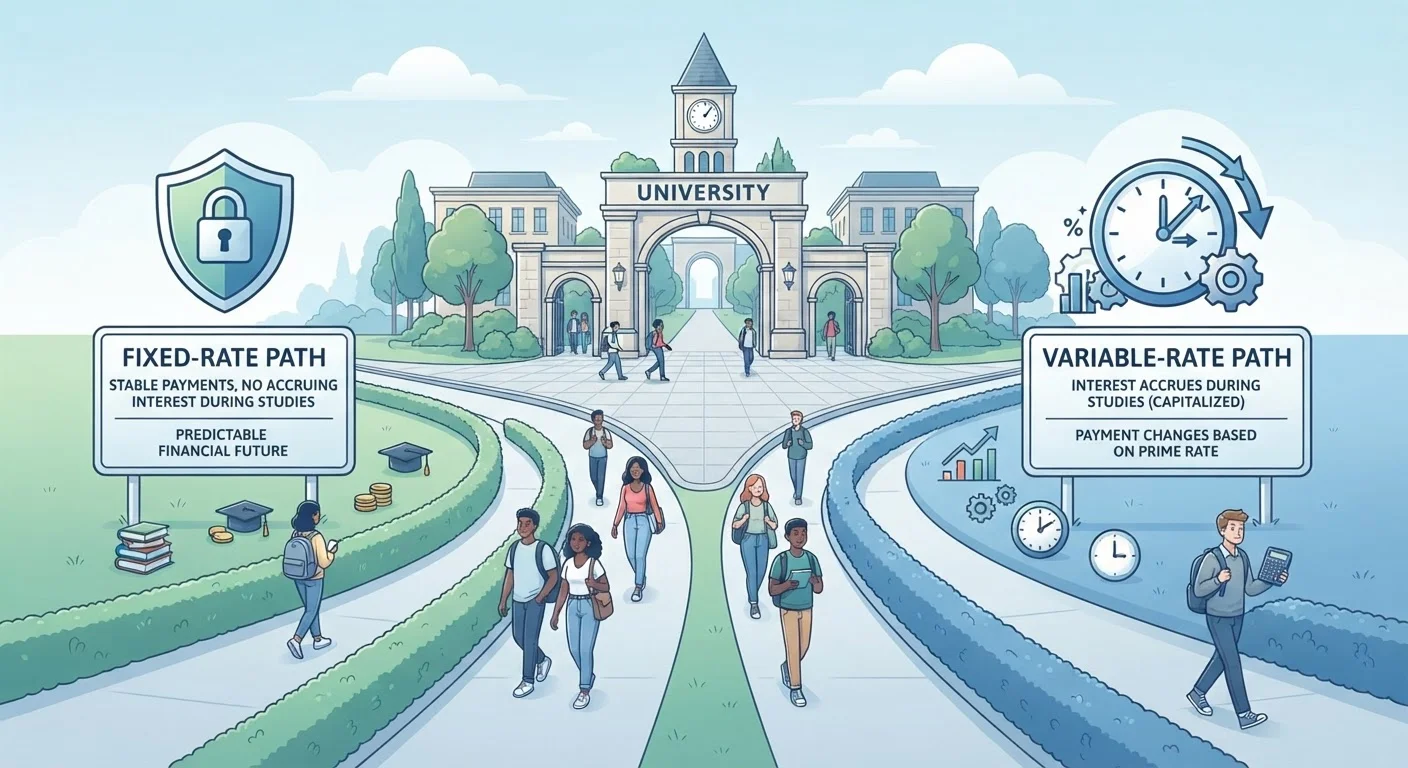
Option A
Subsidized Federal Loans
The interest-protected option for financially eligible students.
Best for: Undergraduate students who demonstrate financial need and want to limit interest accumulation while enrolled.
Option B
Unsubsidized Federal Loans
The broadly available option that starts accruing interest immediately.
Best for: Any eligible student — undergraduate or graduate — who needs to borrow beyond subsidized limits or doesn't qualify based on financial need.
The Core Difference: Who Pays the Interest While You're in School
Both subsidized and unsubsidized loans are federal Direct Loans issued by the U.S. Department of Education. They share the same interest rates for a given academic year, the same federal repayment options, and the same loan limits by year in school. What separates them is a single, consequential rule: who is responsible for interest during in-school and grace periods.
With a subsidized loan, the federal government pays the interest that accrues while you're enrolled at least half-time, during your six-month post-graduation grace period, and during approved deferment periods. Your principal balance stays flat. When repayment begins, you owe exactly what you borrowed.
With an unsubsidized loan, interest begins accumulating from the disbursement date — day one. If you don't pay that interest as it accrues, it's added to your principal balance in a process called capitalization. That higher principal then generates more interest, compounding the cost over time. See our guide to interest capitalization for a deeper look at how this compounds.
| Criterion | Subsidized Loans | Unsubsidized Loans |
|---|---|---|
| Who pays in-school interest | Federal government | Borrower (accrues daily) |
| Eligibility | Undergraduates with financial need | Any eligible student |
| Interest during grace period | Government covers it | Accrues and may capitalize |
| Interest during deferment | Government covers it | Accrues and may capitalize |
| Balance at repayment start | Equal to amount borrowed | Can exceed amount borrowed |
| Available to graduate students | No | Yes |
| Federal repayment plan access | Yes | Yes |
Who Qualifies — and Borrowing Limits
Eligibility rules are strict and non-negotiable for subsidized loans. To qualify, you must be an undergraduate student enrolled at least half-time at an eligible institution and demonstrate financial need as calculated by the Free Application for Federal Student Aid (FAFSA). Graduate and professional students have not been eligible for subsidized loans since 2012.
Unsubsidized loans are available to almost any student — undergraduate or graduate — regardless of income or assets. Financial need is not a factor in unsubsidized eligibility.
Annual borrowing limits apply to both types and depend on your year in school and dependency status. For example, a dependent first-year undergraduate can borrow up to $3,500 in subsidized loans and up to $5,500 combined (subsidized and unsubsidized). Aggregate lifetime limits also apply. Your financial aid award letter will show exactly what you've been offered in each category.
$1,500+
Interest accrued on $5,000 unsubsidized loan before repayment
Estimated interest at 6.53% over a four-year enrollment period plus six-month grace period, assuming no payments made during school.
43 million
Americans with federal student loan debt
According to Federal Student Aid data, tens of millions of borrowers carry federal loan balances, many of which include capitalized interest.
$0
Interest added to subsidized loan principal during school
Subsidized borrowers who maintain at least half-time enrollment see no interest added to their principal balance during that period.
For a broader look at how federal loans differ from private options, see our comparison of federal and private student loans.
What Interest Growth Looks Like in Practice
To understand the dollar difference, consider a student who borrows $5,000 in unsubsidized loans at the start of freshman year at an interest rate of 6.53% (the 2024–25 undergraduate Direct Loan rate). Assuming a four-year program and a standard six-month grace period, roughly $1,400 to $1,600 in interest could accrue before a single repayment payment is due — a figure that then capitalizes onto the principal if left unpaid.
A borrower with $5,000 in subsidized loans under the same terms would still owe exactly $5,000 at the start of repayment. That difference in starting balance directly affects the monthly payment and total interest paid over the life of the loan.
This is why the order in which you accept loans matters. Most financial aid counselors recommend exhausting subsidized loan eligibility before accepting unsubsidized funds. If you later consider refinancing, note that refinancing federal loans into private loans removes federal protections — a trade-off worth understanding carefully.
Interest Accrues Even During Deferment
If you experience financial hardship and request deferment on an unsubsidized loan, interest continues to accrue throughout that period. When deferment ends, any unpaid interest capitalizes — meaning it's added to your principal. This can significantly increase your long-term repayment cost. Subsidized loans, by contrast, do not accrue interest during federally approved deferment periods.
This article provides general financial information about federal student loan types and is not personalized financial or legal advice. Consult a qualified financial aid professional or adviser for guidance specific to your situation.
The content provided on our blog site traverses numerous categories, offering readers valuable and practical information. Readers can use the editorial team’s research and data to gain more insights into their topics of interest. However, they are requested not to treat the articles as conclusive. The website team cannot be held responsible for differences in data or inaccuracies found across other platforms. Please also note that the site might also miss out on various schemes and offers available that the readers may find more beneficial than the ones we cover.