

Why Most Commuters Settle Too Quickly
Most people default to whichever commuting method they used first-usually a car or whatever transit line runs closest to home. That default often costs more than necessary, not because cheaper options don't exist, but because they take a little research to find.
If you've ever felt like your commute was eating into your paycheck, you're probably right. According to general cost analyses, solo car commuting tends to be the most expensive daily option once you factor in fuel, parking, insurance, and depreciation. See our common commuting missteps that drain budgets for a closer look at where the money quietly disappears.
The strategies below aren't obscure workarounds-they're practical, established options that millions of commuters use but that don't get nearly enough attention alongside the standard bus-and-train conversation.
Start With a Full Cost Audit
Before evaluating alternatives, total up what your current commute actually costs per month: fuel or fares, parking, tolls, and a rough estimate of vehicle wear. Most people underestimate this number. Having a real baseline makes it much easier to evaluate whether a vanpool, park-and-ride, or compressed schedule actually saves you money.
Seven Commuting Strategies Worth a Serious Look
Vanpools
A vanpool is a group of coworkers or neighbors who share a larger vehicle-typically a passenger van-for a regular commute. Some employers organize and subsidize them; others are arranged informally. Transit agencies in many metro areas also administer vanpool programs with discounted rates.
The cost per person is usually significantly lower than driving alone, and many vanpool participants qualify for pre-tax commuter benefit spending. The trade-off is a fixed schedule, which suits people with predictable hours but creates friction for those with variable shifts.
Vanpools can cut per-person commuting costs significantly compared to driving alone each day.
Employer Shuttles
Many mid-to-large employers-especially in tech, healthcare, and logistics-operate shuttle services between transit hubs or residential neighborhoods and the worksite. These are often free or heavily subsidized for employees.
It's worth asking your HR department directly, because these programs aren't always advertised prominently. If your company doesn't have one but has a large workforce, employee-led proposals to management have successfully launched shuttle programs at multiple organizations.
Employer shuttle programs are often free to employees but go unused simply because workers don't know they exist.
Park-and-Ride Lots
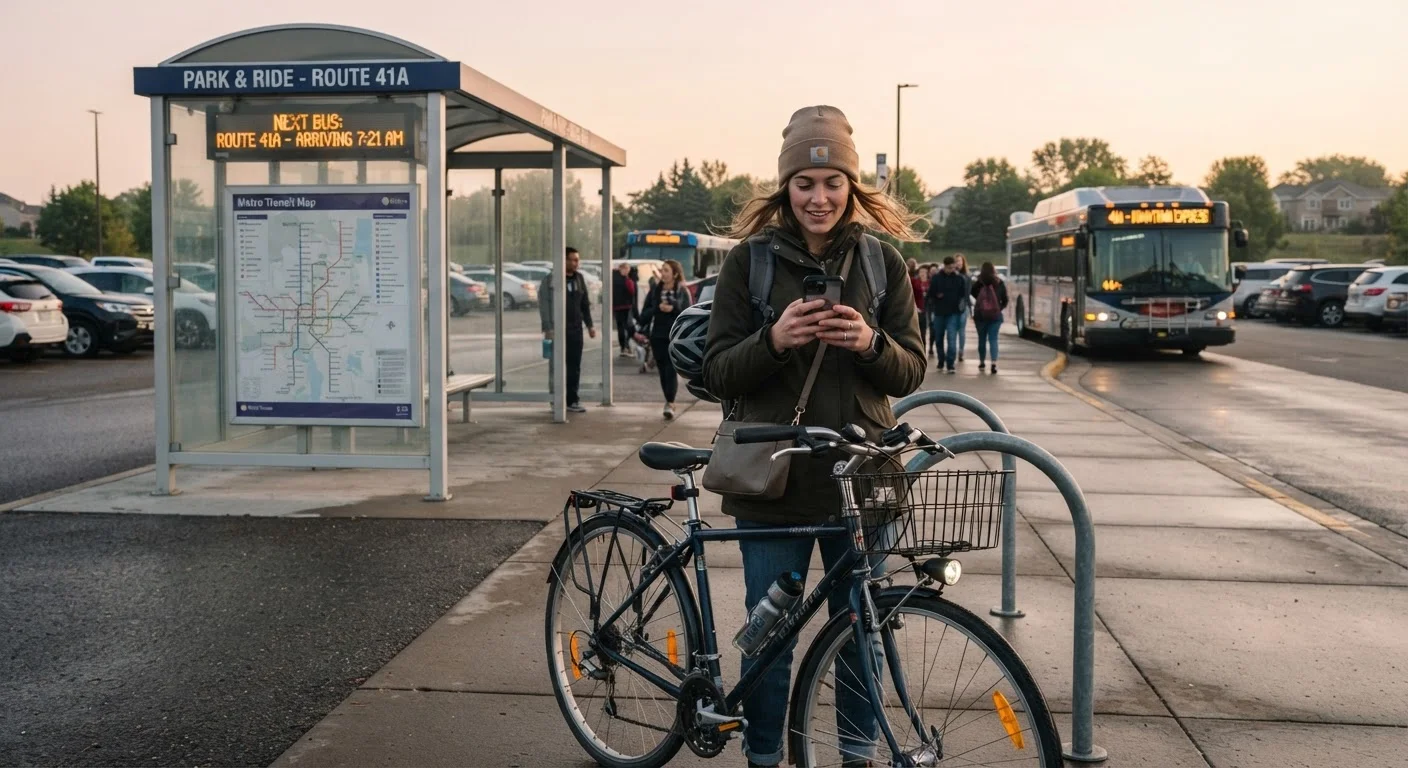
Park-and-ride facilities let you drive part of the way, leave your car at a transit-served lot-often at no cost or a low daily fee-and complete the commute by bus, rail, or carpool. They're particularly useful for commuters who live in areas without good transit access near their home but work in a transit-rich downtown.
The savings come from avoiding expensive downtown parking, which in many US cities runs $15-$30 per day or more. Check your regional transit authority's website for locations and hours.
Avoiding downtown parking by using a park-and-ride lot can save hundreds of dollars each month.
Bike-Share and E-Scooter Programs
Docked bike-share systems and dockless e-scooters have expanded rapidly in US cities and are most valuable as first- or last-mile connectors-bridging the gap between a transit stop and your front door rather than serving as a standalone long-distance commute.
Monthly memberships for bike-share programs are generally affordable, and many cities offer income-based discount plans. For a realistic look at what full bike commuting involves, our piece on what to expect in your first month of bike commuting covers the practical details.
Bike-share and e-scooters work best as connectors to transit, not as standalone long-distance commutes.
Formal Carpooling Arrangements
Carpooling with one or two colleagues means splitting fuel costs directly, often halving or cutting them further. Unlike a rideshare app, formal carpooling is typically free of service fees and surge pricing-just an agreed-upon cost-sharing arrangement between people you already know.
The main challenge is logistics: coordinating schedules, handling breakdowns, and establishing ground rules upfront. Our guide on setting up a carpool arrangement that actually sticks walks through the specifics of making it work long-term.
Formal carpooling eliminates service fees and can cut fuel costs by 50% or more with just one partner.
Compressed Workweek Schedules
This one doesn't change your mode of transport-it changes how often you commute. A compressed schedule (e.g., four 10-hour days instead of five 8-hour days) eliminates one round-trip commute per week. Over a year, that's roughly 50 fewer commutes, with proportional savings in fuel, fares, or wear on your vehicle.
Eligibility depends on your employer and role, but it's worth raising with a manager, especially if your position involves independent or project-based work. Some employers have adopted hybrid or compressed models permanently post-pandemic.
A four-day workweek eliminates roughly 50 commutes per year, with real savings in fuel and fares.
Pre-Tax Commuter Benefits
If your employer offers a commuter benefits program, you can set aside pre-tax dollars-up to IRS-set limits-to pay for qualifying transit passes, vanpool expenses, or parking at a transit facility. Because the deduction comes before federal income tax is applied, it effectively reduces the cost of your commute without requiring any change to how you travel.
Many employees either don't know this benefit exists or haven't enrolled. It applies to bus passes, subway cards, vanpooling, and in some cases commuter rail. Learn how commuter benefits programs work and whether yours qualifies before the next enrollment window opens.
Pre-tax commuter benefits reduce what you pay for transit without requiring any change to your commute route.
Availability Varies Significantly by Location
Not every strategy on this list will be available in every city or suburb. Vanpool programs, employer shuttles, and bike-share networks are more common in larger metro areas and near major employment centers. If you're evaluating options before choosing where to live, see our checklist on evaluating transit before signing a lease-transit access is easier to plan around before you move than after.
Building a Commute That Fits Your Budget and Schedule
None of these strategies works perfectly in isolation for every commuter. The most cost-effective setups usually involve combining two or three modes-something our guide on planning a reliable multi-modal commute breaks down in practical detail.
Before committing to any arrangement, map your full route cost: fare or fuel, parking if applicable, time, and reliability. A vanpool that saves $180 a month beats a slightly faster solo drive every time if your schedule allows it. And if you haven't checked whether your employer offers pre-tax commuter benefits, that's the first place to look-commuter benefits programs explained can cut costs without changing a single thing about how you get to work.
This article is for general informational purposes only and does not constitute financial or transportation advice. Costs, program availability, and infrastructure vary by location. Verify details with your employer, local transit authority, or relevant service provider before making commuting decisions.
The content provided on our blog site traverses numerous categories, offering readers valuable and practical information. Readers can use the editorial team’s research and data to gain more insights into their topics of interest. However, they are requested not to treat the articles as conclusive. The website team cannot be held responsible for differences in data or inaccuracies found across other platforms. Please also note that the site might also miss out on various schemes and offers available that the readers may find more beneficial than the ones we cover.