

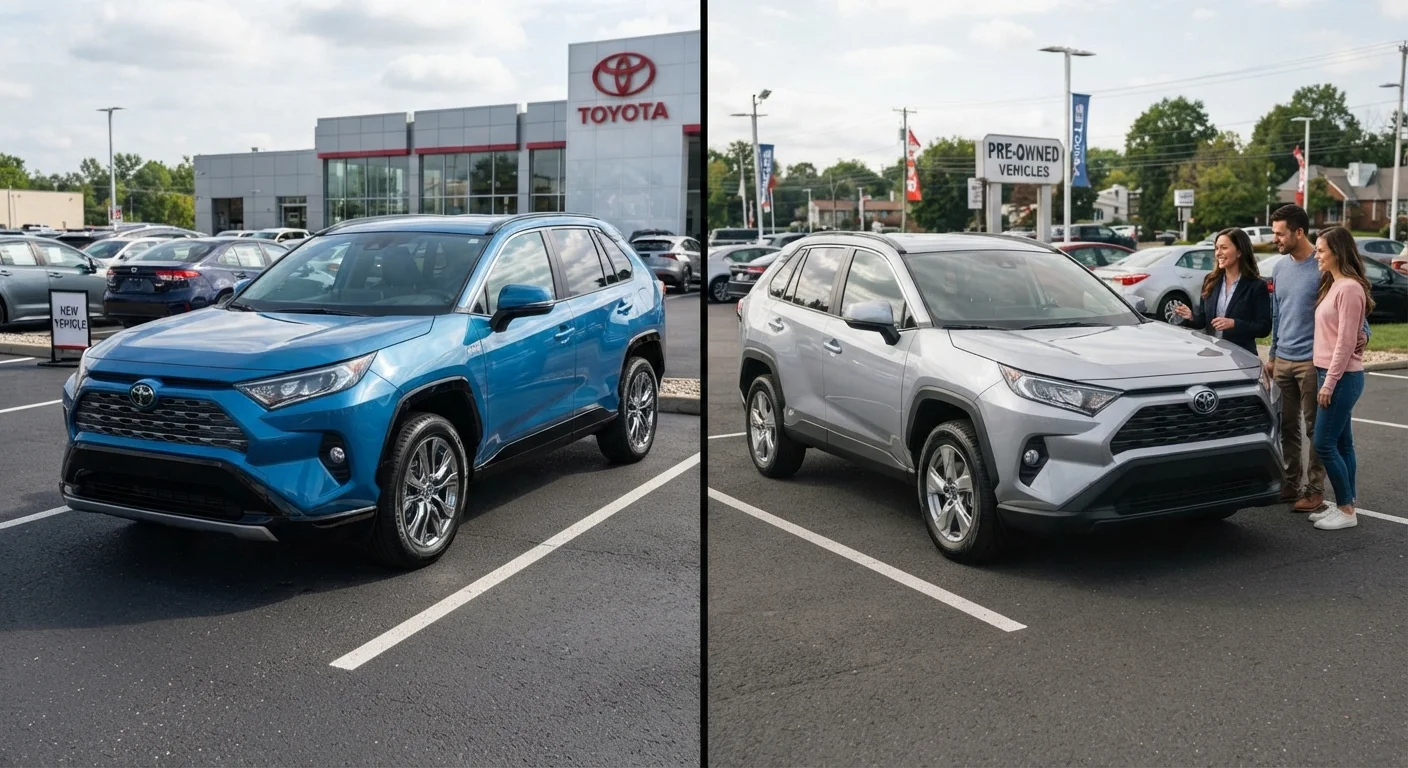
Option A
New Car
The full-warranty, zero-history option.
Best for: Buyers who prioritize peace of mind, the latest safety technology, and access to manufacturer financing incentives.
Option B
Used Car
The lower-cost, depreciation-savvy alternative.
Best for: Budget-conscious buyers who want to minimize upfront cost and let someone else absorb the steepest depreciation hit.
Depreciation: The Hidden Cost That Favors Used
Depreciation is the single largest expense in car ownership - and it hits hardest in the first few years. A new vehicle can lose roughly 15-20% of its value in year one and around 50% over five years, according to data tracked by automotive valuation services. That loss is real money leaving your pocket the moment you drive off the lot.
When you buy a used car that is two or three years old, the previous owner has already absorbed that steepest drop. You inherit a vehicle that will continue to depreciate, but at a much slower rate. For a first-time buyer trying to stretch a limited budget, this distinction matters enormously.
~20%
Average new-car value lost in year one
Automotive valuation analysts consistently find new vehicles shed roughly a fifth of their value within the first twelve months of ownership.
~50%
Depreciation over five years
Industry valuation data suggests the average vehicle retains only about half its original value after five years on the road.
That said, depreciation only costs you directly if you sell or trade in the car. If you plan to drive a new vehicle into high mileage and run it for a decade, the per-year depreciation cost becomes less alarming - and you gain the benefit of full warranty coverage throughout the ownership period.
Financing Rates and Total Loan Cost
Sticker price is just the starting point. How you finance the vehicle shapes what you actually pay. New cars often qualify for lower interest rates - sometimes including promotional rates offered through manufacturer financing arms - because lenders view them as lower-risk collateral. Used car loans, by contrast, typically carry rates that are one to several percentage points higher, depending on your credit profile and the vehicle's age.
To put that in concrete terms: a $5,000 price difference between a new and used vehicle can narrow considerably once you factor in a higher rate on a five-year used-car loan. Running the numbers for your specific situation - using your actual credit score and realistic loan terms - is essential before assuming the used option is cheaper. Our guide on financing through a dealership vs. your own bank breaks down how to compare those offers side by side.
| Criterion | New Car | Used Car |
|---|---|---|
| Purchase Price | Higher sticker price | Lower upfront cost |
| Depreciation Impact | Steepest drop in year one | Prior owner absorbed peak loss |
| Typical Financing Rate | Generally lower APR | Typically higher APR |
| Warranty Coverage | Full manufacturer warranty | Limited or none (CPO adds coverage) |
| Vehicle History | Zero prior use | Varies; requires verification |
| Insurance Cost | Often higher premiums | Often lower premiums |
| Latest Safety Tech | Current standard features | May lack newer systems |
Your credit score has an outsized effect here. Buyers with strong credit scores generally access competitive rates on both new and used loans, while those with limited or damaged credit histories will feel the rate premium on used vehicles more sharply. For a deeper look at how credit scores affect borrowing costs, see the Debt & Credit hub.
Warranty, Reliability, and Unexpected Repair Costs
New cars come with a manufacturer's warranty - typically a three-year/36,000-mile bumper-to-bumper policy and a five-year/60,000-mile powertrain warranty, though terms vary by manufacturer. During that window, most mechanical failures are covered at no cost to you. That predictability has real financial value, particularly for buyers without an emergency fund large enough to absorb a major repair.
Used cars present more variability. A three-year-old vehicle may retain some powertrain coverage; a six-year-old one likely has none. Certified Pre-Owned (CPO) programs offered by many manufacturers provide a middle path: a thorough inspection, a reconditioning process, and an extended warranty. CPO vehicles carry a price premium over standard used cars, but they reduce the uncertainty that makes some buyers nervous about the used market.
What Is a Certified Pre-Owned Vehicle?
A Certified Pre-Owned (CPO) vehicle is a used car that has passed a manufacturer-specified multi-point inspection and meets age and mileage thresholds set by the automaker. CPO programs typically include an extended warranty and, in some cases, additional perks such as roadside assistance. Because CPO vehicles are sold through franchised dealerships and backed by the manufacturer, they generally carry a higher price than non-certified used cars of similar age and mileage. Whether that premium is worthwhile depends on the remaining standard warranty, the specific CPO terms, and your own risk tolerance.
Before purchasing any used vehicle, a pre-purchase inspection by an independent mechanic is one of the most cost-effective steps you can take. Our used car checklist covers what to verify before signing anything.
It's also worth remembering that reliability varies more by the specific vehicle model and its maintenance history than by the new-vs-used label alone. A well-maintained used vehicle can outperform a neglected new one.
Making the Decision That Fits Your Financial Reality
Neither choice is universally superior - the right answer depends on your credit, savings, driving needs, and how long you plan to keep the vehicle. A few practical steps help clarify the decision:
- Calculate total cost of ownership, not just monthly payments. Include insurance, estimated fuel costs, and a realistic maintenance buffer. Our article on the true cost of car ownership is a useful reference.
- Get pre-approved for financing before you shop so you know your actual rate, not an estimate.
- Compare the same loan term across new and used options. Stretching a used-car loan to seven years to match a new car's monthly payment often costs more in total interest than the savings on purchase price.
- Consider whether leasing fits your situation - for some buyers, the calculus looks different. The buying vs. leasing comparison walks through that alternative.
Where you buy also affects the deal you get. Private sellers vs. dealerships each come with distinct protections, risks, and pricing dynamics worth understanding before you commit.
This article is for general informational purposes only and does not constitute personalized financial or purchasing advice. Loan rates, vehicle values, and warranty terms vary by lender, manufacturer, and individual circumstances. Consult a licensed financial professional for guidance specific to your situation.
The content provided on our blog site traverses numerous categories, offering readers valuable and practical information. Readers can use the editorial team’s research and data to gain more insights into their topics of interest. However, they are requested not to treat the articles as conclusive. The website team cannot be held responsible for differences in data or inaccuracies found across other platforms. Please also note that the site might also miss out on various schemes and offers available that the readers may find more beneficial than the ones we cover.