

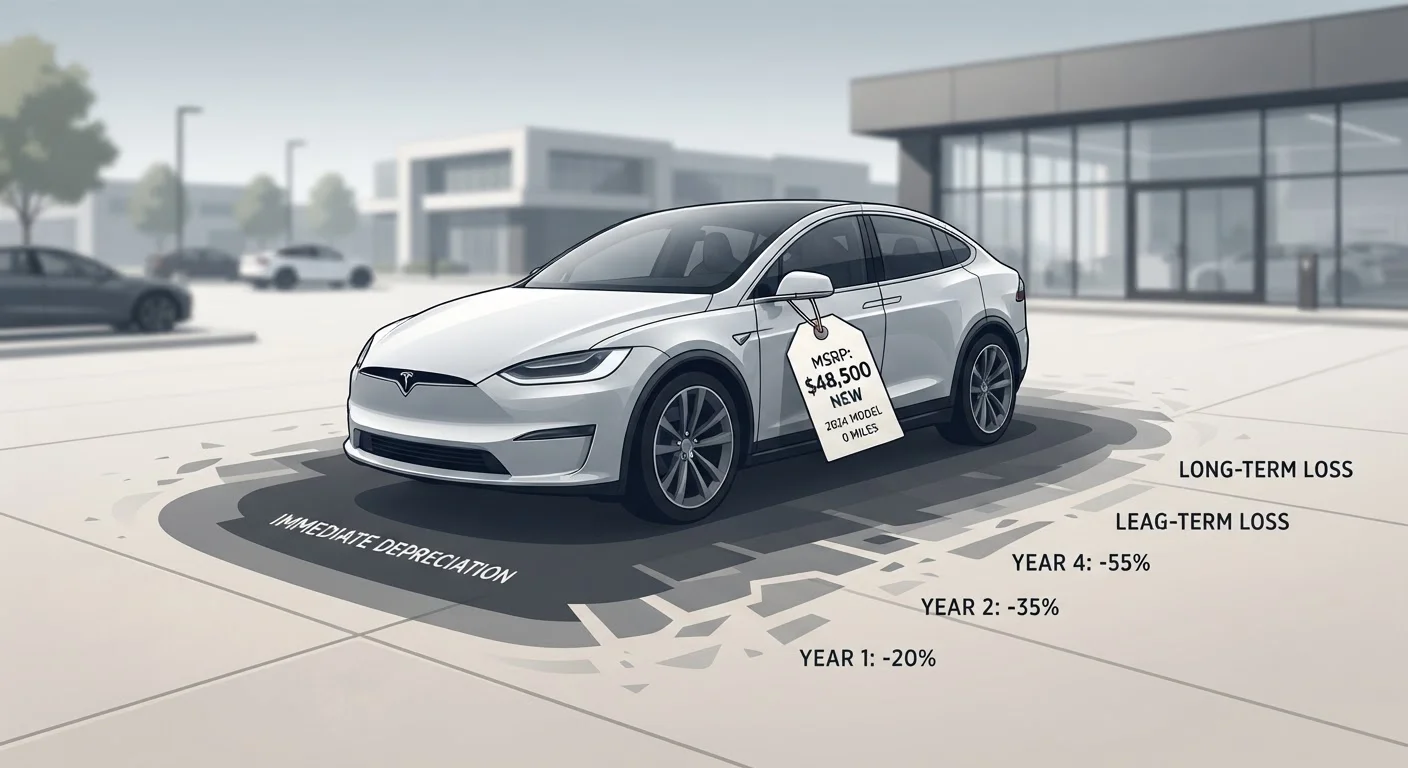
What Depreciation Actually Means for Your Wallet
When people talk about the cost of owning a car, they usually think about gas, insurance, and loan payments. Depreciation rarely makes it into that mental list - but it should. It's consistently one of the largest ownership costs over time, even though you never write a check for it directly.
Depreciation is simply the loss in your vehicle's market value from the day you buy it to the day you sell or trade it in. If you purchase a car for $30,000 and sell it five years later for $15,000, you've experienced $15,000 in depreciation - roughly $3,000 per year on average, not counting interest or other costs.
For a fuller picture of how this fits into overall ownership expenses, see the real cost of owning a car. Depreciation often accounts for the single largest share of total vehicle costs.
15-25%
Value lost in year one for new cars
Industry data consistently shows new vehicles experience the sharpest depreciation in the first 12 months of ownership.
~50%
Value remaining after 5 years (typical)
Many vehicles retain only 40-60% of their original purchase price after five years, depending on brand, condition, and market demand.
$3,000+
Estimated annual depreciation cost (average)
For a mid-range vehicle, depreciation can represent several thousand dollars per year - often more than annual fuel or insurance costs.
The Depreciation Curve: When Value Drops Fastest
Depreciation doesn't happen at a steady pace. The loss is front-loaded - meaning new vehicles shed value most aggressively in the early years of ownership.
- Year 1: A new car can lose roughly 15-25% of its purchase price within the first 12 months, partly just from being driven off the lot.
- Years 2-3: Value continues to decline, typically another 10-15% per year, though the rate begins to ease.
- Years 4-5: Depreciation slows further. By the end of five years, many vehicles are worth around 40-60% less than their original purchase price.
After this initial steep decline, most vehicles depreciate more gradually - which is why older, high-mileage cars tend to hold a relatively stable value in the used market.
Buy Used to Skip the Steepest Drop
If you're budget-conscious, consider vehicles that are one to three years old rather than brand new. They've already passed through the sharpest phase of depreciation, so you're getting a newer vehicle at a lower cost - and your own value loss going forward will be more gradual. Check vehicle history reports and have any used car inspected by a qualified mechanic before committing.
What Makes Some Cars Depreciate Faster Than Others
Not all vehicles lose value at the same rate. Several factors shape how quickly a car depreciates:
- Brand and reliability reputation
- Vehicles from manufacturers with strong long-term reliability track records tend to hold their value better in the used market.
- Market demand
- Trucks and SUVs have historically retained value well due to consistent consumer demand. Niche or luxury vehicles can swing in either direction depending on trends.
- Mileage
- Higher annual mileage accelerates depreciation. The average American drives around 14,000-15,000 miles per year; well above that and resale value suffers.
- Condition and accident history
- Dents, interior wear, and any reported accidents reduce what buyers are willing to pay. A clean vehicle history report supports higher resale value.
- Fuel type
- As the market shifts toward electric and hybrid vehicles, the resale value of some traditional gas-powered models is being reassessed - and vice versa.
How Depreciation Should Shape Your Buying Decisions
Understanding depreciation gives you real leverage as a buyer. One of the most practical takeaways: a lightly used vehicle - one that's one to three years old - has already absorbed the steepest portion of the depreciation curve. You get a newer vehicle at a meaningfully lower price, and the ongoing value loss from that point forward tends to be more gradual.
This is one of the central arguments in the new-versus-used debate. For a deeper breakdown of that comparison, see new car vs. used car financial trade-offs.
If you're buying new, choosing a model with a historically strong resale value helps limit your long-term depreciation exposure. If you're leasing, be aware that your monthly payment is partly a function of how much the car is expected to depreciate during your lease term - faster-depreciating vehicles can mean higher lease costs.
For first-time buyers working through the full purchase process, what to expect with your first car walks through budgeting, financing, and ownership responsibilities step by step.
Depreciation Affects Loans Too
If you finance a new vehicle and depreciation outpaces your loan repayment, you can end up 'underwater' - owing more on the loan than the car is currently worth. This situation, sometimes called negative equity, can complicate selling or trading in the vehicle. Making a reasonable down payment and choosing a shorter loan term can reduce this risk, though individual circumstances vary. Consult a financial professional for guidance specific to your situation.
Frequently Asked Questions
Most new cars lose roughly 15-25% of their value within the first 12 months of ownership. This makes the first year the most significant period of depreciation over a vehicle's life.
Vehicles with strong brand reputations for reliability and high demand in the used market tend to hold their value better. Depreciation rates vary widely, so researching historical resale value data before buying is a good practice.
Yes, higher mileage generally accelerates depreciation because it signals more wear on the vehicle. A car with significantly above-average annual mileage will typically be worth less at resale than a comparable low-mileage model.
Depreciation is central to how lease payments are calculated. You essentially pay for the portion of the vehicle's value that depreciates during your lease term, which is why leasing a fast-depreciating vehicle can mean higher monthly payments.
You can't stop depreciation, but keeping the vehicle in good condition, staying current on maintenance, and keeping mileage reasonable can help preserve its resale value. Accident history and poor cosmetic condition tend to accelerate value loss.
The content provided on our blog site traverses numerous categories, offering readers valuable and practical information. Readers can use the editorial team’s research and data to gain more insights into their topics of interest. However, they are requested not to treat the articles as conclusive. The website team cannot be held responsible for differences in data or inaccuracies found across other platforms. Please also note that the site might also miss out on various schemes and offers available that the readers may find more beneficial than the ones we cover.