

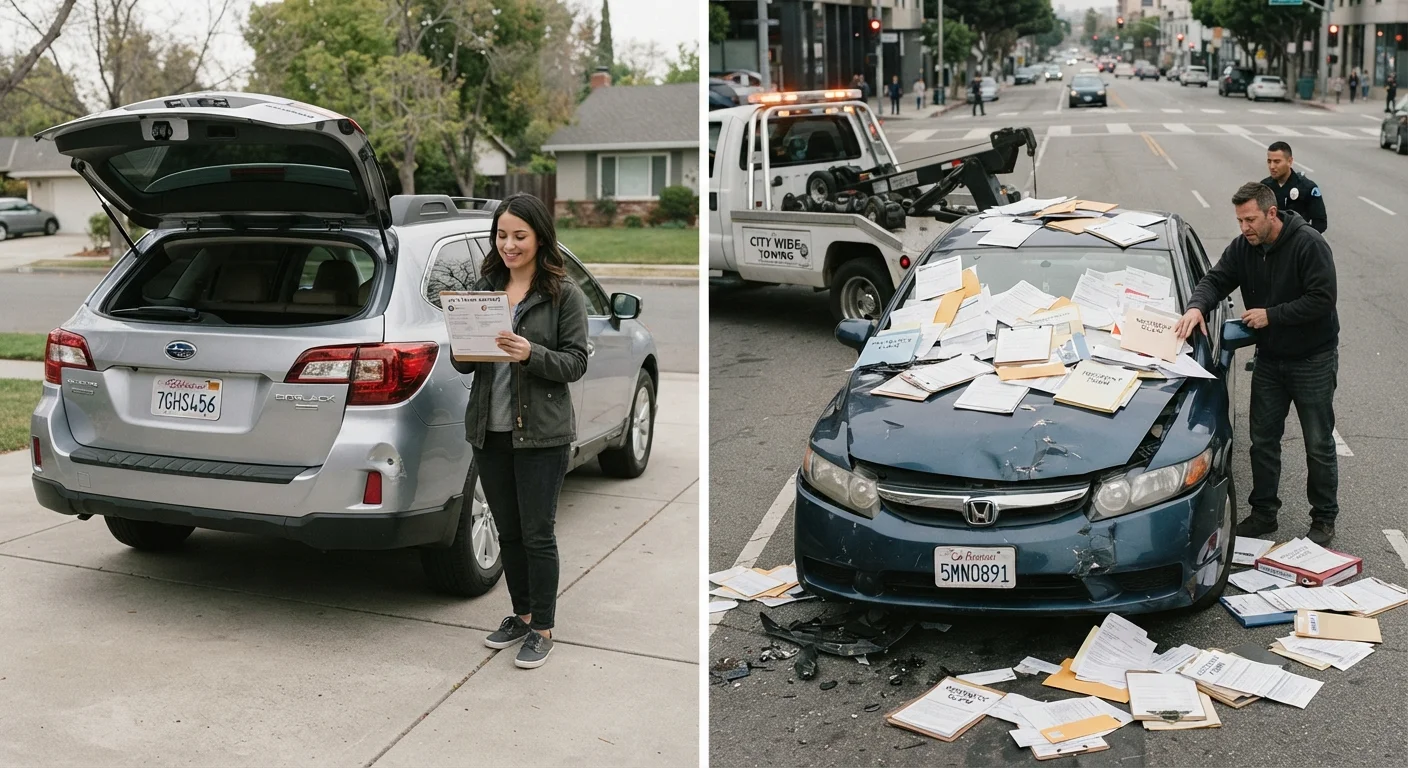
Option A
Minimum Coverage
The legally required baseline that keeps you on the road.
Best for: Drivers with older, low-value vehicles who can absorb out-of-pocket repair costs for their own car.
Option B
Full Coverage
A broader safety net that protects your vehicle and your finances.
Best for: Drivers with newer or financed vehicles who cannot afford a large unexpected repair or replacement bill.
What Each Policy Actually Covers
Minimum coverage - sometimes called liability-only - satisfies the legal threshold required to register and drive a vehicle in most states. It pays for bodily injury and property damage you cause to other people in an at-fault accident. What it does not do is contribute a single dollar toward repairing or replacing your own car.
Full coverage is an industry shorthand (not a formal policy category) for combining liability with two additional protections: collision, which pays for damage to your car after an accident regardless of fault, and comprehensive, which covers non-collision events like theft, vandalism, hail, flooding, and animal strikes. Together, these three components cover most realistic loss scenarios a driver will face. For a deeper look at how each layer works, see Liability, Collision, and Comprehensive.
State Minimums Vary Widely
Every state sets its own required liability limits. Some states require only $10,000 in property damage liability, while others mandate $25,000 or more. A few states also require personal injury protection (PIP) or uninsured motorist coverage as part of their minimums. Always verify your state's specific requirements before choosing a policy. For a plain-English breakdown of each coverage type, see our Car Insurance Coverage Types reference.
The Real Cost Gap: Premiums vs. Claims
The premium difference between minimum and full coverage is real, but it needs to be weighed against potential claim costs - not just compared in isolation.
~$947
Average annual minimum coverage premium (US)
According to Bankrate's 2024 rate analysis, average minimum coverage costs roughly $947 per year nationally, though rates vary significantly by state and driver profile.
~$2,014
Average annual full coverage premium (US)
Bankrate's 2024 data places average full coverage at approximately $2,014 per year - a meaningful gap, but one that can be offset by a single uncovered accident.
$4,700+
Average collision claim payout
The Insurance Information Institute reports that the average auto collision claim has historically exceeded several thousand dollars, far outpacing a typical deductible.
Consider a straightforward scenario: you rear-end another vehicle on a rainy morning. Your car sustains $6,000 in front-end damage. With minimum coverage, that entire $6,000 comes out of your pocket. With full coverage and a $1,000 deductible, your maximum exposure is $1,000. The annual premium difference of roughly $1,000-$1,100 would need to accumulate for six or more years before minimum coverage became the financially superior choice in that single scenario - and that assumes no accidents during that window.
The math shifts for older, low-value vehicles. If your car is worth $3,500, paying an extra $1,000 per year for full coverage means you'd recover at most $3,500 in a total-loss claim, minus your deductible. In that case, minimum coverage may genuinely be the smarter financial call - provided you have savings to absorb the loss.
| Criterion | Minimum Coverage | Full Coverage |
|---|---|---|
| Covers damage to others | Yes (liability required) | Yes |
| Covers your own car after a crash | No | Yes (collision) |
| Covers theft or weather damage | No | Yes (comprehensive) |
| Required by law | Yes (most states) | No (unless financed) |
| Typical annual premium range | $500-$900 | $1,200-$2,200 |
| Out-of-pocket after at-fault crash | Full repair cost of your car | Deductible only ($500-$2,000) |
| Suitable for financed vehicles | No - lenders prohibit it | Yes - satisfies lender requirements |
When Minimum Coverage Puts You at Real Risk
Minimum coverage carries several gaps that are easy to overlook until a claim occurs.
- Your car after an at-fault crash: You bear 100% of repair or replacement costs.
- Theft and weather events: Comprehensive coverage is absent, so a stolen vehicle or hail-damaged roof is entirely your financial problem.
- Financed vehicles: Lenders require full coverage as a condition of the loan. Dropping to minimum coverage on a financed car typically violates your loan agreement and can trigger force-placed insurance at significantly higher cost.
- High liability limits: State minimums are often low enough that a serious at-fault accident could exhaust your coverage, leaving you personally liable for damages beyond the policy cap.
To understand what happens after you file - and how your premiums and policy status may be affected - see What Happens to Your Coverage When You File a Claim.
How to Decide Which Level Is Right for You
No single answer fits every driver. A practical framework involves three questions:
- What is your car worth? Use a market valuation tool to get a realistic estimate of your vehicle's current value. If your annual full-coverage premium exceeds 10% of that value, the cost-benefit case weakens considerably.
- Could you absorb a large unexpected expense? If a $5,000 or $8,000 repair bill would create genuine financial hardship, full coverage effectively functions as a financial safety net. Your deductible is your worst-case out-of-pocket, not the full repair cost.
- Is your car financed? If so, full coverage is not a choice - it is a contractual obligation. Review your loan agreement for specifics.
If you are weighing how collision and comprehensive individually behave before bundling them, Collision vs. Comprehensive Coverage breaks each one down clearly. And if you are considering switching insurers to close the premium gap, review Before You Switch Auto Insurers to avoid inadvertent coverage gaps during the transition.
This article is for general informational purposes only and does not constitute personalised insurance or financial advice. Coverage terms, premiums, and requirements vary by state and insurer. Consult a licensed insurance agent to evaluate your specific situation.
The content provided on our blog site traverses numerous categories, offering readers valuable and practical information. Readers can use the editorial team’s research and data to gain more insights into their topics of interest. However, they are requested not to treat the articles as conclusive. The website team cannot be held responsible for differences in data or inaccuracies found across other platforms. Please also note that the site might also miss out on various schemes and offers available that the readers may find more beneficial than the ones we cover.