

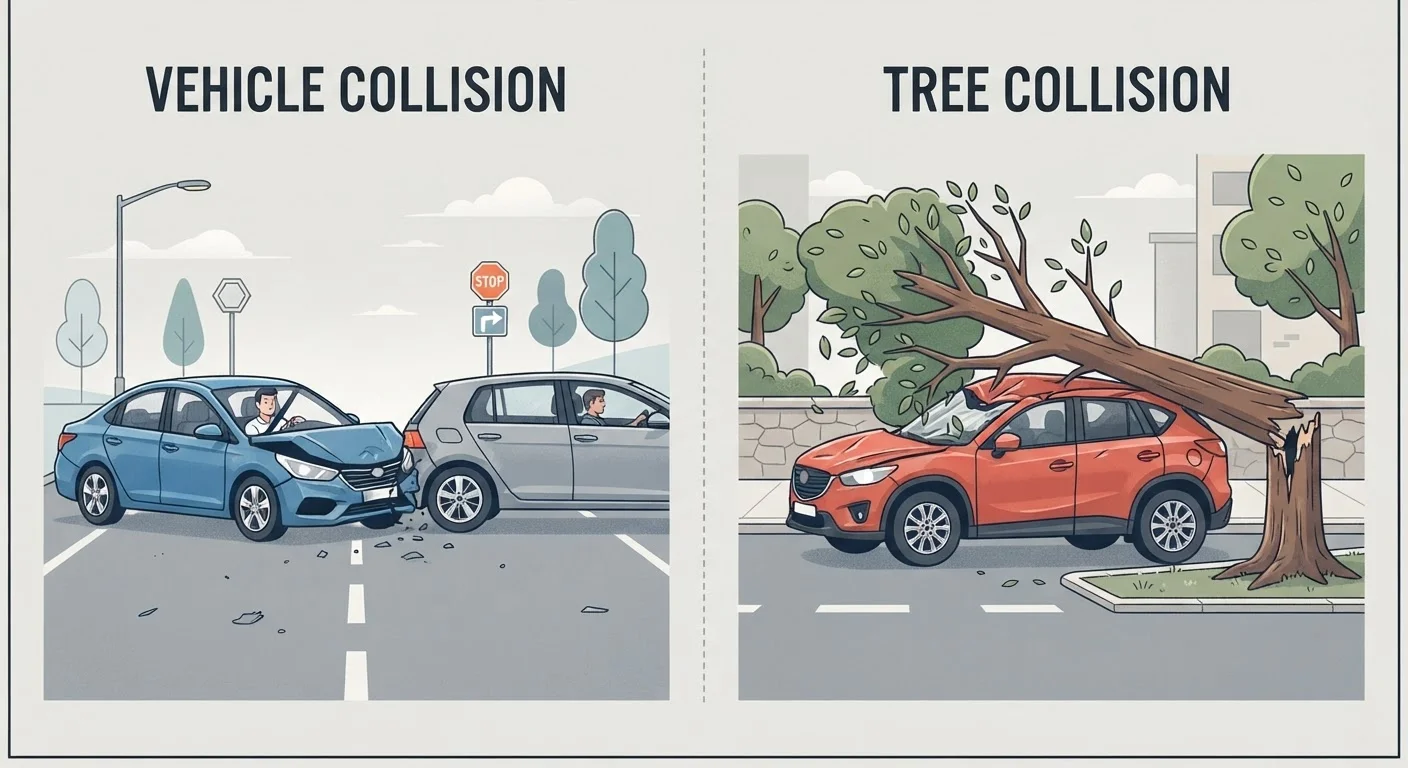
Option A
Collision Coverage
The coverage that steps in when your car hits something - or something hits it.
Best for: Drivers who want protection against accident-related vehicle damage, regardless of who was at fault.
Option B
Comprehensive Coverage
The coverage for everything else - weather, theft, animals, and other non-collision events.
Best for: Drivers who want financial protection against unpredictable, non-accident damage or total vehicle loss.
What Each Coverage Type Actually Does
Auto insurance terminology can blur together fast - especially when two coverage types sound equally vague. Collision and comprehensive are sold as a pair so often that many drivers assume they're interchangeable. They're not. Each one responds to a completely different category of event.
Collision coverage pays to repair or replace your vehicle when it's damaged in a crash - whether you rear-end another car, are hit by another driver, or slide into a guardrail. The key factor is physical contact with another vehicle or object. Fault matters for your liability exposure, but collision coverage responds regardless of who caused the accident.
Comprehensive coverage handles the scenarios that have nothing to do with driving into something. A tree limb falls on your parked car - comprehensive. Your vehicle is stolen - comprehensive. A deer runs across the highway and you can't stop in time - that's comprehensive too, because it's classified as an animal strike rather than a conventional collision. Other covered events typically include fire, flooding, hail, and vandalism.
For a broader look at how these fit alongside liability and other policy components, see our breakdown of the three core coverage types.
| Criterion | Collision Coverage | Comprehensive Coverage |
|---|---|---|
| What triggers a claim | Crash with vehicle or object | Theft, weather, fire, animals, vandalism |
| Fault requirement | None - covers regardless of fault | Not applicable - no collision involved |
| Legally required | No (but lenders may require it) | No (but lenders may require it) |
| Deductible applies | Yes, per claim | Yes, per claim |
| Typical relative premium cost | Generally higher | Generally lower |
| Covers animal strikes | No | Yes |
| Covers theft | No | Yes |
| Covers at-fault accident repairs | Yes | No |
Deductibles, Premiums, and the Real Cost Equation
Both coverage types come with a deductible - the dollar amount you pay out of pocket before your insurer covers the rest. Common deductible amounts range from $250 to $1,500. Choosing a higher deductible reduces your monthly premium but increases your exposure when you actually file a claim. Each coverage type carries its own deductible, so if a single event somehow triggers both (rare but possible in a few scenarios), you'd face two separate deductibles.
~6%
Of insured vehicles file a collision claim annually
According to the Insurance Information Institute, collision claims are filed by roughly 6 in 100 insured vehicles each year in the U.S.
~3%
Of insured vehicles file a comprehensive claim annually
The Insurance Information Institute estimates comprehensive claims occur at roughly half the rate of collision claims across the U.S.
$500
Most common collision deductible chosen by drivers
Industry surveys consistently show $500 as the most frequently selected deductible level for both collision and comprehensive coverage.
Premium costs vary based on your vehicle's value, your location, your driving history, and the insurer's own risk models. As a general pattern, collision tends to cost more than comprehensive because accidents are statistically more common than theft or weather events. That said, in regions with high vehicle theft rates or severe weather exposure, comprehensive premiums can close that gap.
The most useful question when evaluating either coverage: What would it cost to replace or repair my vehicle out of pocket? If your car's market value is only marginally higher than your deductible plus annual premium, the financial case for carrying that coverage weakens. This calculation is worth revisiting as your vehicle ages. See also how full coverage compares to minimum coverage at claim time.
When You're Required to Carry Both - and When You're Not
Unlike liability insurance, neither collision nor comprehensive is legally mandated by any U.S. state. But legal requirement and practical requirement are two different things. If you financed your vehicle through a lender or are leasing it, your contract almost certainly requires you to maintain both coverages for the duration of the loan or lease. This protects the lender's financial stake in a vehicle they technically still own.
Once a loan is paid off, that obligation ends. You're then free to drop either coverage - though that decision should be driven by your vehicle's value, your savings cushion, and your personal risk tolerance, not just the fact that you can. If a covered loss occurs and you've dropped comprehensive, a stolen or weather-totaled car becomes entirely your financial problem.
For drivers considering a policy switch, this coverage continuity checklist can help you avoid accidental gaps during the transition.
Gap Insurance: A Related Coverage Worth Knowing
If you owe more on your auto loan than your car is currently worth, standard collision and comprehensive payouts may not cover your remaining balance. Gap insurance (Guaranteed Asset Protection) is designed to cover that difference. It's typically offered by lenders and dealers at loan origination, and it's worth factoring in if you financed a new vehicle with a small down payment. For a full picture of coverage types, see our plain-English reference guide to auto insurance coverage.
This article provides general information about auto insurance coverage types and is not personalized insurance or financial advice. Coverage terms, exclusions, and availability vary by provider and state. Review your actual policy documents and consult a licensed insurance agent for guidance specific to your situation.
The content provided on our blog site traverses numerous categories, offering readers valuable and practical information. Readers can use the editorial team’s research and data to gain more insights into their topics of interest. However, they are requested not to treat the articles as conclusive. The website team cannot be held responsible for differences in data or inaccuracies found across other platforms. Please also note that the site might also miss out on various schemes and offers available that the readers may find more beneficial than the ones we cover.