

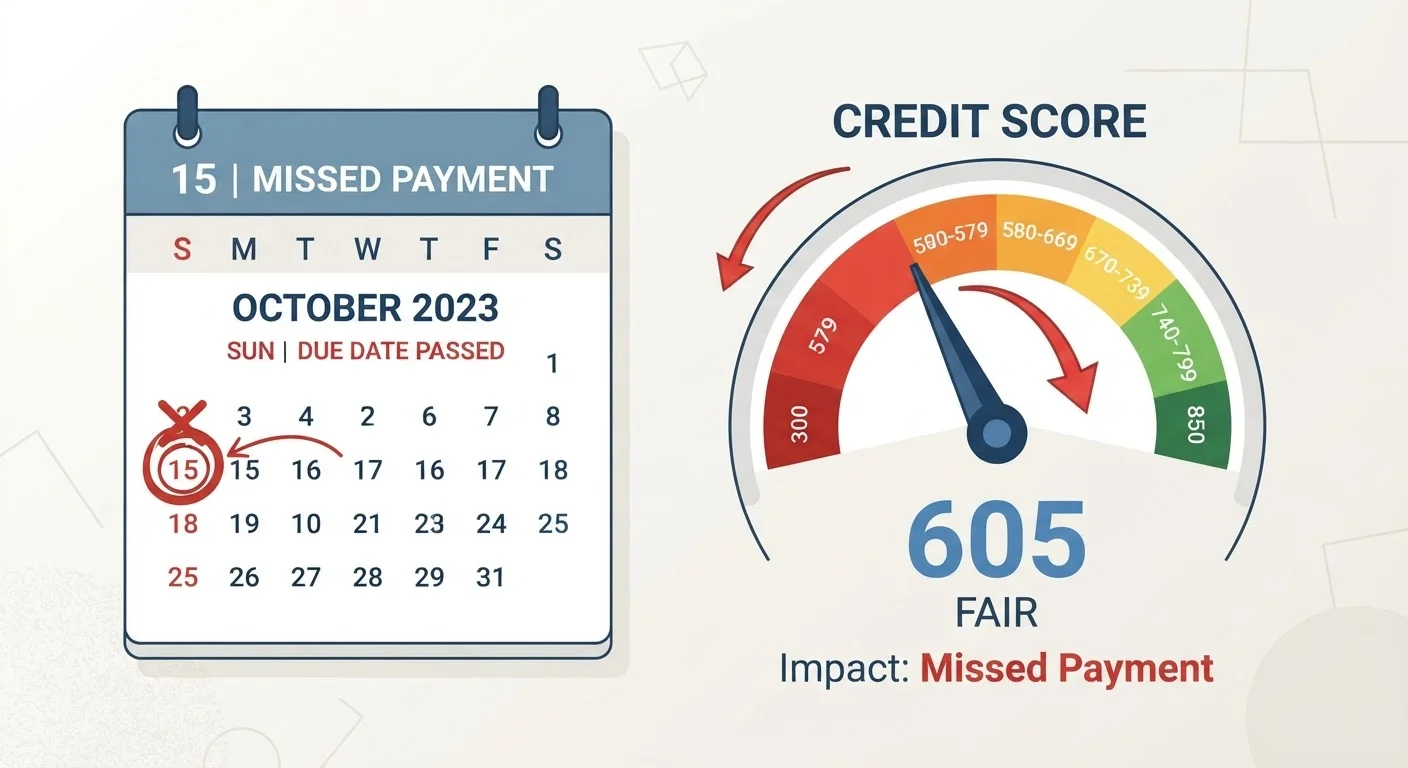
The 30-Day Window That Changes Everything
Missing a payment due date is stressful, but the actual credit damage doesn't happen the moment you forget. Federal regulations give consumers a meaningful buffer: lenders cannot report a payment as late to the credit bureaus until it is at least 30 days past due.
This means if you realize you missed a payment within that window, you can often pay it immediately and avoid any negative mark on your credit report. You may still owe a late fee from your lender, but your credit score remains unaffected. That 30-day window is one of the most important — and least understood — facts in consumer credit.
If you're concerned about credit myths clouding your judgment, our credit score myth breakdown can help you separate fact from fiction.
Set Up Autopay for the Minimum
Even if you plan to pay more each month, setting up autopay for at least the minimum payment due creates a safety net against missed payment reports. You can always make additional manual payments on top. This single habit protects your payment history — the most heavily weighted factor in your credit score.
How the Damage Escalates Over Time
Once a payment crosses the 30-day mark without being made, lenders report it to one or more of the three major credit bureaus. From that point, the delinquency escalates in 30-day intervals — each milestone making a bad situation considerably worse.
35%
Weight of payment history in FICO scoring
According to FICO's publicly published scoring model breakdown, payment history is the single largest component of your credit score.
7 years
How long late payments stay on your credit report
Under the Fair Credit Reporting Act (FCRA), most negative credit information — including late payments — may remain on your report for up to seven years.
30 days
Minimum days late before a lender can report to bureaus
Federal rules prohibit lenders from reporting a payment as late to credit bureaus until it is at least 30 days past the due date.
- 30 days late: Reported to credit bureaus; score drops, often significantly. The exact drop depends on your overall credit profile and history.
- 60 days late: A second negative mark is added. Many lenders may now raise your interest rate on the account.
- 90 days late: Considered a serious delinquency. Some lenders may begin collection procedures at this stage.
- 120+ days late: The account may be charged off — meaning the lender writes it off as a loss — or sold to a collections agency. A collection account is a separate and additional negative entry on your report.
Each of these events can appear as its own negative item, compounding the impact on your credit profile over time.
What This Means for Your Credit Score
Payment history is the single largest factor in most credit scoring models, accounting for roughly 35% of a FICO score. This is why a single missed payment can cause a larger score drop than many people anticipate — sometimes 50 to 100 or more points.
Ironically, the stronger your credit was before the missed payment, the larger the initial drop tends to be. A person with a 780 score may see a steeper decline than someone with a 620 score, simply because there's more distance to fall and less existing negative history to absorb the impact.
Late payment marks can remain on your credit report for up to seven years from the original delinquency date. That said, their practical effect on your score typically diminishes over time as you build a track record of on-time payments afterward.
Steps to Take If You've Already Slipped
If the 30-day mark has passed and a late payment has been reported, you still have options worth exploring.
- Pay immediately. Stopping the delinquency from advancing further is the most urgent priority. A 30-day late is significantly less damaging than a 90-day late.
- Ask for a goodwill adjustment. If you have an otherwise strong payment history with your lender and this is an isolated incident, some creditors will remove the late payment as a courtesy. There's no guarantee, but the ask costs nothing.
- Dispute errors. If the late payment was reported in error — for example, your payment was received but not processed correctly — you can dispute it with the credit bureau directly. Bureaus are required to investigate legitimate disputes.
- Continue paying on time. New, consistent on-time payments are the most reliable way to rebuild your credit score over time. There's no shortcut, but the path forward is straightforward.
If you're navigating student loans and worried about how missed payments might affect forgiveness eligibility, it's worth reading about common forgiveness pitfalls before assuming you're disqualified.
This article is for general informational purposes only and does not constitute personalized financial or legal advice. For guidance specific to your situation, consult a licensed financial professional.
Frequently Asked Questions
It won't ruin it permanently, but a single 30-day late payment can cause a significant drop — sometimes 50 to 100 points or more. The impact is generally more severe the higher your score was to begin with. Over time, consistent on-time payments help rebuild your score.
Late payments remain on your credit report for seven years from the date of the original delinquency. However, their impact on your score typically lessens over time, especially as you add positive payment history.
Pay it as soon as possible — ideally within 30 days to avoid a credit bureau report. Contact your lender to explain the situation and ask about a goodwill adjustment or hardship program. Acting quickly gives you the best chance of minimizing long-term damage.
Lenders can submit a goodwill deletion request to the bureaus, but they are not required to do so. If the report was made in error, you have the right to dispute it directly with the credit bureau. Accurate late payments cannot be forcibly removed.
Potentially yes — but not automatically. Lenders choose which bureaus they report to, and some report to all three while others report to just one or two. Check all three of your credit reports to see where a delinquency may appear.
The content provided on our blog site traverses numerous categories, offering readers valuable and practical information. Readers can use the editorial team’s research and data to gain more insights into their topics of interest. However, they are requested not to treat the articles as conclusive. The website team cannot be held responsible for differences in data or inaccuracies found across other platforms. Please also note that the site might also miss out on various schemes and offers available that the readers may find more beneficial than the ones we cover.