

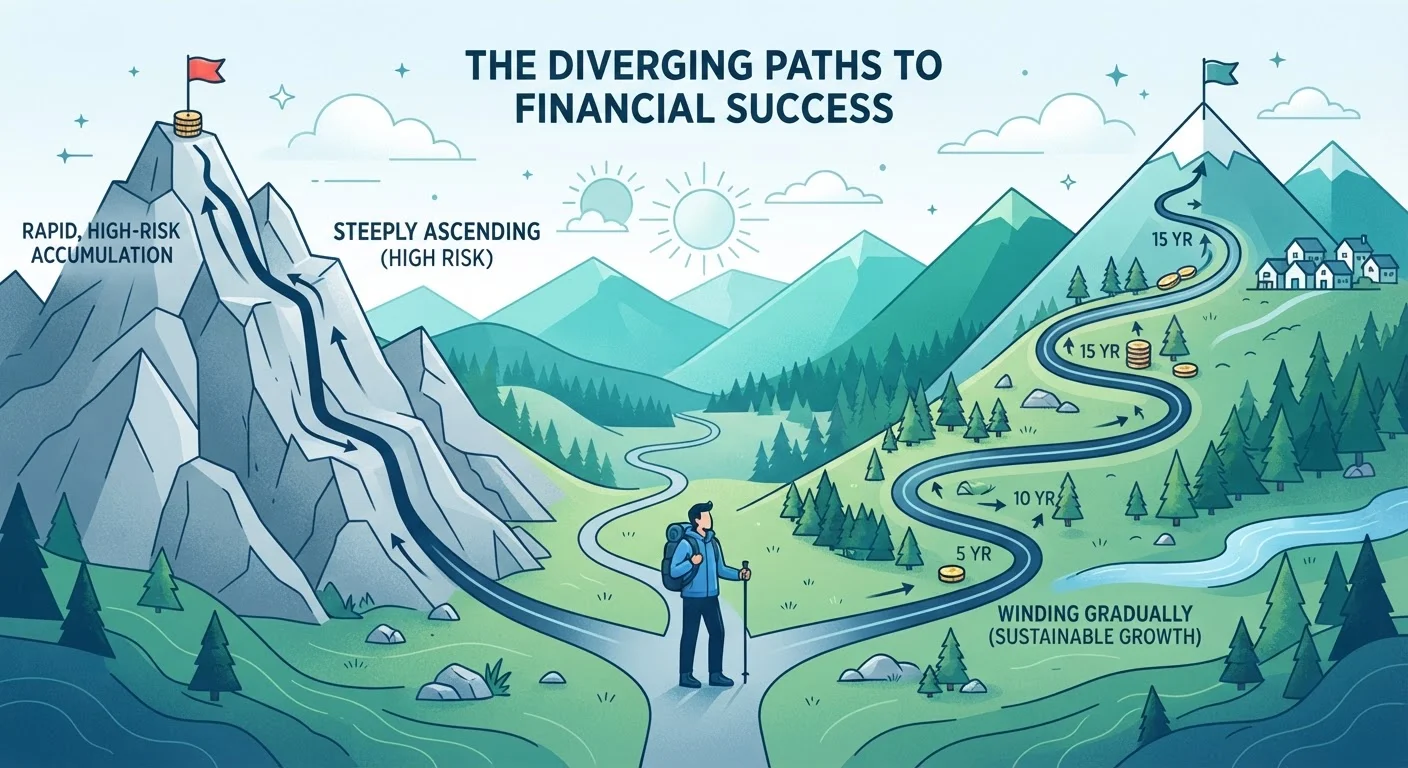
Option A
Debt Avalanche
The mathematically efficient, interest-minimizing approach.
Best for: People who want to pay the least total interest and are comfortable staying motivated without quick wins.
Option B
Debt Snowball
The momentum-driven, psychologically rewarding approach.
Best for: People who need early wins to stay motivated and are carrying several smaller balances alongside larger ones.
How Each Method Actually Works
Both the debt avalanche and debt snowball are structured repayment strategies — not budgeting philosophies or financial products. They share the same core mechanic: you make minimum payments on every debt you carry, then direct any additional money you can spare toward one specific target debt. The difference is how that target is chosen.
Debt Avalanche: You rank your debts by interest rate (APR — annual percentage rate, meaning the yearly cost of borrowing). The debt with the highest rate becomes your target. Once it's paid off, you redirect that freed-up payment toward the next-highest-rate debt, and so on. Because you're neutralizing the most expensive debt first, you pay less interest in total.
Debt Snowball: You rank debts by outstanding balance, smallest to largest, ignoring interest rates. You attack the smallest balance first. When it's gone, you roll its payment into the next-smallest, building a larger and larger payment over time — like a snowball gaining mass. The payoff here is speed of account closure, not interest savings.
| Criterion | Debt Avalanche | Debt Snowball |
|---|---|---|
| Payoff priority | Highest interest rate first | Smallest balance first |
| Total interest paid | Lower (mathematically optimal) | Potentially higher |
| Time to first payoff | Longer if highest-rate debt is large | Faster — smallest balance cleared first |
| Psychological reward | Slower; rewards come later | Faster wins sustain motivation |
| Best motivator | Tracking interest savings | Watching account count drop |
| Complexity | Requires knowing each debt's APR | Simple — just sort by balance |
| Ideal candidate | Disciplined, numbers-driven planner | Needs momentum to stay consistent |
If you're also weighing whether to prioritize debt repayment over saving, see our article on the saving vs. paying down debt trade-off for a fuller picture of that decision.
The Real Cost Difference: Math vs. Motivation
The avalanche method wins on pure arithmetic. By eliminating high-interest debt sooner, you reduce the principal that interest is calculated on each month. Over time — especially with credit card rates that can exceed 20% APR — this can translate to meaningful savings and a shorter overall payoff timeline.
The snowball method, by contrast, may cost more in total interest. When you ignore rate and focus on balance size, you may leave a high-rate debt growing while you pay off a lower-rate one. That's a real trade-off.
But personal finance research has consistently found that behavior matters enormously. A mathematically superior strategy abandoned after three months produces worse outcomes than a slightly less efficient strategy maintained for three years. Studies examining actual repayment behavior suggest that eliminating individual accounts — regardless of size — can meaningfully improve the probability that someone continues making progress on debt.
~20%+
Typical US credit card APR
The Federal Reserve tracks average credit card interest rates, which have risen substantially in recent years, making high-rate debt especially costly to carry.
Behaviorally significant
Impact of account closures on persistence
Academic research published in the Journal of Marketing Research found that focusing on eliminating individual accounts — rather than reducing total balances — was associated with higher rates of debt repayment completion.
The practical implication: if you've tried debt payoff before and lost steam, the snowball's psychological scaffolding may be worth more than the avalanche's interest savings. If you're disciplined and motivated by numbers, the avalanche is likely the stronger long-term choice. For more on managing debt on a tight budget, different constraints call for different approaches.
Choosing the Right Strategy for Your Situation
There's no universally correct answer — both methods are legitimate tools with distinct advantages. A few factors can help you decide:
- Look at your rate spread. If one debt carries a 24% APR and others sit at 6–8%, the avalanche is hard to argue against — that rate gap is expensive every month. If your rates are all within a few percentage points of each other, the snowball's motivation boost may outweigh the marginal interest difference.
- Count your accounts. If you have six or seven debts, snowballing through the smaller ones can simplify your financial picture quickly, reducing the number of minimum payments you track each month.
- Be honest about your track record. If past attempts to pay down debt stalled, choose the method more likely to keep you engaged.
It's also worth noting that these strategies aren't mutually exclusive over time. Some people start with the snowball to build momentum, then switch to the avalanche once they've cleared several small accounts and feel more confident in their habits.
If you're a recent graduate structuring payments around an entry-level salary, the article on building a repayment strategy around your post-graduation income walks through how to fit these frameworks into a realistic budget. And if your debt feels like it may be outpacing your ability to manage it, signs your debt load is becoming unmanageable covers when to seek additional help.
Both Methods Require One Thing First
Before applying either strategy, you need a clear list of all your debts: the outstanding balance, the interest rate, and the minimum monthly payment for each. Many people are surprised to find they've lost track of one or more accounts. Pulling your credit report — available free at AnnualCreditReport.com — can help ensure your inventory is complete before you choose a payoff order.
This article is for general informational and educational purposes only and is not personalized financial advice. Consider consulting a qualified financial professional for guidance specific to your circumstances.
The content provided on our blog site traverses numerous categories, offering readers valuable and practical information. Readers can use the editorial team’s research and data to gain more insights into their topics of interest. However, they are requested not to treat the articles as conclusive. The website team cannot be held responsible for differences in data or inaccuracies found across other platforms. Please also note that the site might also miss out on various schemes and offers available that the readers may find more beneficial than the ones we cover.