

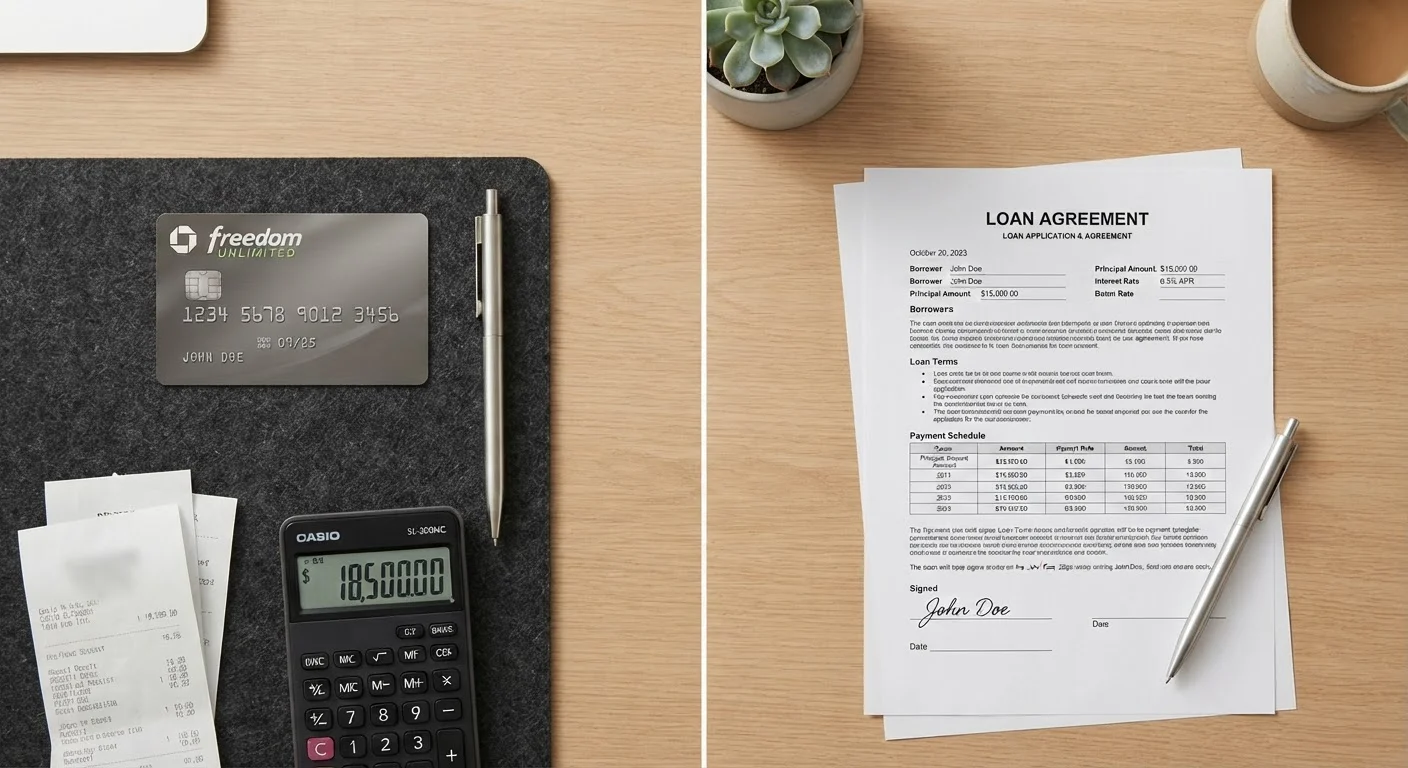
Our Verdict
Personal loans generally make more sense for large, planned expenses where you need structured, predictable payments over time at a lower interest rate. Credit cards are better suited for smaller purchases you can realistically pay off within one to two billing cycles. For most large expenses above a few thousand dollars, a personal loan typically costs less overall — but your credit profile and repayment discipline are the deciding factors.
| Best for | Recommended |
|---|---|
| Large planned expenses needing a fixed repayment schedule | Personal Loan |
| Smaller purchases you can repay within one to two months | Credit Card |
| Those who want to avoid accumulating revolving debt | Personal Loan |
| Emergencies where funds are needed immediately without an application process | Credit Card |
How Each Option Works
A personal loan is a lump sum borrowed from a bank, credit union, or online lender that you repay in fixed monthly installments over a set term — typically one to seven years. The interest rate is usually fixed, meaning your payment stays the same each month from start to finish.
A credit card is a revolving line of credit. You can charge purchases up to your limit, pay some or all of the balance each month, and borrow again. If you carry a balance past the due date, the remaining amount accrues interest — typically at a much higher rate than a personal loan.
Both tools involve borrowing money, but they behave very differently once you start repaying. Understanding those mechanics is the first step toward choosing the right one. For context on how lenders evaluate borrowers for installment debt, see our guide to auto loan basics, which covers the same credit score and term-length logic that applies to personal loans.
Comparing Costs: Interest Rates and Total Repayment
This is where the gap between the two products becomes most visible. Personal loan APRs (Annual Percentage Rate — the yearly cost of borrowing including fees) typically range from roughly 7% to 36%, depending on your creditworthiness. Credit card APRs commonly range from 20% to 30% or higher for general purchase cards.
| Personal Loan | Credit Card | |
|---|---|---|
| Interest Rate (typical APR) | 7%–36%, often fixed | 20%–30%+, variable |
| Repayment Structure | Fixed monthly payments | Flexible, minimum payment required |
| Access to Funds | 1–5 business days after approval | Immediate if card is already open |
| Best Expense Size | $2,000 and above | Under $2,000 (paid off quickly) |
| Credit Utilization Impact | None (installment debt) | Can spike ratio if balance is high |
| Risk of Long-Term Debt | Low — set payoff date | Higher — minimum payments extend debt |
Consider a $5,000 expense. If you put it on a credit card at 24% APR and pay $150 per month, you'd spend over $2,000 in interest and take nearly four years to pay it off. The same $5,000 on a personal loan at 12% APR over three years would cost roughly $830 in total interest. The math often favors the loan for larger balances.
20%–30%+
Typical credit card APR range
The Consumer Financial Protection Bureau (CFPB) has noted that average credit card interest rates have risen significantly in recent years, often exceeding 20% for general-purpose cards.
~$1,200
Estimated interest saved on a $5,000 loan vs. card
Illustrative comparison: a $5,000 balance at 12% APR personal loan vs. 24% APR credit card, each paid at $150/month — actual figures vary by lender and credit profile.
Keep in mind that if you can pay a credit card balance in full before interest accrues, the effective interest rate is 0%. The risk is overestimating how quickly you'll pay it down.
Repayment Structure and Financial Discipline
One underrated advantage of personal loans is the forced structure. A fixed monthly payment creates a clear payoff date, which can make budgeting easier and prevents the open-ended cycle that credit card debt can become.
Credit cards require only a minimum payment — often as low as 1–2% of the balance — which makes it easy to stay in debt for years while barely reducing principal. This flexibility is useful in a genuine cash crunch, but it's also how small balances grow into large ones.
Plan Your Payoff Before You Borrow
Before choosing either option, calculate the total interest you'd pay under realistic repayment conditions — not just the minimum. Free online loan calculators let you model different rates and terms in minutes. Knowing your true cost upfront prevents surprises and helps you commit to a payoff timeline that actually works for your budget.
If you're already managing other forms of installment debt, it's worth reading about balancing savings with debt repayment before taking on a new loan or large charge.
Credit Score Impact and Practical Fit
Both products affect your credit score, but in different ways. Personal loans add an installment account to your credit mix, and on-time payments build a positive history. Credit cards affect your credit utilization ratio — the percentage of your available revolving credit you're using. Charging a large amount to a card can spike this ratio and temporarily lower your score, even if you're making payments.
From a practical standpoint, personal loans require an application and approval process that can take one to several business days. Credit cards, if you already have one, offer immediate access. If a large expense is unexpected and time-sensitive, a card may be the only immediate option — just go in with a repayment plan.
If you've accumulated balances across multiple cards financing a big purchase, it may be worth exploring consolidation strategies. Our article on how debt consolidation works explains when rolling multiple debts into one loan actually saves money and when it doesn't.
This article is for general informational and educational purposes only. It does not constitute personalized financial advice. Speak with a licensed financial professional before making borrowing decisions specific to your circumstances.
The content provided on our blog site traverses numerous categories, offering readers valuable and practical information. Readers can use the editorial team’s research and data to gain more insights into their topics of interest. However, they are requested not to treat the articles as conclusive. The website team cannot be held responsible for differences in data or inaccuracies found across other platforms. Please also note that the site might also miss out on various schemes and offers available that the readers may find more beneficial than the ones we cover.