

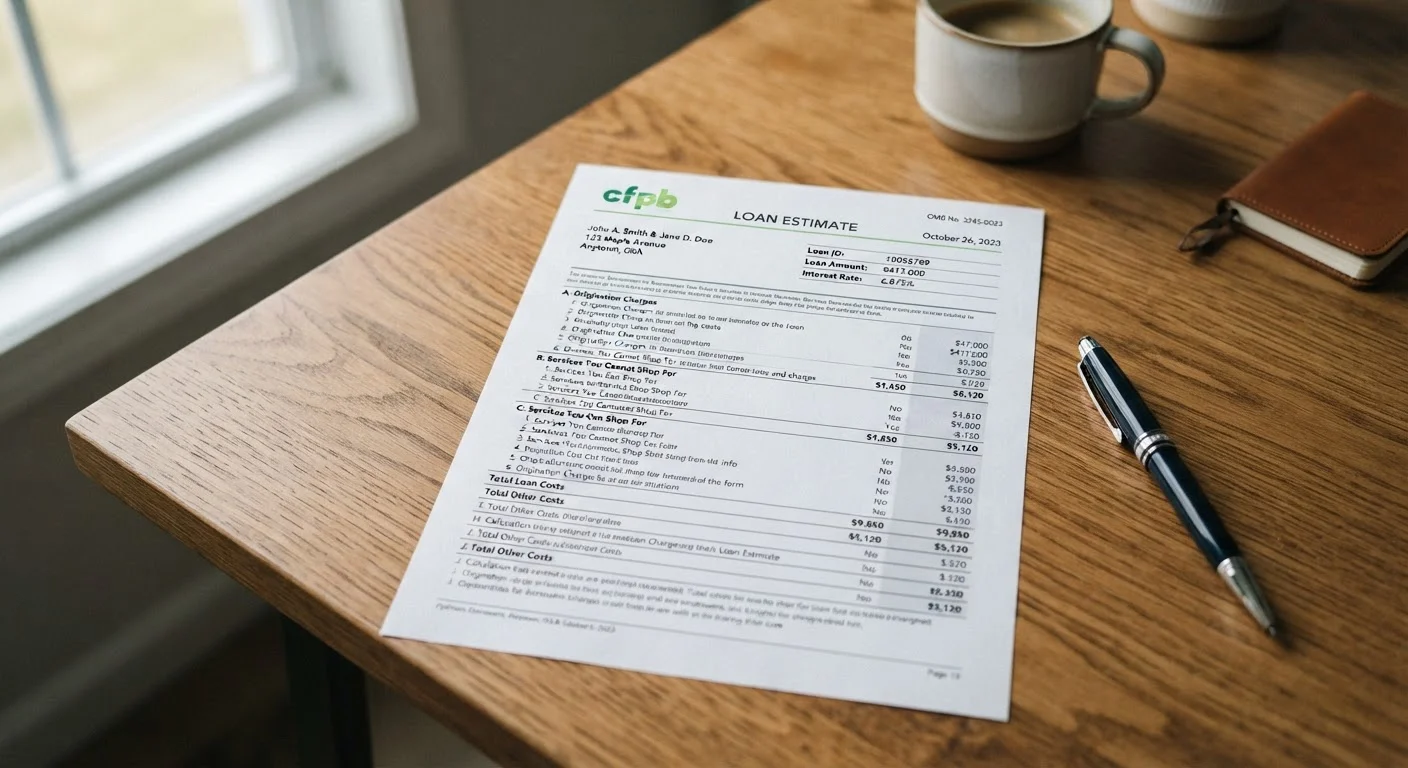
What a Loan Estimate Is — and Why It Matters
When you apply for a mortgage, federal law requires your lender to give you a standardized three-page form called the Loan Estimate. It must arrive within three business days of submitting your application. The form is regulated under the TRID rules (TILA-RESPA Integrated Disclosure), which means every lender uses the same layout — making it easier to compare offers side by side.
The Loan Estimate is not a final commitment. It is an estimate of what your loan terms and costs will look like. You'll receive a separate Closing Disclosure at least three business days before closing that reflects the finalized numbers.
Before diving in, brush up on terminology. If terms like escrow, PMI, or LTV are unfamiliar, the first-time homebuyer glossary is a useful starting point.
What you will need
Page by Page: What Each Section Tells You
The Loan Estimate is organized into clearly labeled sections. Here is what to focus on in each one.
Page 1 — Loan Terms and Projected Payments
The top of page one confirms the basics: loan amount, interest rate, and loan term. Check that these match what you discussed with your lender. Below that, the Projected Payments table breaks down what your monthly payment will include — principal and interest, mortgage insurance (if applicable), and estimated escrow for property taxes and homeowners insurance. This combined figure is what you'll actually pay each month, not just the principal-and-interest portion.
Page 2 — Closing Costs
This page lists every fee you're expected to pay at closing, organized into categories:
- Section A (Origination Charges): Fees charged directly by the lender, including any points you're paying to lower your rate. These cannot change between the estimate and closing.
- Section B (Services You Cannot Shop For): Costs like the appraisal and credit report. These are also fixed.
- Section C (Services You Can Shop For): Title insurance, settlement services, and similar costs. You have the right to choose your own providers here, which means you may be able to reduce these fees.
- Prepaids and Initial Escrow: Upfront payments for homeowners insurance, prepaid interest, and the initial escrow deposit. These are not fees — they are funds you'll eventually use.
At the bottom, you'll find Cash to Close — the total amount you need to bring to the closing table.
Shopping Closing Costs Can Save Real Money
For Section C services, lenders must give you a list of approved providers, but you are not required to use them. Comparing title or settlement service quotes is legal, encouraged, and can reduce closing costs by hundreds of dollars. Always confirm that any provider you choose meets the lender's requirements.
Page 3 — Comparisons and Other Considerations
The Comparisons table is one of the most useful sections. It shows your Annual Percentage Rate (APR), which incorporates the interest rate plus most lender fees, giving you a truer cost-of-borrowing figure. It also shows the total interest you'll pay over the life of the loan — a number that can be sobering but important to understand. The In 5 Years row shows total payments and principal paid down by year five, useful for comparing loans if you don't plan to stay long-term.
How to Use the Loan Estimate to Compare Lenders
Getting one Loan Estimate is a start. Getting two or three lets you make an informed decision. When comparing, make sure each estimate is based on the same loan amount, loan type, and term — otherwise the numbers won't be comparable.
Verify the loan details on page one
Confirm that the loan amount, interest rate, loan term, and loan type (fixed vs. adjustable) all match what you agreed to. If anything differs from your conversation with the lender, ask for an explanation in writing before proceeding.
Look at the full Projected Payments figure, not just principal and interest
Your actual monthly obligation includes mortgage insurance (if your down payment is below 20%) and estimated escrow for taxes and insurance. Use the total Projected Payment number when evaluating affordability, not the lower principal-and-interest figure.
Review closing costs by category
On page two, note which costs are fixed (Sections A and B) and which you can shop for (Section C). For Section C services, you are entitled to choose your own providers. Request quotes from at least two settlement or title companies to see if you can reduce these costs.
Compare the APR across lenders, not just the interest rate
The APR on page three folds in origination fees and most lender costs, making it a more useful comparison point than the interest rate alone. A loan with a lower rate but high origination charges may carry a higher APR than a competing offer.
Check the total interest paid over the life of the loan
The Comparisons table on page three shows total interest paid if you keep the loan to its full term. This figure is useful context — it illustrates the long-run cost of a lower monthly payment stretched over a longer term versus a higher payment on a shorter one.
Understanding how fees and rate structures work across loan types is a transferable skill. If you've ever reviewed a financial aid loan package or an auto loan offer, the logic is similar: the headline rate is rarely the whole story.
Your Loan Estimate Is Not a Locked Rate
Receiving a Loan Estimate does not lock in your interest rate. Rates can change until you formally request a rate lock in writing. If you want to secure the rate shown on your estimate, ask your lender about the lock period and any associated fees before time-sensitive deadlines pass.
This article is for general informational purposes only and does not constitute personalized financial or legal advice. Consult a licensed mortgage professional or financial adviser for guidance specific to your situation.
The content provided on our blog site traverses numerous categories, offering readers valuable and practical information. Readers can use the editorial team’s research and data to gain more insights into their topics of interest. However, they are requested not to treat the articles as conclusive. The website team cannot be held responsible for differences in data or inaccuracies found across other platforms. Please also note that the site might also miss out on various schemes and offers available that the readers may find more beneficial than the ones we cover.