
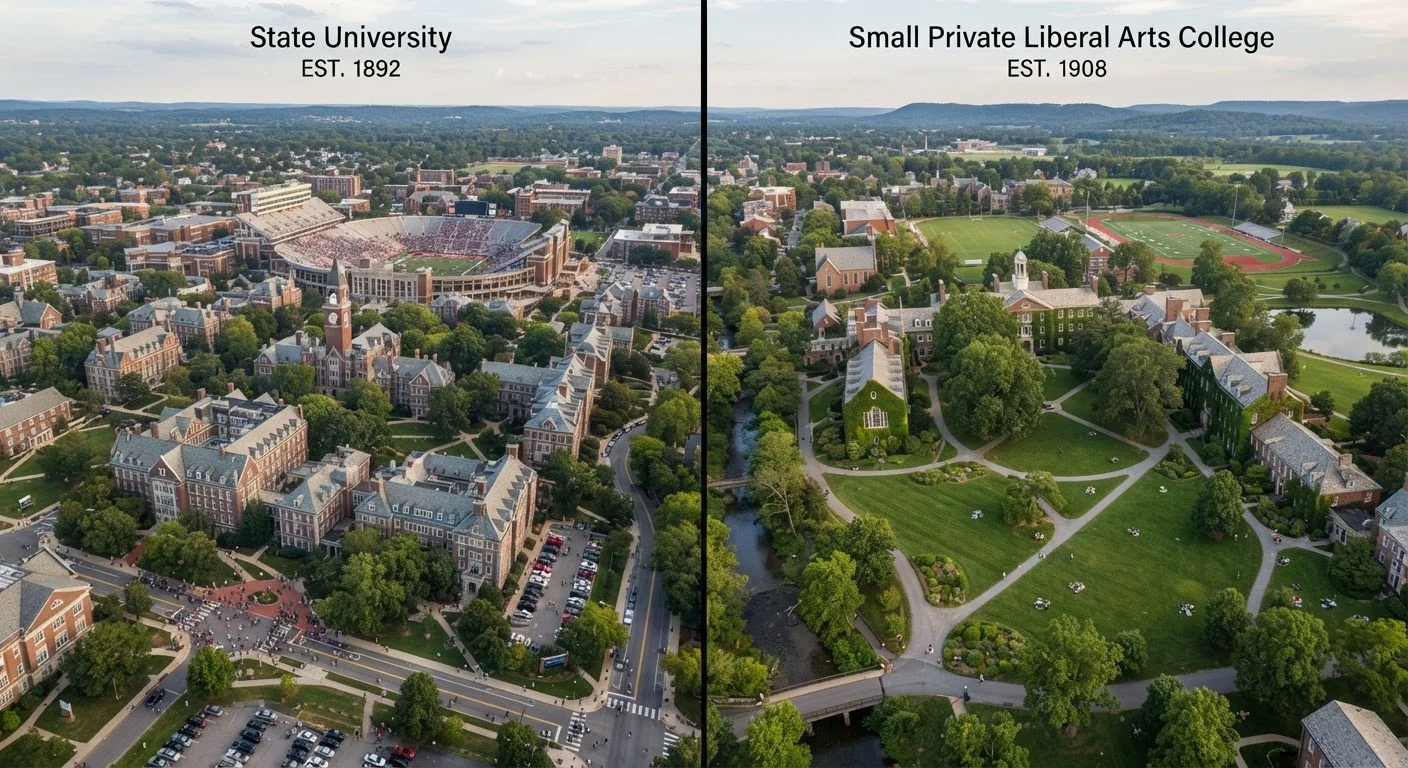
Option A
Public University
The high-enrollment, state-subsidized option with lower listed tuition.
Best for: In-state students seeking affordable tuition, large program variety, and strong professional networks within their state.
Option B
Private College
The independently funded institution with higher sticker prices but often generous aid.
Best for: Students who qualify for strong institutional aid packages and prefer smaller class sizes or specialized academic programs.
Why Sticker Price Is the Wrong Starting Point
Most families make the mistake of comparing colleges by their published tuition — the number on the school's website before any aid is applied. That figure, often called the sticker price, rarely reflects what students actually pay. Once grants, scholarships, and institutional aid enter the picture, the ranking of affordable schools can shift dramatically.
Public universities are state-subsidized, which is why in-state residents enjoy tuition that is significantly lower than what private colleges publish. But when you factor in room, board, fees, and the aid each school offers, the gap narrows — and sometimes reverses entirely. The number that actually matters is your net price: total cost of attendance minus free money (grants and scholarships, not loans). Before drawing any conclusions, use each school's net price calculator, available on every federally funded institution's website, to get a personalized estimate.
Once you receive offers, learn how to decode financial aid award letters so you can compare schools accurately rather than being misled by how packages are presented.
| Criterion | Public University | Private College |
|---|---|---|
| In-state tuition (avg.) | ~$11,000/year | ~$42,000/year |
| Out-of-state tuition (avg.) | ~$29,000/year | Same sticker for all students |
| Institutional grant aid | Generally limited | Often more generous |
| Aid forms required | FAFSA only (typically) | FAFSA + CSS Profile (often) |
| Average class size | Larger, especially intro courses | Typically smaller |
| Program breadth | Wide variety | Varies; some highly specialized |
| State alumni network | Strong in-state reach | Varies by institution prestige |
How Aid Generosity Differs by School Type
Public universities distribute aid primarily through state grant programs and federal aid tied to FAFSA results. Institutional grants — money the school itself awards — tend to be more limited at public schools because tuition revenue is already subsidized by state funding. Merit scholarships exist but are often competitive and capped.
Private colleges operate differently. Many well-endowed private institutions commit to meeting 100% of demonstrated financial need through grants alone, with no loans required. Because private colleges set their own tuition, they also have more flexibility to discount it aggressively for students they want to enroll. This is why a private college with a $60,000 sticker price might cost a middle-income family less than a public out-of-state school charging $35,000.
One structural difference: private colleges frequently require the CSS Profile in addition to the FAFSA. The CSS Profile digs deeper into family finances and can affect how much aid you receive — for better or worse depending on your household's financial picture. Understanding both forms matters before you apply.
$11,610
Average in-state public tuition (2023–24)
According to the College Board's Trends in College Pricing report, average in-state tuition and fees at public four-year institutions was approximately $11,610 for 2023–24.
$41,540
Average private college tuition (2023–24)
The College Board reports the average published tuition and fees at private nonprofit four-year colleges was approximately $41,540 for 2023–24 before aid.
~$15,900
Average net price at private nonprofits
After grant aid, the College Board estimates the average net tuition and fees paid at private nonprofit four-year colleges was considerably lower than sticker price in recent years.
The Out-of-State Variable That Changes Everything
In-state enrollment at a public university is genuinely one of the most cost-effective options in American higher education. Out-of-state enrollment at the same school is a fundamentally different financial proposition. Public universities charge non-residents tuition that can be two to three times the in-state rate, stripping away the primary cost advantage of attending a public school.
For students considering public schools outside their home state, private colleges become directly competitive on price — especially if those private schools offer strong merit or need-based aid. Some public universities offer regional tuition compacts or reciprocity agreements with neighboring states, which can reduce the gap, but these programs vary widely and are not guaranteed.
If you are weighing a private college against an out-of-state public university, the comparison deserves the same scrutiny you'd apply to any major financial commitment. Factors like academic culture, campus size, and support systems should also factor into the decision alongside cost.
Debt, Outcomes, and Long-Term Value
Where you go matters less than what you do when you get there — but how much you borrow matters enormously regardless. Students who graduate with debt loads that exceed their expected starting salary face years of financial strain. A useful general guideline from financial aid professionals: total student loan debt at graduation should not exceed your anticipated first-year income.
If borrowing is unavoidable, understanding your loan type is critical. Federal loans come with income-driven repayment options and forgiveness programs that private loans do not offer. Before signing anything, review how federal and private student loans differ in protections and repayment flexibility. You can also explore the student loans hub for a broader overview of repayment strategies.
As for outcomes: graduation rates, career placement, and alumni networks vary within school types as much as between them. A well-resourced public flagship university may outperform a struggling private college on nearly every outcome metric. Research specific schools, not just categories.
This article is for general informational and educational purposes only and does not constitute personalized financial or college advising. Consult a qualified financial aid counselor or adviser for guidance specific to your situation.
The content provided on our blog site traverses numerous categories, offering readers valuable and practical information. Readers can use the editorial team’s research and data to gain more insights into their topics of interest. However, they are requested not to treat the articles as conclusive. The website team cannot be held responsible for differences in data or inaccuracies found across other platforms. Please also note that the site might also miss out on various schemes and offers available that the readers may find more beneficial than the ones we cover.