

Our Verdict
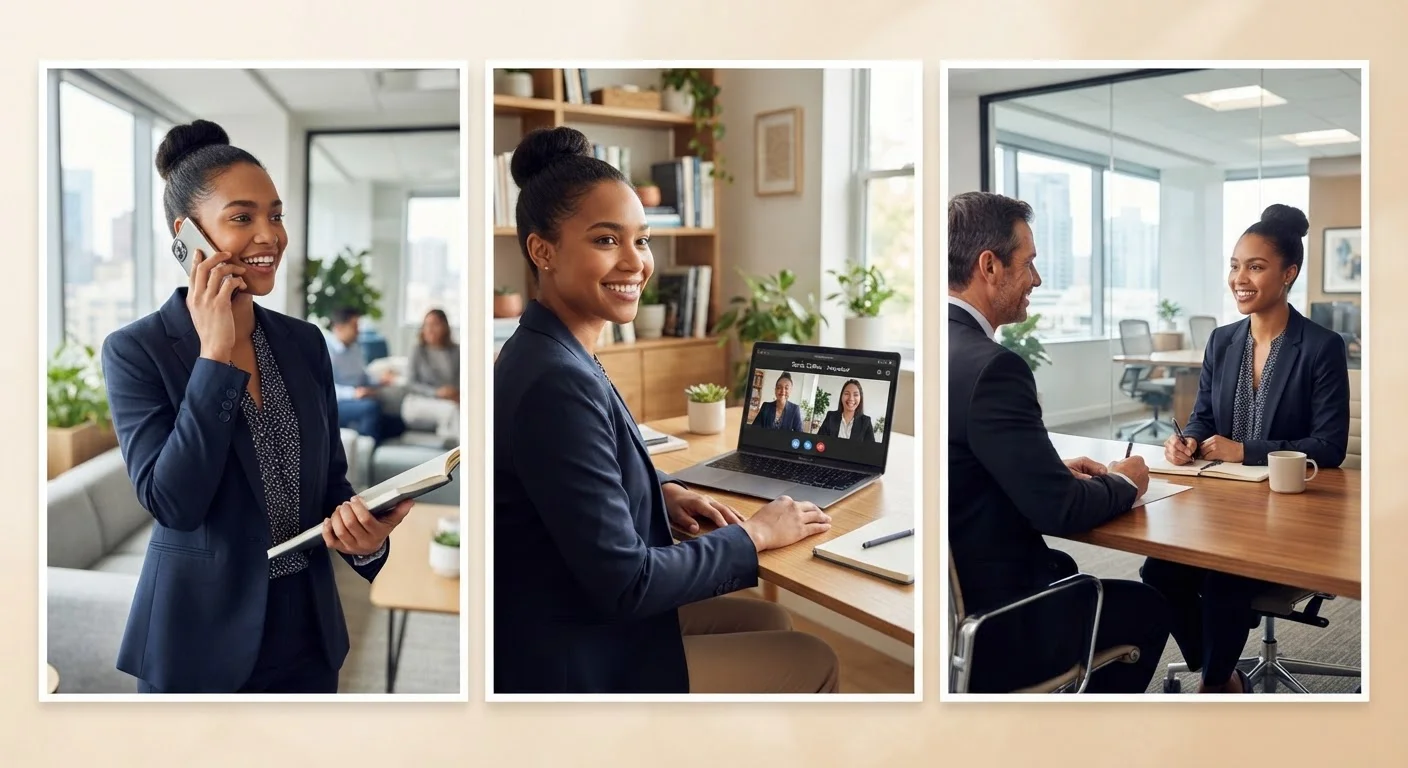
No single interview format is inherently harder than the others - each just surfaces different challenges. Phone interviews demand crisp verbal communication without visual cues. Video calls require technical readiness and a professional background. In-person meetings add physical presence and logistics to manage. The underlying preparation, however, is nearly identical across all three.
| Best for | Recommended |
|---|---|
| Candidates who prefer controlled environments and detailed note access | Phone Interview |
| Those comfortable with technology and seeking a middle ground between remote and in-person | Video Interview |
| Candidates who build rapport naturally in face-to-face settings | In-Person Interview |
The Core Preparation That Never Changes
Regardless of format, every interview is testing the same things: whether you understand the role, can communicate your relevant experience clearly, and will work well with the team. That means your foundational prep - researching the company, preparing stories using the STAR method, and preparing questions to ask - applies equally to a two-minute phone screen and a full-day on-site.
Start by studying the job posting carefully. If you haven't yet, learn how to decode a job description so you know exactly which qualifications to address. Then, practice answering likely questions out loud. Mental rehearsal is far less effective than actually speaking your answers - this is especially important for phone and video formats where your voice carries almost all the weight.
For behavioral questions in particular, understanding what interviewers are actually evaluating helps you structure stronger answers. Behavioral interview prep is format-agnostic and pays dividends in every setting.
Practice Out Loud Every Time
Reading your answers silently feels like preparation but rarely translates to smooth delivery. Record yourself answering three to five likely questions in the exact format you'll be using - phone audio for phone screens, webcam video for video calls. Replay it and note where you hesitate, ramble, or lose energy. One or two sessions of this kind of review is more effective than hours of silent rehearsal.
Phone Interviews: Clarity Over Everything
Phone screens are usually the first filter - often 15 to 30 minutes with a recruiter. Because the interviewer can't see you, every pause, filler word, and mumbled phrase is magnified. Speak at a deliberate pace, enunciate clearly, and don't rush to fill silence.
One real advantage of phone interviews: you can have notes in front of you. Keep a printed copy of your resume, two or three bullet points about the company, and your prepared questions. Don't read from a script, but use notes as a safety net.
- Find a quiet location with good cell signal or use a landline if possible.
- Stand or sit upright - posture affects how you project your voice and energy.
- Smile while you speak - it genuinely changes your vocal tone in ways listeners notice.
- Avoid multitasking - shuffling papers or typing are audible and signal distraction.
After the call, send a brief thank-you email within 24 hours. It's a simple step most candidates skip, and it keeps your name in front of the recruiter.
Video Interviews: Tech and Environment as First Impressions
Video interviews - now standard at many employers - sit somewhere between phone and in-person. You gain back visual communication, but you're managing a layer of technology that can undermine you if you're unprepared.
Before the interview: test your camera, microphone, and internet connection. Know how to log into the platform (Zoom, Teams, Google Meet) and do a dry run with a friend if possible. Close browser tabs and notifications to prevent interruptions.
Your environment matters. Position your camera at eye level so you're not looking down into the lens. Choose a neutral, clutter-free background or use a clean virtual background if your space is unavoidable. Ensure your face is well-lit - natural light from a window in front of you is often ideal.
Eye contact on video means looking at your camera, not at the interviewer's face on screen. It feels unnatural at first, but practice makes it habitual. Body language still counts: sit up straight, nod to show engagement, and avoid swiveling or fidgeting.
| Phone | Video | In-Person | |
|---|---|---|---|
| Visual cues available | None | Partial (camera) | Full |
| Notes allowed | Yes, freely | Yes, discreetly | Resume/notepad only |
| Tech requirements | Phone signal | Camera, mic, platform | None |
| Environment control | Moderate | High importance | Out of your hands |
| Logistics complexity | Low | Low-Medium | High |
| Rapport-building potential | Limited | Moderate | Highest |
| Body language impact | None | Moderate | High |
In-Person Interviews: Logistics, Presence, and the Full Picture
In-person interviews are the most logistically complex format. You have to manage travel, timing, and physical presentation on top of everything else - but you also gain the richest opportunity to build rapport and read the room.
Plan to arrive 10 to 15 minutes early, giving yourself buffer for transit delays. Bring printed copies of your resume even if you submitted one digitally - interviewers sometimes don't have it in front of them. A notepad and pen signal that you're engaged and organized.
Body language carries real weight in person. A firm handshake, steady eye contact, and an upright posture all contribute to a first impression before you've said a word. Avoid crossing your arms or checking your phone while waiting. If you're meeting multiple interviewers, make deliberate eye contact with each person when answering questions, not just the one who asked.
In-person settings also let you observe company culture directly. Notice how employees interact, what the workspace looks like, and how your escort treats support staff - all useful data as you evaluate whether the role is right for you. If you're weighing whether to pursue a full-time role at all, comparing internships and entry-level positions can help clarify your decision.
82%
Employers using video interviews
According to a survey by the Society for Human Resource Management, video interviewing became standard practice at the majority of U.S. employers following widespread remote work adoption.
33%
Decisions made in first 90 seconds
Research on interviewer bias suggests a significant portion of initial impressions form within the first minute and a half, underscoring why first-moment preparation matters in every format.
Adapting Your Strategy Without Starting Over
Once you've built a solid interview foundation - knowing your stories, your questions, and your value proposition - shifting between formats is mostly about adjusting logistics and environment, not rewriting your preparation. A few targeted adjustments go a long way:
- Confirm the format in advance and ask about the structure (number of interviewers, topics covered, length).
- Tailor your practice session to the format: record yourself for video prep, practice with a phone for phone screens, and do mock in-person interviews with a mentor or career center contact.
- Build your professional network before you need it - people who know you can sometimes tip you off to format preferences at specific companies. Start building those connections now, even without a formal career to discuss.
Your LinkedIn profile is increasingly reviewed before or after interviews in every format. Make sure it reinforces what you're saying in the room - or on screen. A well-optimized LinkedIn profile gives employers context that a 30-minute conversation can't fully provide.
The content provided on our blog site traverses numerous categories, offering readers valuable and practical information. Readers can use the editorial team’s research and data to gain more insights into their topics of interest. However, they are requested not to treat the articles as conclusive. The website team cannot be held responsible for differences in data or inaccuracies found across other platforms. Please also note that the site might also miss out on various schemes and offers available that the readers may find more beneficial than the ones we cover.